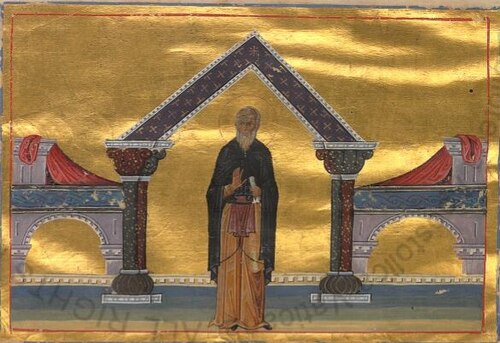
Venerable
Thalelaeus the Weeper
Syrian hermit
Syrian hermit of the 5th century known for continuous weeping, who died around 460.
- Feast
- February 27old style March 12
- Reposed
- 4605th century
- Order
- Venerables
Life
Venerable Thalelaeus (Thalelaios, fourth to fifth century, died about 460) was a Syrian hermit from Cilicia, known for continuous weeping. He is commemorated (Old Style) on 27 February. News of his life comes from Theodoret, bishop of Cyrus, who knew him personally, in the twenty-eighth chapter of his "Religious History".
Life
He was a Greek, born in Cilicia, in Asia Minor. According to the English source he was ordained presbyter in the monastery of Saint Sabbas the Sanctified. As the place of his struggle he chose a hill twenty stadia from the small but beautiful town of Gabala. On this hill there had been from of old a temple of idols, and Thalelaeus built himself a hut there. After a time of fasting and prayer he suffered attacks from demons and, to increase his labour, he devised a structure: he took two wheels of two cubits in diameter, joined them with boards set with small gaps, fastened to the wheels with wedges and nails, and set the structure in the open air. He planted three long stakes in the ground, joined their upper ends also with boards and set the structure on them, and put himself inside it, in a small space, two cubits high and one wide. Being very tall, he had to sit there not upright, but constantly bent, with his head bowed to his knees.
Theodoret came to him and found him inside reading the Gospel. He asked what was the aim of this new way of life, and Thalelaeus answered: "Being burdened with many sins and believing in the punishments that await sinners, I devised this labour for myself, so that, subjecting the body here to measured punishments, I might lessen the weight of the future penalties. For those will be heavy not only in size but also in torment, since they will not be voluntary; all that is against the will brings special sufferings. What is voluntary, though hard, is less grievous, since the labour of ascetic effort is undertaken here by one's own will, not by compulsion. So if by these small present afflictions I lessen the future ones, I shall have great profit from it." Astonished at what he heard and saw, Theodoret wrote down his labour. The local people testified that through the prayers of Thalelaeus many miracles and healings were wrought, not only of people but of animals: camels, donkeys and mules. Because of the labours and miracles, the local people left their paganism and believed in Christ. Thalelaeus, with the help of people, destroyed the temple of demons on the hill and built in its place a great church in honour of the victorious martyrs. John Moschus and Sophronius of Jerusalem, in the "Spiritual Meadow", from the words of the presbyter Peter of the Lavra of Saint Sabbas, relate that Thalelaeus struggled sixty years and wept constantly, saying: "God gave us the time of this life for repentance and will require a strict account of it from us". According to the English source he died about 460.
Commemorated the same day February 27
 Leander of SevilleSaint · Bishop of SevilleFeb 27
 Procopius of DecapolisVenerableFeb 27
 Titus of the Kiev CavesVenerable · Priest of the Kiev CavesFeb 27
 Titus the SoldierVenerable · Monk of the Kiev CavesFeb 27
 Stephen of ConstantinopleVenerableFeb 27
- Jacob the SyrianVenerable · Hermit of SyriaFeb 27
 Michael MarkovMartyr · Church readerFeb 27
- Gelasius of HeliopolisMartyrFeb 27
- AbundantiusSaintFeb 27
- Abundius of Pietra MontecorvinaSaintFeb 27
- Aelfnoth of StoweMartyrFeb 27
- AntigonusMartyrFeb 27