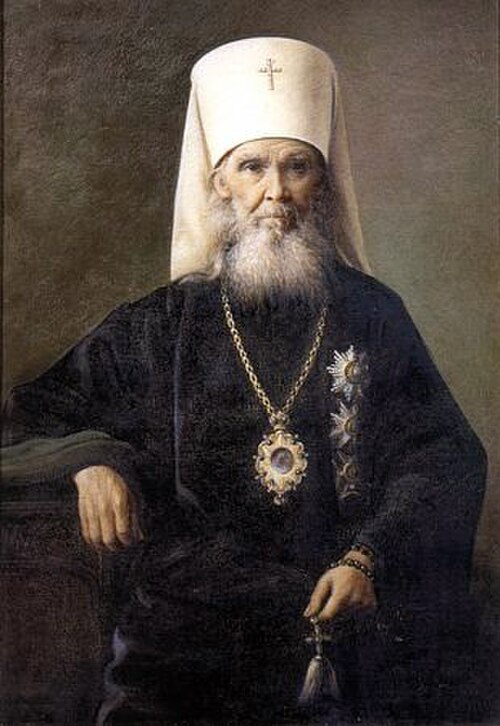
Saint
Macarius Nevsky
Metropolitan of Moscow, Altai missionary
Metropolitan of Moscow from 1912 to 1917, missionary and enlightener of the Altai region; died in 1926.
- Feast
- February 16old style March 1
- Reposed
- 192620th century
- Place
- Kotelniki
- Order
- Hierarchs
Life
Saint Macarius Nevsky, Hierarch, in the world Mikhail Andreyevich Nevsky, was Metropolitan of Moscow and Kolomna from 1912 to 1917, missionary and enlightener of the Altai region, called the “Siberian pillar of Orthodoxy” and the “Apostle of the Altai.” He fell asleep on 1 or 2 March 1926 and was glorified in 2000. He is remembered on 16 February (in leap years), on 1 March and on other days.
Youth and mission
He was born on 1 October 1835 in the village of Shapkino, in the province of Vladimir, in the poor and many-childed family of Andrei Parvitsky, reader of the church of the Nativity of the Mother of God; he was the sixth child. His mother was the sister of Archpriest John Rozhdestvensky. Because of poverty the family moved in 1843 to Tobolsk. He finished the school and the seminary at Tobolsk (1854); the name Nevsky was given to him at the seminary, where students' names were often changed. To devote himself to mission, he refused to enter the Theological Academy, which he could have done, being second in his class. On 22 February 1855 he entered the service of the Altai Spiritual Mission as a teacher and missionary assistant. His model of missionary service was always the founder of the mission, Archimandrite Macarius Glukharev, whose labours he followed. In 1855-1857 he was reader at the church in Ulala. By his own recollection he read at the choir, accompanied the missionaries on journeys, worked at the school, went from house to house to teach the converts their prayers, cared for the sick and did not shrink from heavy labour: he dug garden beds, plastered with clay the walls of the poor dwellings of the mission's people. In two years he learned the Altai language and translated prayers and services with the translator Mikhail Chevalkov. To find and put into use a new term he often went on purpose for weeks and even months to remote backwaters of the Altai and only through long and many conversations with the locals, after becoming convinced that the expression was suitable and understood by all, did he adopt it. On 25 January 1857 he was tonsured a rassophore, was catechist at Chulyshman and teacher of church singing in the mission schools; in 1861 he was tonsured a monk with the name Macarius, after the founder of the mission, then hierodeacon and hieromonk, ordained in the mission's field church. He also did the work of a physician: cures of gravely sick Altaians through him are known. He laboured much on the building of the missionary monastery of the Annunciation at Chulyshman, of which he was from 1861 superior. He told of the missionary's work thus: “Missionary service, like apostolic service, is above all a series of sorrows, illnesses and labours... We do not speak of the hardships of missionary journeys, made rarely by carriage, never by railway car, but often on foot, on skis, on horseback, by boat, in rain, in snowstorm, all these are illnesses and labours for the body. But there are greater sufferings, the sufferings of the soul. The missionary is a sufferer.”
In 1864 and in 1867-1868 he was in Saint Petersburg, where he printed the first “Altai Primer” compiled by him and Orthodox books in the Altai language, among them the “Liturgy of Saint John Chrysostom,” the “Sacred History of the New Testament,” “Catechetical Instructions for Those Preparing for Holy Baptism,” and the “Sunday, Matins and Feast Gospels.” They were the first books printed in Altai. In 1868-1869, at Kazan, together with Professor Nikolai Ilminsky and the baptized Altaian Chevalkov, he prepared for print the first grammar of the Altai language. For lay Altaians he wrote a collection of his own spiritual verses, “The Mite.” He was elected a member of the Council of the Translation Brotherhood of Saint Gurias at Kazan. While in Kazan he also organized services in the Tatar language, with a choir of baptized Tatars.
Bishop and metropolitan
In 1883 he was appointed head of the Holy Altai Mission, raised to archimandrite, then consecrated bishop of Biysk, vicar of the Tomsk diocese. In 1891 he was bishop of Tomsk and Semipalatinsk, in 1905 of Tomsk and Barnaul (later archbishop), and in 1908 archbishop of Tomsk and Altai. In 1912 he was summoned to Moscow by the Holy Synod and elected Metropolitan of Moscow and Kolomna, thereby also becoming a member of the Holy Governing Synod. In 1913 he became an honorary member of the Saint Petersburg Theological Academy. On 20 March 1917 he was removed from his post and sent to the Nikolo-Ugreshsky monastery. Three years later Metropolitan Tikhon gave him the honorary lifelong title of Metropolitan of the Altai. He died in 1926 at Kotelniki, near Moscow. In 1956 his remains were moved to Sergiyev Posad and placed under the Dormition cathedral of the Trinity-Saint Sergius Lavra. In 2000 he was numbered among the saints by the Russian Church.
Commemorated the same day February 16
 Pamphilus of CaesareaHieromartyr · Presbyter of CaesareaFeb 16
 Marutha of MartyropolisSaint · Bishop of MaypherkatFeb 16
 Mary of VizyeSaintFeb 16
- Mary the YoungerSaint · Of ThraceFeb 16
- Aedh Glas of Rath na n-EpscopSaintFeb 16
- AenghasSaintFeb 16
- Daniel of EgyptMartyr · Martyr of Caesarea in PalestineFeb 16
- EliasNew MartyrFeb 16
- Elias and CompanionsHoly MartyrsFeb 16
- Elias, Jeremiah, Isaiah, Samuel and DanielHoly MartyrsFeb 16
- Eulalius of SyracuseSaint · Bishop of SyracuseFeb 16
- Generosus of SyriaSaintFeb 16