Saint
Marutha of Martyropolis
Bishop of Maypherkat
Syriac monk, then bishop of Maypherkat in Mesopotamia, who died before 420.
- Feast
- February 16old style March 1
- Reposed
- 4225th century
- Order
- Hierarchs
Life
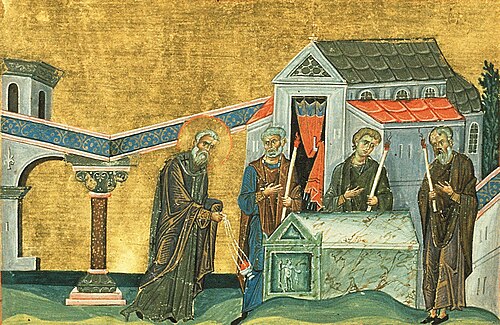
Saint Maruthas was bishop of the city of Maypherkat in Mesopotamia, named after him Martyropolis, the city of martyrs. The Church remembers him as a Syriac monk and bishop, famous for his love for the Christians of Persia and as an envoy of the Roman emperors to the Persian king. He fell asleep before 420 (according to some sources, in 422).
According to the Greek tradition, he was of Syriac origin, born at Amida (modern Diyarbakır), the son of the prefect of Sophene. He received a careful education and distinguished himself as a physician and a diplomat. He was bishop of Maypherkat from before 399 until about 410. He was a friend of Saint John Chrysostom, and through his connections he could serve as an envoy between the Roman emperor and the king of Persia. He took part in the First Council of Constantinople (381) and in a council at Antioch (383 or 390), where the Messalians were condemned.
For the Church of Persia, which had suffered greatly in the persecution of Shapur II, he went to Constantinople; but Emperor Arcadius was then busy with the exile of John Chrysostom. Later he was sent by Theodosius II to the court of Persia, where, in spite of the Magi, he won the esteem of King Yazdegerd I by his kindness, holy life and, it is said, his knowledge of medicine. Greek sources say that he healed the king's daughter, and the historian Socrates Scholasticus tells that, with Bishop Abdas, he delivered the king's son from a demon by fasting and prayer. He succeeded in negotiating peace between the two empires, and the king allowed Christians to confess their faith openly, to build churches and to hold synods. He went to Ctesiphon and, with Catholicos Isaac, held the synod of 410 (and, according to some sources, another in 415), setting the order of the Church of Persia and confirming the Creed of Nicaea.
He obtained from the king the relics of the martyrs of Shapur's persecution and brought them to his city, which has since been called Martyropolis. He was a great organiser of the Church. His writings include the Acts of the Persian Martyrs, a history of the Council of Nicaea, a Syriac translation of the Nicene canons, a Syriac anaphora, commentaries on the Gospels, and hymns on the Holy Eucharist, the Cross and the martyrs, some still used by the Syrians. He is commemorated on 16 February and 4 December.
Commemorated the same day February 16
 Pamphilus of CaesareaHieromartyr · Presbyter of CaesareaFeb 16
 Macarius NevskySaint · Metropolitan of Moscow, Altai missionaryFeb 16
 Mary of VizyeSaintFeb 16
- Mary the YoungerSaint · Of ThraceFeb 16
- Aedh Glas of Rath na n-EpscopSaintFeb 16
- AenghasSaintFeb 16
- Daniel of EgyptMartyr · Martyr of Caesarea in PalestineFeb 16
- EliasNew MartyrFeb 16
- Elias and CompanionsHoly MartyrsFeb 16
- Elias, Jeremiah, Isaiah, Samuel and DanielHoly MartyrsFeb 16
- Eulalius of SyracuseSaint · Bishop of SyracuseFeb 16
- Generosus of SyriaSaintFeb 16