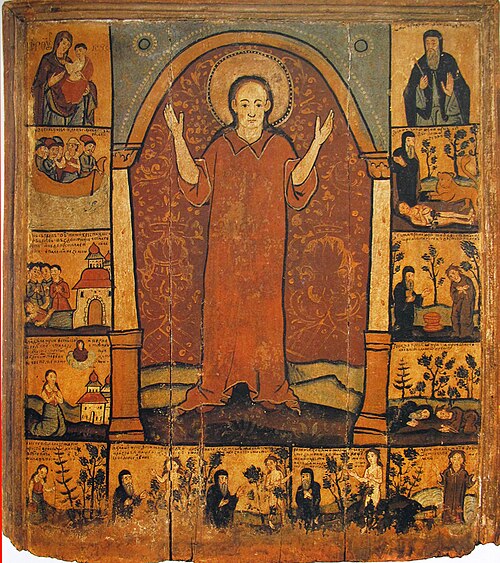
Venerable
Mary of Egypt
Hermit of the Jordan
Egyptian woman who, after a sinful life, repented and lived for decades in the desert beyond the Jordan.
- Feast
- April 1old style April 14
- Reposed
- 4215th century
- Place
- Palestine
- Order
- Venerables
Life
Venerable Mary of Egypt is one of the best-loved ascetics of the Church, an example of true repentance. Born in Egypt, she lived for years in debauchery, then repented and spent forty-seven years in the desert beyond the Jordan. Her life was written down, according to tradition, by Saint Sophronius, patriarch of Jerusalem, in the seventh century. The Church commemorates her on 1 April and on the fifth Sunday of Great Lent.
A sinful life
Mary was born in Egypt and at twelve left her parents and went to Alexandria. There, by her own account, she lost her chastity and gave herself to unrestrained passion for more than seventeen years. She says she did it without pay, not because she was rich, but because she lived in poverty, spinning flax and living by begging. One summer she saw a crowd of people from Libya and Egypt heading for the sea, to sail to Jerusalem for the feast of the Exaltation of the Holy Cross. She had no food or money and went with them on the ship, paying her way by her sinful life, not out of piety. At Jerusalem she spent the days before the feast in the same way.
Repentance
On the day of the feast the crowd was entering the church of the Holy Sepulchre, and Mary went too. When she reached the threshold, an unseen force stopped her. She tried several times, but she alone could not enter, while others went in without difficulty. At last, exhausted, she withdrew to a corner of the porch. Then she understood that her sins kept her from seeing the Life-Giving Wood. The grace of the Lord touched her heart, she began to weep and beat her breast, and seeing above her an icon of the all-holy Mother of God, she prayed to Her: to be allowed to enter and see the Cross of Her Son, promising she would never again defile her body and would go wherever She led her.
After the prayer she felt confidence, and entered the church without being stopped. She kissed the holy ground, then returned before the icon and gave thanks. Then she heard a voice: "If you cross the Jordan, you will find glorious rest." A man gave her three coins, with which she bought three loaves. By evening she reached the church of Saint John the Baptist on the bank of the Jordan, prayed, received the Holy Mysteries, and the next morning crossed the river in a small boat and entered the desert.
In the desert
Mary says she spent forty-seven years in the desert without seeing a human face. The loaves dried out and she ate them little by little over a few years, then lived on herbs. The first seventeen years were a hard fight with desires: she remembered the meat, fish and wine of Egypt, heard shameful songs and burned with the wish to sin. She threw herself face down on the ground, wept and recalled her vow, and the all-holy Virgin seemed to threaten her. She remained so until a light poured over her and the thoughts scattered. After those years, she says, the Mother of God helped her in everything. Her clothes wore to rags and fell away, and she suffered from the heat of summer and the cold of winter.
The meeting with Zosimas
Father Zosimas was a monk in a Palestinian monastery near Caesarea, where he had struggled since childhood. At fifty-three he was moved by the thought that he had attained perfection, and an angel commanded him to go to the monastery by the Jordan, to see how many other ways lead to salvation. There, by the custom of the monastery, on the first Sunday of Great Lent the monks went out into the desert and scattered, so that no one might see the struggle of another. Zosimas walked for twenty days and saw a human figure, black from the sun, with short hair white like fleece. She fled from him, then asked for his cloak to cover herself, saying she was a woman. She called him by name and recognized him as a priest, though she had never seen him. Zosimas saw her praying lifted more than a cubit from the ground. Then she told her life, asking him to tell no one until she was taken from the world.
She asked him to remain at the monastery during the next Great Lent, and on Holy Thursday to bring her the Holy Mysteries on the bank of the Jordan. Zosimas came, and she crossed the water on foot, with the sign of the Cross, and when he wished to bow to her, she stopped him, saying that he was a priest and carried the Mysteries of God. She communed and asked him to come in a year to the place where they had first met.
Repose
After a year Zosimas found her dead, her hands folded on her breast and her face to the east. On the ground by her head it was written: "Abba Zosimas, bury on this spot the body of humble Mary. Give to dust what is dust. Pray to the Lord for me. I reposed on the first day of April, in the very night of the saving Passion, after partaking of the Mystical Supper." Zosimas understood that she had been carried in an instant to that place, though it had taken him twenty days to walk there. Having nothing to dig with, he prayed. A great lion came and licked her feet, and at the command of Zosimas it dug the grave. Mary was buried, and each went his way.
Zosimas returned to the monastery and told everything. The abbot John corrected what needed correcting, and Zosimas lived almost to a hundred. The monks passed on the story by word of mouth until it was written down. The Life was read in 787 at the Seventh Ecumenical Council, as proof of the benefit of icons. In Great Lent it is read together with the Great Canon of Saint Andrew of Crete. Some scholars treat the historical details of the life written by Sophronius with reserve, and her dating varies between the fifth and sixth century.
Commemorated the same day April 1
 Melito of SardisSaint · Bishop of SardisApr 1
 Abraham of BulgariaMartyr · Convert from IslamApr 1
 Euthymius of SuzdalVenerable · Founder of the Suzdal MonasteryApr 1
 Venantius of SalonaHieromartyr · Bishop of SalonaApr 1
 Varsonofy PlikhankovVenerable · Schema-archimandrite and elderApr 1
 Gerontius the CanonarchVenerable · Canonarch of the Kiev CavesApr 1
 Sergius ZavarinHieromartyr · ArchpriestApr 1
- Makarios of PeleketeConfessor · Abbot of Pelekete MonasteryApr 1
- Aedhan of Cill AedhainSaintApr 1
- AhazRighteous · King of JudahApr 1
- AlexanderMartyrApr 1
- Anastasius of SalonaMartyrApr 1