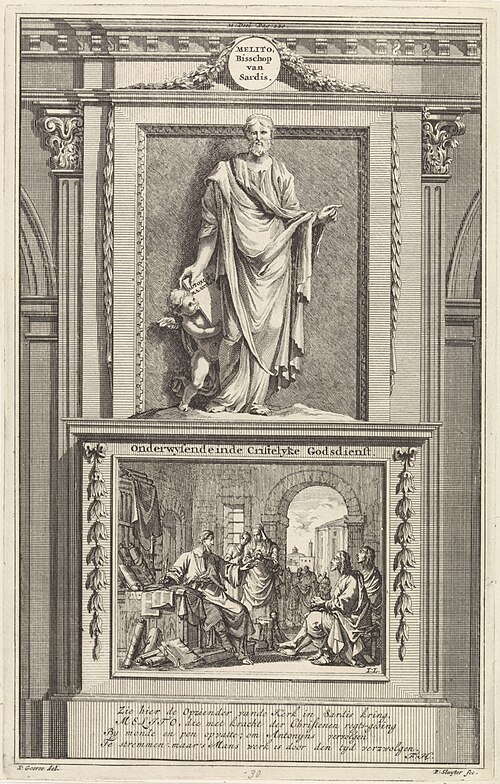
Saint
Melito of Sardis
Bishop of Sardis
Bishop of Sardis in Asia Minor in the second century and an apologist for Christianity.
Life
Saint Melito of Sardis was bishop of Sardis, in Lydia in Asia Minor, in the second half of the second century, a writer and defender of Christianity. He wrote many works, most of which are lost. The Orthodox Church commemorates him on 1 April.
His life
Little is known of his life, chiefly from Eusebius of Caesarea. He was bishop of Sardis, an important city, in the time of the emperor Marcus Aurelius. According to Polycrates of Ephesus, who mentions his name in a letter to Pope Victor, he was one of the "great luminaries" of Asia, a man who "lived entirely in the Holy Spirit" and who rests at Sardis, awaiting the resurrection. Polycrates calls him "the eunuch," that is, one who remained in purity. Tertullian speaks of him as a man with the gift of words, whom many believers regarded as a prophet.
The canon of the Old Testament
Melito wanted to know precisely which are the books of the Old Testament, so he went to the East, to Palestine, where he learned what concerns the Scriptures. He then made a list of the books, sent in a letter to his brother Onesimus. It is the oldest Christian list of the books of the Old Testament, preserved by Eusebius. It includes all the books of the Hebrew canon, apart from Esther.
Writings
Eusebius lists among Melito's writings books on Pascha, on the life of the Lord and on the prophets, on faith, on the Church, an apology addressed to the emperor and others, of which only fragments survive. Around 170, in a time of persecution, Melito wrote an apology to the emperor Marcus Aurelius, asking that Christians not be persecuted, since "our philosophy grew up together with the empire." In 1940 the homily On Pascha (Peri Pascha) came to light from a papyrus, one of the oldest Christian homilies preserved complete. In it Melito explains the Old Testament Passover as a prefiguring of the Passion and Resurrection of Christ and speaks of the forgiveness of sins and the victory over death. As a bishop of Asia Minor he followed the custom of the Quartodecimans, who celebrated Pascha on 14 Nisan, on whatever day of the week, a custom later abandoned. The homily also contains harsh passages concerning the Jews, which scholars today view critically.
Repose
He departed to the Lord in peace, around 180, and was buried at Sardis.
Commemorated the same day April 1
 Mary of EgyptVenerable · Hermit of the JordanApr 1
 Abraham of BulgariaMartyr · Convert from IslamApr 1
 Euthymius of SuzdalVenerable · Founder of the Suzdal MonasteryApr 1
 Venantius of SalonaHieromartyr · Bishop of SalonaApr 1
 Varsonofy PlikhankovVenerable · Schema-archimandrite and elderApr 1
 Gerontius the CanonarchVenerable · Canonarch of the Kiev CavesApr 1
 Sergius ZavarinHieromartyr · ArchpriestApr 1
- Makarios of PeleketeConfessor · Abbot of Pelekete MonasteryApr 1
- Aedhan of Cill AedhainSaintApr 1
- AhazRighteous · King of JudahApr 1
- AlexanderMartyrApr 1
- Anastasius of SalonaMartyrApr 1