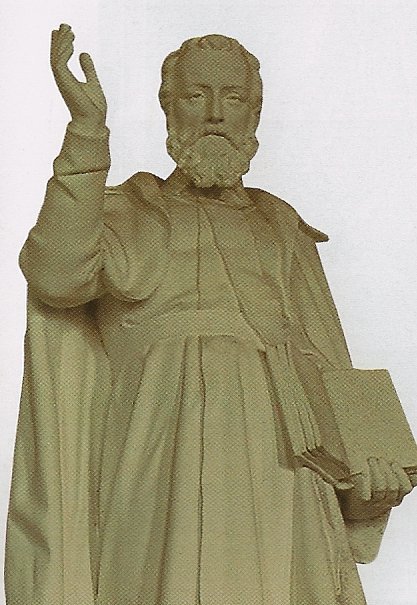
Saint
Maturinus
Exorcist and missionary
Gallo-Roman exorcist and missionary who died around 300 and is venerated as a saint.
- Feast
- November 1old style November 14
- Reposed
- 3014th century
- Place
- Rome
Life
Saint Maturinus was a Gallo-Roman exorcist and missionary who died around 300 and is venerated in the Western Church and in France as a protector of those troubled in mind. The first mention of him is in the Martyrology of Usuard, from the year 875, and a life of him was composed in the following century. What follows rests on the tradition tied to his name.
Life
According to tradition, Maturinus was born at Liricantus, today Larchant, of pagan parents, Marinus and Euphemia. His father had been charged by the emperor Maximian with wiping out the Christians of the region. Yet the boy was secretly baptized by Polycarp when he was twelve. He is said to have begun then to work miracles, to drive out demons and to calm unruly people, and in the end he brought his parents to the Christian faith.
At twenty he was ordained a priest and cared for the diocese while the local bishop was away in Rome. His fame grew, and the emperor Maximian asked him to come to Rome to heal his stepdaughter, Flavia Maximiana Theodora, who was possessed by an evil spirit. The demon was driven out of Theodora's body. Maturinus lived three more years in Rome, interceding with the emperor for persecuted Christians.
He fell asleep on 1 November and was buried in a Roman cemetery. Tradition says that, in a miraculous way, he showed that he wished to be buried at Larchant, and his body was carried to Sens and then to Larchant.
Veneration
His relics were kept in the basilica of Saint-Mathurin at Larchant and in the church of Saint-Mathurin in Paris, in the Latin Quarter. The church at Larchant, a possession of the chapter of Notre-Dame of Paris since 1005, was rebuilt from 1153 and became a notable place of pilgrimage. King Louis XI and Henry IV both came here.
In the Middle Ages his cult was widespread. He was called upon against mental illness and infertility, and the medical faculty of the University of Paris kept its great seal in the church of Saint-Mathurin. Because of his link with madness he became the patron of comic actors, jesters and clowns. He was also counted patron of sailors in Brittany, of tinsmiths in Paris and of plumbers. The Trinitarian friars, who were based at the church of Saint-Mathurin in Paris from 1228, were known in France as "Mathurins". The saint's relics were destroyed by the Huguenots.
His memory is kept on 1 November.
Commemorated the same day November 1
 Benignus of DijonHieromartyr · Patron of DijonNov 1
 Vigor of BayeuxSaint · Bishop of BayeuxNov 1
 David of EuboeaVenerable · Abbot in EuboeaNov 1
 Jacob of KastoriaNew MartyrNov 1
 Theodore LebedevHieromartyr · ArchpriestNov 1
- Helen of SinopeNew MartyrNov 1
- Caesarius of DamascusMartyrNov 1
- Abbo of TroyesSaint · Bishop of TroyesNov 1
- Adalbert of TegernseeVenerableNov 1
- Adrian of DamascusMartyrNov 1
 AelhaearnConfessorNov 1
- Agrippa of DamascusMartyrNov 1