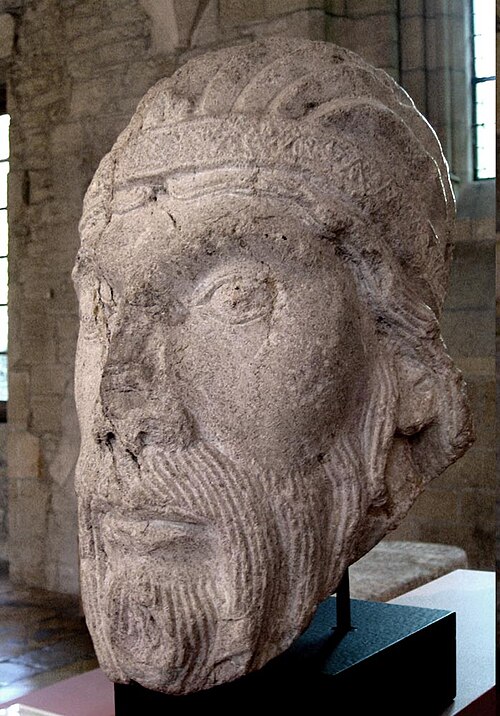
Hieromartyr
Benignus of Dijon
Patron of Dijon
Honored as patron of Dijon and the first herald of Christianity in the city; he died a martyr.
- Feast
- November 1old style November 14
- Reposed
- 1792nd century
- Place
- Dijon
- Order
- Martyrs
Life
Saint Benignus, hieromartyr, is honoured as the patron of the city of Dijon in Burgundy (in Roman times Divio) and as the first herald of Christianity there. He died a martyr, according to tradition in the time of the emperor Aurelian (270 to 275), around 200 according to other notes. He is commemorated on 1 November, together with All Saints, the day under which his name stands in the Martyrology attributed to Saint Jerome. The Russian Church has another day of commemoration on 26 April, for the transfer of his relics at Langres.
What is known and what is told
At Dijon no sure memory of his person and life was kept. He may have been a missionary priest from Lyon, martyred at Épagny near Dijon. According to Gregory of Tours, the common people reverenced the grave, but his great-grandfather, Saint Gregory, bishop of Langres (507 to 539/540), wished to end this veneration, thinking the tomb belonged to a pagan. One night, however, he learned in a vision that the burial spot, in a large necropolis outside the Roman city, was in fact the overlooked tomb of Benignus. The bishop restored the tomb in which the sarcophagus lay and built a basilica over it.
The earliest account, the Passion of Saint Benignus, from the sixth century, says he was a native of Smyrna. Saint Polycarp of Smyrna, after seeing Saint Irenaeus, already dead, in a vision, sent Benignus with two priests and a deacon to preach the Gospel in Gaul (the Russian source also names Andochius, Thyrsus and Andeolus). Their ship was wrecked on Corsica, but they reached Marseille, went up the Rhône and the Saône and, arriving at Autun, converted Symphorian, son of the nobleman Faustus, later a martyr. Left alone, Benignus preached openly in several parts of Gaul and worked many miracles despite the persecution. Denounced to the emperor Aurelian, he was arrested at Épagny and tried. He refused to sacrifice to the gods and to Caesar and to deny Christ. The Russian source adds that he was beaten, hung up, thrown into prison, put in stone stocks, had red-hot nails driven under his nails and was thrown to hungry dogs, while an angel strengthened and healed him. The Western account says he was clubbed to death with an iron bar and his heart pierced, while the Eastern one says he died by a spear thrust, a dove came out of his body and rose to heaven, and the air was filled with fragrance. According to some sources he was buried in a tomb made to look like a pagan monument, to deceive the persecutors; according to others, by Saint Leonilla, grandmother of the holy children Speusippus, Eleusippus and Meleusippus, baptized by him.
Scholars point out that these writings appeared in a wave of legends in the early years of the sixth century, in the time of Gregory of Tours, brought to Dijon, he says, by a pilgrim from Italy and edited at Dijon. Louis Duchesne showed that they belong to a whole group of narratives made to prove the early beginnings of Christianity in the cities of that region (Besançon, Autun, Langres, Valence), and so they are considered historically unreliable. The date is hard to reconcile too: Polycarp died about 155, and the persecution of Aurelian is much later.
Veneration
Around the tomb grew Saint Benignus Abbey, which joined the Cluniac order. In the early eleventh century its abbot William of Volpiano (died 1031) built a larger church. The Romanesque basilica replaced the church of Gregory of Langres, but collapsed in 1272, and in its place rose the present Dijon cathedral, dedicated to Saint Benignus. His shrine survived the earthquake of 1280 and the French Revolution, and his purported sarcophagus can still be seen in the crypt. On the seal of the abbey he is shown with a dog at his side and holding a key.
Commemorated the same day November 1
 MaturinusSaint · Exorcist and missionaryNov 1
 Vigor of BayeuxSaint · Bishop of BayeuxNov 1
 David of EuboeaVenerable · Abbot in EuboeaNov 1
 Jacob of KastoriaNew MartyrNov 1
 Theodore LebedevHieromartyr · ArchpriestNov 1
- Helen of SinopeNew MartyrNov 1
- Caesarius of DamascusMartyrNov 1
- Abbo of TroyesSaint · Bishop of TroyesNov 1
- Adalbert of TegernseeVenerableNov 1
- Adrian of DamascusMartyrNov 1
 AelhaearnConfessorNov 1
- Agrippa of DamascusMartyrNov 1