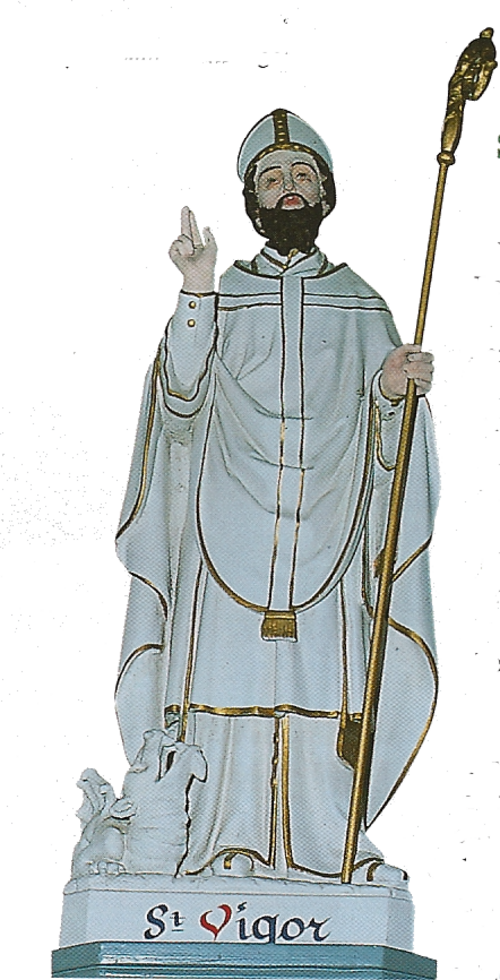
Saint
Vigor of Bayeux
Bishop of Bayeux
French bishop and missionary who died around 537.
- Feast
- November 1old style November 14
- Reposed
- 5386th century
- Place
- Artois
- Order
- Hierarchs
Life
Saint Vigor was a bishop and missionary in France in the first half of the sixth century, bishop of the city of Bayeux in Normandy. The Church remembers him for his struggle against paganism. He died about 537, and his day is 1 November.
Life
He was born into a noble family in Artois and studied at Arras under Saint Vedast. His father, concerned for worldly standing, would not let him become a priest, so Vigor ran away from home taking nothing with him, accompanied by an acolyte, Theodimir. He then lived as a hermit and preacher at Reviers in Calvados and worked as a missionary. About 514 he was named bishop of Bayeux.
He opposed paganism fervently and is said to have founded a monastery, later known as Saint-Vigor-le-Grand. At Bayeux he destroyed a pagan temple that was still in use and built a church on the site.
Veneration
He was honoured early at Bayeux, where he had been bishop. An early Life of him, from about 750 to 775, was probably composed there, though other scholars date it to the early eleventh century. His cult as a saint is attested in 834 by the mention of a relic at Le Mans. About 987 his relics came to the abbey of Saint-Riquier in Ponthieu. In 1032 Robert the Magnificent, Duke of Normandy, founded an abbey dedicated to Saint Vigor on the site of an older one destroyed by the Normans.
The Norman conquest brought his cult to England. His name appears in an eleventh-century breviary at Worcester. Two English churches bear his name, one at Fulbourn in Cambridgeshire and the other at Stratton-on-the-Fosse in Somerset. He is also mentioned in the Life of Saint Paternus. His feast falls on 1 November, All Saints' Day, and so is often moved to another date.
Commemorated the same day November 1
 Benignus of DijonHieromartyr · Patron of DijonNov 1
 MaturinusSaint · Exorcist and missionaryNov 1
 David of EuboeaVenerable · Abbot in EuboeaNov 1
 Jacob of KastoriaNew MartyrNov 1
 Theodore LebedevHieromartyr · ArchpriestNov 1
- Helen of SinopeNew MartyrNov 1
- Caesarius of DamascusMartyrNov 1
- Abbo of TroyesSaint · Bishop of TroyesNov 1
- Adalbert of TegernseeVenerableNov 1
- Adrian of DamascusMartyrNov 1
 AelhaearnConfessorNov 1
- Agrippa of DamascusMartyrNov 1