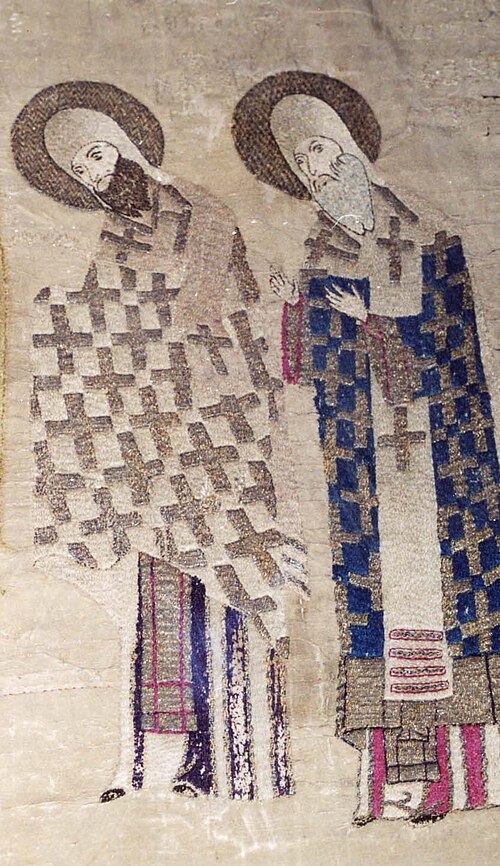
Saint
Maximus of Kyiv
Metropolitan of Kyiv and All Rus
Metropolitan of Kyiv and all Rus from 1283 to 1305, consecrated at Constantinople.
- Feast
- December 6old style December 19
- Reposed
- 130514th century
- Place
- Vladimir
- Order
- Hierarchs
Life
Saint Maximus, Metropolitan of Kyiv and all Rus, was a hierarch of Greek descent, consecrated at Constantinople, who shepherded between 1283 and 1305. Known for moving the metropolitan see from Kyiv to Vladimir on the Klyazma, he fell asleep on 6 December 1305. He is commemorated on 6 December (19 December by the new calendar) and on 23 June, in the Synaxis of the Saints of Vladimir.
A shepherd in a hard time
He came to Rus from Constantinople in 1283, successor to Metropolitan Kirill II of Kyiv. At that time the Rus princes were vassals of the Golden Horde. Khan Tokhta wanted to end the princes' semi-independence and in 1293 sent to Rus his brother Tudan, whose army devastated fourteen towns. Tokhta himself went to Tver and forced Dmitry of Pereslavl, an ally of Khan Nogai, to abdicate. The Rus chronicles depicted these events as "the return of the harsh time of Batu". One source says that the metropolitan first stopped at Kyiv, but the city had been emptied by Mongol-Tatar raids, so he went on to Bryansk, then to Suzdal. As he passed through the towns of Volhynia, he was met by Abbot Peter of the Ratsk monastery, his future successor. Maximus was known for his church journeys to the Golden Horde and for reconciling the quarrelling princes of northeastern Rus, such as Dmitry of Pereslavl and Andrey of Gorodets, sons of Alexander Nevsky.
The move to Vladimir
In 1299, after the devastation of Kyiv by Khan Tokhta, Maximus moved the metropolitan seat from Kyiv to Bryansk, then to Vladimir on the Klyazma, east of Moscow, according to the English source on the Khan's instruction. Bishop Simeon of Vladimir was moved to Rostov. All the metropolitan clergy moved to Vladimir, while a deputy remained in the old capital. According to Vasily Klyuchevsky, "in 1299 Metropolitan Maximus, not enduring Tatar violence, gathered his whole clergy and left Kyiv for Vladimir on the Klyazma", which began the gaining by Moscow of the role of church capital of Rus, in the time of his successor, Metropolitan Peter. One source adds that he feared to offend the princes of Kyiv by moving north. Then, in 1303, Patriarch Athanasius I of Constantinople established the metropolis of Halych, with its see at Halych, in the Kingdom of Galicia-Volhynia. In 1301 Maximus came to Constantinople for the patriarchal council, where Bishop Theognostus of Sarai put forward the problems of the Russian Church for resolution.
Shepherding
In 1295 he removed Bishop Jacob from his seat at Vladimir and installed Simeon. In 1300 he consecrated Theoctistus bishop at Novgorod. He set the order of fasts: besides Great Lent, the Apostles', Dormition and Nativity fasts, and determined when the Wednesday and Friday fast is relaxed. He wrote the "Rules on Fasts and the Keeping of Marriage", in which he insisted on church marriage: "I write of this also, that you, my children, born in the font, take wives from the holy catholic and apostolic Church, a wife for the salvation of man. If you keep them in fornication, without wedding, what profit have you? No, beg and urge them, whether old or young, to be married in church." He supported the princes of Tver against Yury of Moscow, tried to reconcile Yury Danilovich with Mikhail Yaroslavich (according to one source he advised Yury not to go to the Horde for the grand throne) and in 1304 set Mikhail Yaroslavich of Tver on the grand-prince's throne at Vladimir. He was canonized by the Russian Orthodox Church in 1982.
Repose and veneration
He fell asleep on 6 December 1305 at Vladimir on the Klyazma and was buried in the Dormition cathedral in Vladimir. Over the grave a gilded canopy was raised, with an inscription in letters of gold: "Maximus the Greek, consecrated in the year 6791 from the creation of the world, in 1283 from the Nativity of Christ, came to Kyiv; because of frequent Tatar attacks he moved from Kyiv to the Great Russian city of Vladimir; he shepherded the Church of Christ twenty-three years, and passed in the year 6812." On the wall above the grave was set the icon of the Mother of God "of Maximus", painted in 1299 after a vision of the metropolitan.
Commemorated the same day December 6
 Nicholas of MyraSaint · Archbishop of Myra in LyciaDec 6
- Abraham of CrateaSaint · Bishop of CrateaDec 6
 Nicholas of Sofia the NewNew MartyrDec 6
- Nicholas of KievSaint · Metropolitan of KievDec 6
- Auxilius of IrelandSaint · BishopDec 6
- IserninusSaint · BishopDec 6
- Aemilius of AfricaMartyr · Martyr of AfricaDec 6
- AerusSaint · BishopDec 6
- AsellaVenerableDec 6
- Berchert of TullyleaseSaintDec 6
- Boniface of SicilibbaSaintDec 6
- DativaMartyrDec 6