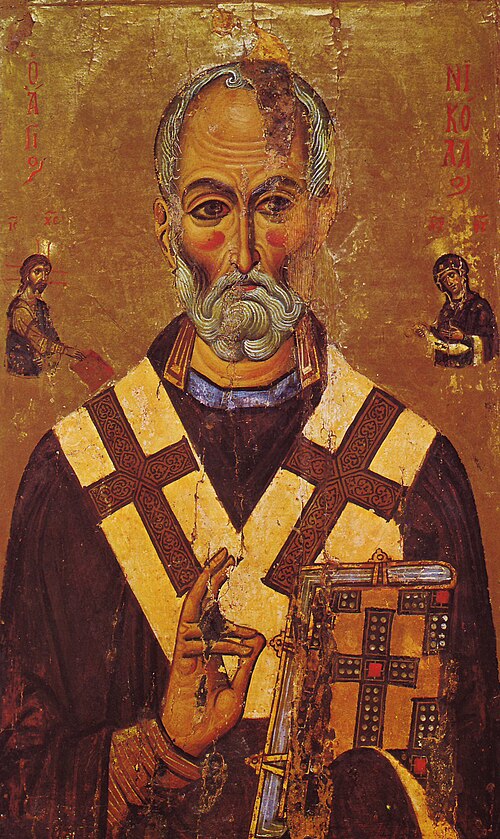
Saint
Nicholas of Myra
Archbishop of Myra in Lycia
Fourth-century bishop, protector of those in need and wonderworker.
- Feast
- December 6old style December 19
- Reposed
- 3434th century
- Place
- Myra
- Order
- Hierarchs
Life
Saint Nicholas of Myra, archbishop in Lycia, is one of the most beloved saints of the Church. He lived in the third and fourth centuries in Asia Minor and has remained in the memory of the faithful as a merciful shepherd, a defender of the wronged, and a wonderworker. His troparion calls him a rule of faith and an image of meekness. Few historical sources survive from his own time, and over the centuries tradition added many stories.
Childhood and youth
He was born at Patara in Lycia to pious Christian parents, Theophanes and Nonna, who had vowed to dedicate him to God. The synaxarion says that from infancy he fasted on Wednesdays and Fridays and loved the reading of Scripture. His uncle, Bishop Nicholas of Patara, ordained him reader and then priest and entrusted the flock to his care. After his parents died, Nicholas distributed his wealth to the poor.
The best-known deed of his youth concerns a man of Patara who had once been rich and, having no dowry for his three daughters, was ready to leave them to a life of sin. Nicholas threw a bag of gold through the window by night, and the man was able to marry off his first daughter. He did the same for the other two. Nicholas always tried to do good in secret.
Pilgrimage and election as archbishop
The bishop of Patara went on pilgrimage to the Holy Places and left the flock to Nicholas. On his return Nicholas asked for a blessing to go himself. On the ship he foretold a storm and calmed it by prayer, and a sailor who had fallen from the mast and was mortally hurt was restored. At Jerusalem he worshipped at Golgotha and at all the holy places.
Back in Lycia, he entered a monastery called Holy Sion, founded by his uncle, but a divine voice sent him back to the world. He went to Myra. There, after the death of Archbishop John, the assembled bishops learned in a vision that the first man to enter the church that night, named Nicholas, should be made archbishop. Nicholas, always first at church, was stopped at the door by one of the bishops, gave his name, and was consecrated archbishop.
Ministry
In the persecution of Diocletian Nicholas was imprisoned with other Christians and strengthened them to endure. He was freed when Saint Constantine became emperor. Returning to his flock, he went round the pagan temples of Myra and its surroundings and demolished them. In 325, according to the synaxarion, he took part in the First Ecumenical Council at Nicaea and stood up against Arius.
The synaxarion also tells that Nicholas struck Arius on the face and was deprived of his episcopal insignia and put under guard. Several Fathers then saw in a vision the Lord and the Mother of God returning to him the Gospel and the omophorion, and the Council judged his boldness pleasing to God. Historians note that his name is missing from the writings of those who were present at the Council and appears only in a list of attendees from about the sixth century, and that the story of the blow to Arius is attested late. Among the deeds attributed to him is the rescue of three men condemned unjustly, when he took the sword from the executioner's hand, and of three officers of Constantine who had been slandered; the saint appeared to the emperor in a dream and asked him to overturn the sentence. In a time of famine Myra was saved through his prayers: he left an Italian merchant three gold coins as a pledge and asked him to bring grain to Myra. He also rescued many from the sea, from captivity and from prison.
Repose and relics
Saint Nicholas fell asleep in peace in great old age. Tradition gives 6 December as the day of his repose and 343 as the year. His relics were kept incorrupt in the cathedral of Myra and flowed with healing myrrh. In 1087, when the region was under Seljuk rule, merchants from Bari took a large part of the relics in haste, over the objections of the monks. They reached Bari on 8 May and were laid on 9 May in the church of Saint Stephen. A few years later Pope Urban II consecrated the new church that now holds them. Venice also obtained fragments. The translation of the relics is commemorated on 9 May.
Veneration
The Church celebrates him on 6 December and his nativity on 29 July. Saint Nicholas is the patron of travellers, sailors, children and those in need. The synaxarion says that he promised to help those who remember his parents, Theophanes and Nonna. His right hand, brought from Bari, is kept in the church of Saint George the New in Bucharest; according to tradition it was given to Michael the Brave around 1600.
On the night of 5 to 6 December, Romanian children are accustomed to clean their boots and leave them at the door, to receive sweets and small gifts from Moș Nicolae, in memory of his charity. Among the churches dedicated to him are the Church of Saint Nicholas in the Șchei district of Brașov and the Princely Church of Saint Nicholas in Iași. Through the Dutch form Sinterklaas, his name also gave the Santa Claus of the English-speaking world.
Commemorated the same day December 6
 Maximus of KyivSaint · Metropolitan of Kyiv and All RusDec 6
- Abraham of CrateaSaint · Bishop of CrateaDec 6
 Nicholas of Sofia the NewNew MartyrDec 6
- Nicholas of KievSaint · Metropolitan of KievDec 6
- Auxilius of IrelandSaint · BishopDec 6
- IserninusSaint · BishopDec 6
- Aemilius of AfricaMartyr · Martyr of AfricaDec 6
- AerusSaint · BishopDec 6
- AsellaVenerableDec 6
- Berchert of TullyleaseSaintDec 6
- Boniface of SicilibbaSaintDec 6
- DativaMartyrDec 6