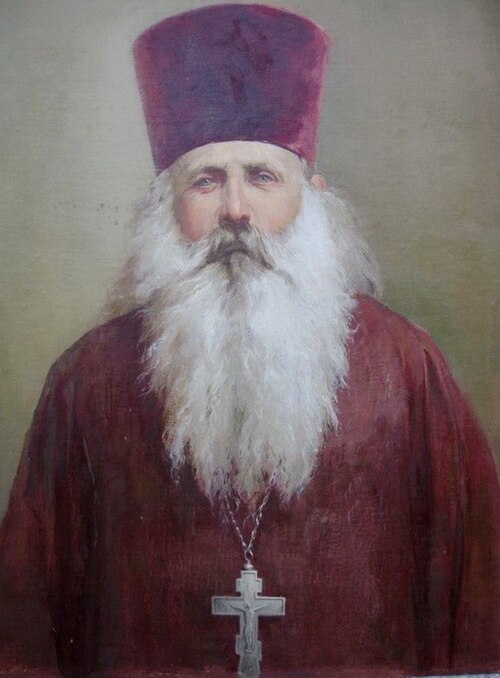
Hieromartyr
Michael Lisitsyn
Priest and journalist
Russian priest and journalist who died a martyr at Ust-Labinskaya in the Kuban in 1918.
- Feast
- February 26old style March 11
- Reposed
- 191320th century
- Place
- Vladivostok
- Order
- Martyrs
Life
Saint Michael Lisitsyn (1862-1918) the hieromartyr was a priest and teacher of religion in the Kuban, killed by the Bolsheviks on 26 February 1918 in the Cossack settlement of Ust-Labinskaya, in the first months of the civil war. The Holy Synod of the Russian Church decided on 4 May 2017 to enter his name in the Synaxis of the New Martyrs and Confessors of the Russian Church, with a day of commemoration of his own, 11 March. He is commemorated on 26 February (11 March in the new style).
Youth and priesthood
The dates of birth and death in some records (1862 and 1913) do not agree with the biographical sources, which speak of his death in 1918. He was born in the family of a priest in the village of Ekshur, Ryazan district, Ryazan governorate. He was a nephew of Archpriest Peter Dmitrievich Pavlov (1823-1899) and a cousin of Ivan Petrovich Pavlov (1849-1936), the physiologist. After the death of his father, in 1870, he was taken care of by his uncle, the priest of the village of Ershovo, Pavel Timofeevich Krylov, who afterwards looked after his spiritual upbringing. In 1873 he entered the theological school of Ryazan, graduating in 1877 in the first category. From 1877 to 1883 he studied at the Ryazan theological seminary and graduated in the second category. In 1883 he took a post as teacher at the village school of Zadnie Pilevo.
On 22 September 1885 he was ordained deacon by Archbishop Theoctistus (Popov) of Ryazan and Zaraysk, and on 25 September 1885 appointed priest at the church of the Holy Trinity in the village of Katino, Skopin district, where he served ten years. On 25 December 1895 he was moved to the church of the Exaltation of the Cross at Kislovodsk station in the Terek region, diocese of Vladikavkaz and Mozdok. The Vladikavkaz diocesan gazette wrote in 1896 appreciatively of his catechetical sermons and of his struggle against heresies and sects. In 1906 he received a new appointment to the village of Orbelianovskoe in the Terek region and wished also to serve the Church as a military priest, but for unknown reasons did not succeed. At the end of 1907 he moved to the diocese of Stavropol, as third priest at the church of the Archangel Michael in the village of Aleksandrovskoe, Terek region. From January 1908 he was a teacher of religion in the village schools.
On 25 June 1912 he was appointed priest at the church of Saint Nicholas in the Cossack settlement of Ust-Labinskaya, Kuban region, and from 15 October 1913 was a teacher of religion at the higher primary school. As a gifted teacher he continued his missionary work there among the Cossack population. At the start of the First World War he helped the front and the wounded soldiers much: in 1914 and 1915 he sent several times large quantities of clothing and hygiene items for soldiers of the active army. In his years at Ust-Labinskaya he enjoyed great respect from people of all classes as a good, gentle and compassionate pastor. He served at the church of Saint Nicholas until his death.
Revolution and death
The revolution of 1917 and the abdication of Emperor Nicholas II began a new tragic page in the history of the Russian Church. The civil war that soon began and the persecution of the Church did not bypass the Kuban Cossack land either. In January 1918 revolutionary unrest began in Ust-Labinskaya, inflamed by local Bolsheviks, between front-line Cossacks and representatives of the old Cossack population. Tension rose with the Bolshevik proclamation of 20 January 1918, which contained open calls to civil war. On 27 January the first clashes began between Cossack units and the Bolsheviks. The armed confrontation continued through February 1918 and ended on 22 February with the capture of the settlement by the Bolsheviks and the establishment of Soviet power. Swift reprisals began against those unwelcome to the authorities: officers, Cossacks, officials and priests. None of the local Bolsheviks who knew Father Michael personally raised a hand to carry out a revolutionary judgment on him. He was warned of danger and urged to flee or hide, but he bravely refused, staying at home, where he was arrested. He was killed on 26 February 1918. His wife, Evdokia Lisitsyna, ransomed his torn body and prepared it for Christian burial: she clothed him in white priestly vestments, laid him in a new coffin and took him to the church of Saint Nicholas, where for many years he had preached the word of God, for the funeral service.
At the session of the Local Council of the Russian Church on 20 September 1918 a special list of those who had suffered for the faith was read, in which Kuban priests were mentioned. On 13 (26) September the delegate of the Stavropol-Kuban diocesan assembly, the priest John Grevtsov, sent to the Council's chancery a request to correct the data on the sufferers. According to the recollections of Father Michael's granddaughter, the parishioners of Saint Nicholas persuaded his wife to rebury him nearer the church where he had served. According to his great-grandson, Gennady Lisitsyn, in 2003 the lost burial place was found, by the east wall of a former summer cinema, on the site of the church of Saint Nicholas, demolished in the 1930s, in the city park of Ust-Labinsk. A plaque was placed on the wall, and in 2010 devout parishioners of the church of Saint Sergius also placed a plaque at the place of the killing.
His family
His parents were Mikhail Kondratievich Lisitsyn (1835-1870), priest of Ekshur, and Ksenia Petrovna Lisitsyna (née Mezerova). His wife was Evdokia Ivanovna Lisitsyna, née Gilyarova (1865-1959), a priest's daughter from the village of Prudki. His daughter Natalia (1887-1961) was a teacher and librarian; his son Vasily (1891-1941), a military engineer, died in the defence of the Brest fortress in June-July 1941, and his name is on the monument to the defenders; his daughter Serafima (1899-1990) graduated from the Stavropol diocesan school, and his daughter Vera (1900-1971) was a teacher at Shakhty and Rostov-on-Don. He received church awards: the epigonation, the skufia, the kamilavka, the Bible from the Holy Synod for zealous labours in educating children (1902) and the thanks of bishops.
Commemorated the same day February 26
 Porphyrius of GazaSaint · Bishop of GazaFeb 26
 Basil BogdashevskySaint · Archbishop of KanivFeb 26
- Andrew of FlorenceSaint · Bishop of FlorenceFeb 26
 John PashinHieromartyr · Bishop of RylskFeb 26
- Anna of RybinskVenerable Martyr · NunFeb 26
- Aedlugh of Cluain mic NoisVenerableFeb 26
- Agricola of NeversSaint · Bishop of NeversFeb 26
- AnatoliaGreat MartyrFeb 26
- AsfeyaSaintFeb 26
- Began of Ceann SaileSaintFeb 26
- Christodulus of RomeMartyrFeb 26
- Cronan of Glenn AosaSaintFeb 26