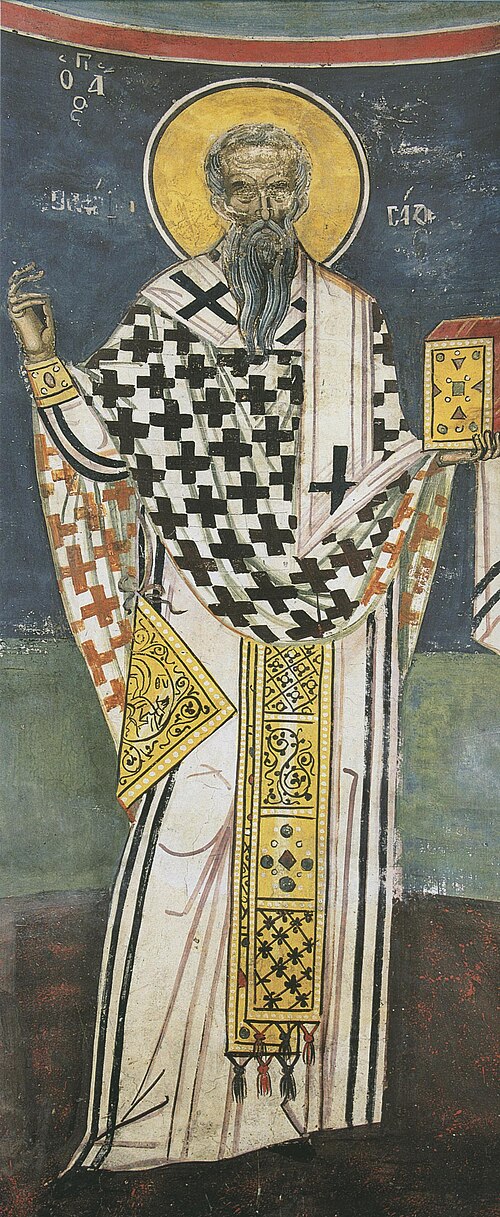
Saint
Porphyrius of Gaza
Bishop of Gaza
Bishop of Gaza from 395 to 420, who Christianized the city and demolished its pagan temples.
- Feast
- February 26old style March 11
- Reposed
- 4205th century
- Place
- Gaza City
- Order
- Hierarchs
Life
Saint Porphyrius, hierarch, was bishop of Gaza from 395 until his death in 420, known for the Christianizing of the pagan city of Gaza and the demolition of its temples. He is commemorated on 26 February.
The source
We know Porphyrius mostly from his Life written by the deacon Mark, his companion and helper, who lived at Gaza in that time. Some regard the text as church edification rather than history, but the author knew fifth-century Gaza well.
Youth and struggle
He was born at Thessalonica, into a wealthy and distinguished family. At about twenty-five he left his parents’ house and went to Egypt, to a skete, where he spent five years and became a monk. Then he went to Jerusalem to venerate the holy places and settled in a cave near the Jordan, where he remained another five years, in great hardship. He fell gravely ill, and tradition says that in a vision the Lord appeared to him and healed him. At about forty he was ordained priest by the patriarch of Jerusalem, who entrusted to him the keeping of a part of the wood of the Holy Cross. After the death of the bishop of Gaza, in 395 or 396, he was made bishop, and he accepted this ministry reluctantly, at about forty-five.
Bishop at Gaza
At Gaza he found only some two hundred and eighty Christians; the other inhabitants were idol-worshippers, very fierce. In the year he arrived there was a drought, and the pagans laid it to him, saying that Marnas had shown them that Porphyrius’ feet bring misfortune on the city. The church had had to be built outside the walls. Porphyrius sent Mark to Constantinople, in 398, to obtain an order to close the temples, but the Marneion stayed open, because the emperor’s envoy was bribed. In the winter of 401-402 Porphyrius went himself to Constantinople, with the bishop of Caesarea Palaestina, and persuaded the empress Eudoxia to ask the emperor Arcadius for a decree. The decree was carried out in May 402: eight temples, among them those of Aphrodite, Hecate, the Sun, Apollo, Persephone and even the Marneion, were pulled down or burned. On the site of one of them, with the support of Eudoxia, a church was built with thirty marble columns.
His end
Porphyrius lived long enough to see the city of Gaza Christianized, and fell asleep in 420. He is believed to have been a wonderworker both in life and after death, and his relics lie in Gaza.
Commemorated the same day February 26
 Basil BogdashevskySaint · Archbishop of KanivFeb 26
 Michael LisitsynHieromartyr · Priest and journalistFeb 26
- Andrew of FlorenceSaint · Bishop of FlorenceFeb 26
 John PashinHieromartyr · Bishop of RylskFeb 26
- Anna of RybinskVenerable Martyr · NunFeb 26
- Aedlugh of Cluain mic NoisVenerableFeb 26
- Agricola of NeversSaint · Bishop of NeversFeb 26
- AnatoliaGreat MartyrFeb 26
- AsfeyaSaintFeb 26
- Began of Ceann SaileSaintFeb 26
- Christodulus of RomeMartyrFeb 26
- Cronan of Glenn AosaSaintFeb 26