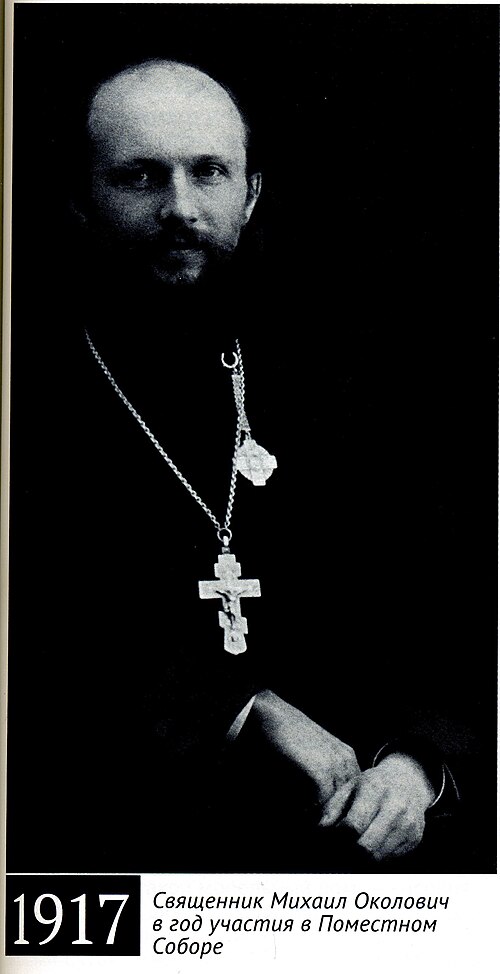
Hieromartyr
Michael Okolovich
Archpriest
Archpriest, member of the Local Council of 1917, who died a martyr in 1938 at Komsomolsk-on-Amur.
Life
Holy Hieromartyr Michael Okolovich was an archpriest of the Russian Church and a member of the Local Council of 1917. He died as a martyr in 1938 at Komsomolsk-on-Amur, shot in a camp; the sources give as the date of his death either 26 March or 20 May. He was glorified among the saints in 2003 as a hieromartyr. His commemoration is on 26 March by the new calendar.
He was born in Vitebsk province, into the family of a priest. He graduated from the Polotsk clerical school (1904), the Vitebsk seminary (1910) and the Saint Petersburg Theological Academy, with the degree of candidate of theology (1914). He married Maria Maksimovna Mastryukovich and they had a daughter, Anna, and a son, who died in October 1917. He was priest, rector, religion teacher and class inspector at the Irkutsk diocesan school for girls (1914). He received the epigonation and was a member of the Irkutsk diocesan school council (1915) and of the Union of Orthodox Christians (1917).
In 1917 he was a member of the Local Council of the Russian Orthodox Church, elected as a cleric by the Irkutsk diocese, took part in the first session and was in the sixth, thirteenth, fourteenth and fifteenth sections. In 1918 he was elected by the faithful rector of the church of the Exaltation of the Cross in Irkutsk, member of the Irkutsk diocesan council and participant in the Siberian Church Council Conference. In 1921 he was imprisoned three months on a charge of keeping weapons, did not admit guilt and was released by an amnesty. He temporarily administered the Irkutsk diocese, was a member of the Temporary Diocesan Council under the bishop of Nizhny Tagil, fought against the Renovationists and helped the persecuted clergy, and rejected the political police's proposal to become an informer.
From 1924 he was an archpriest. In 1925, as dangerous to the foundations of Soviet legal order, he was sentenced to three years in a concentration camp. He served the sentence in the Vishera section of the Solovki Special Camp, where he worked as timekeeper and accountant. From 1928 he lived in the town of Minusinsk. In 1933, as a member of a counter-revolutionary insurgent church-monarchist organization, he was sentenced to ten years in a labour camp. He served the sentence in the fourth section of the Far Eastern camp, at the Balyn camp point, where he ran the pharmacy and worked as accountant at a plant. In 1938, for participation in a counter-revolutionary group preparing an escape abroad and anti-Soviet, insurgent, defeatist agitation in the camp (as before, he did not admit guilt), he was shot.
Commemorated the same day March 13
 Helena DragašVenerable · Byzantine EmpressMar 13
 Sabinus of HermopolisMartyr · Martyr of EgyptMar 13
- Christina of PersiaMartyr · Persian noblewomanMar 13
 Cassian the RecluseVenerable · Recluse of the Kiev CavesMar 13
- Gerald of MayoVenerableMar 13
 Mochoemoc of LiathmoreVenerable · Abbot of LiathmoreMar 13
- Africanus of CarthageMartyrMar 13
- Alexander of MacedoniaMartyrMar 13
- Alexander of PydnaMartyrMar 13
- AltheusSaintMar 13
- Ansovinus of CamerinoSaint · Bishop of CamerinoMar 13
- CoincheandSaintMar 13