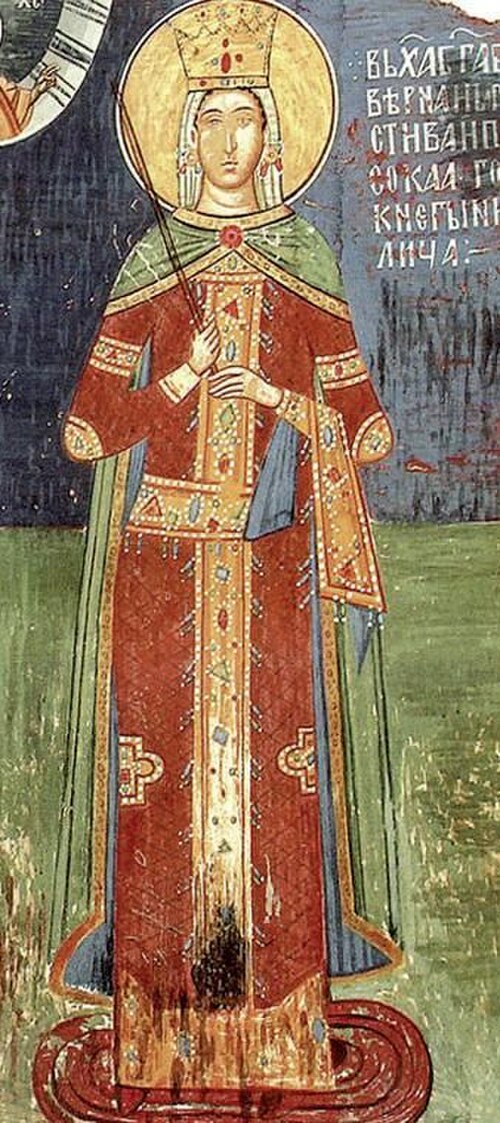
Venerable
Milica of Serbia
Empress of Serbia, later a nun
Wife of Prince Lazar, who fell at Kosovo, she later became a nun at Ljubostinja and died in 1405.
- Feast
- July 19old style August 1
- Reposed
- 140515th century
- Place
- Ljubostinja
- Order
- Venerables
Life
Venerable Milica of Serbia, in monasticism Eugenia and in the schema Euphrosyne, was the wife of Prince Lazar, who fell at Kosovo in 1389. After his death she governed Serbia as regent until 1393 and then became a nun at the monastery of Ljubostinja, which she had founded. She was born around 1335 and passed to the Lord on 11 November 1405. She was a writer and laboured for her country and for the Church. The Serbian Orthodox Church commemorates her on 19 July by the old calendar.
Family and marriage
Milica was the daughter of Prince Vratko, called in Serbian folk songs Jug Bogdan, a great-grandson of Vukan Nemanjić. She thus came from the collateral but older branch of the Nemanjić dynasty. Around 1353 she married Lazar Hrebeljanović, a court official who, as the power of Emperor Uroš waned, became prince of Moravian Serbia, with his seat at Kruševac. They had several children, according to some sources eight: three sons and five daughters, among them Stefan Lazarević, Jelena, married to Đurađ II Balšić, Mara, married to Vuk Branković, and Olivera, given to Sultan Bayezid I. Through her, their children, of the Lazarević dynasty, descended in the female line from the Nemanjići. The sources present her as a woman of strong character.
Regency
After Lazar's death in the battle of Kosovo, Milica governed the country until 1393, when her son Stefan came of age. They were very hard times. As early as November 1389 she was attacked by the Hungarians of Sigismund, who took several fortresses in the north and penetrated as far as Kragujevac. Scholars disagree on the outcome of this attack. Vuk Branković, a leader in Lazar's army, tried to overthrow her, and the regent found herself between two enemies who were negotiating an alliance. In the summer of 1390, when the Ottomans reached her borders, she accepted the sultan's suzerainty and allowed his troops to pass through the land. It is thought that the quarrel with Branković led her to start a campaign of slander that may have marked the early sources on Kosovo.
Nun
Around 1390 she founded the monastery of Ljubostinja, where she took monastic vows around 1393, with the name Eugenia, and before her death she received the great schema with the name Euphrosyne. Together with Venerable Jefimija, famed as a writer, she went in 1398 or 1399 to the court of Sultan Bayezid, to support her son's interests. With the help of her daughter Olivera, the sultan's wife, they obtained, according to some sources, the transfer of the relics of Saint Paraskeva from Vidin to Belgrade. In 1403 she went to the sultan at Serres to plead for Stefan in a dispute with Branković.
She wrote several prayers and religious poems. In 1397 she issued, together with her sons, at Dečani, A Mother's Prayer, and she ordered the repair of the bronze horos (chandelier) of Dečani. Her lament for her husband, My Widowhood's Bridegroom, is also known.
Repose and veneration
She was buried at Ljubostinja, in her own monastery. The Serbian Orthodox Church numbered her among the saints and commemorates her on 19 July (1 August by the new calendar), on the same day as her son, Despot Stefan Lazarević. Several streets in Serbia bear her name.
Commemorated the same day July 19
 Symmachus of RomeSaint · Bishop of RomeJul 19
 Stefan LazarevićFool-for-ChristJul 19
 Macrina the YoungerVenerable · Sister of St. Basil the GreatJul 19
 Paisius of the CavesVenerable · Monk of the Kyiv Caves LavraJul 19
- DiocletusSaintJul 19
- Ambrose AutpertusVenerableJul 19
 Arsenie PapaciocConfessor · Elder of TechirghiolJul 19
- Aurea of CórdobaMartyrJul 19
- BabilaMartyrJul 19
- Cobran of CluainSaintJul 19
- Corban of CluanaVenerableJul 19
- DioclesVenerableJul 19