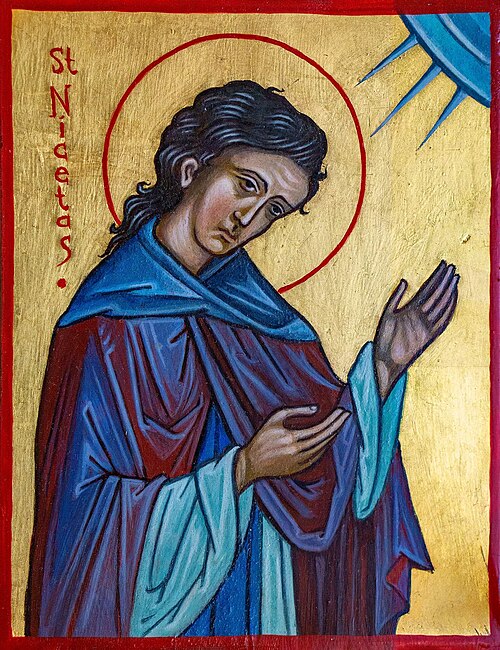
Venerable
Nicetas the Patrician
Byzantine monk and former high official, a fervent opponent of iconoclasm, who died in 836.
- Feast
- October 13old style October 26
- Reposed
- 8369th century
- Order
- Venerables
Life
Saint Nicetas the Patrician was a high Byzantine official turned monk and a confessor of the holy icons in the time of the second Iconoclasm. He was born in Paphlagonia in 761 or 762 and passed to the Lord on 6 October 836 in the village of Katesia in Bithynia. The Church commemorates him on 13 October as a holy confessor of the faith.
Beginnings at court
According to his life, Nicetas was born in Paphlagonia to parents probably named Gregory and Anna. A later tradition made him a descendant of the Empress Theodora, wife of Theophilos, which is impossible, though some relationship cannot be excluded; another tradition makes him a relative of the Empress Irene. The hagiography says that his parents had him made a eunuch while still young, that he received a good education and that at seventeen he was sent to Constantinople, where he entered the service of the court. He stood out among the palace eunuchs and came to the notice of the empress-mother Irene, who governed the empire as regent after 780 and advanced him for his ability and for their kinship. It is said that in 787 he represented the empress at the Second Council of Nicaea, but given his age this is probably an invention of the hagiographer.
Soon he was raised to the rank of patrician and sent to Sicily as strategos of the theme there. For this reason he is usually identified with the patrician Nicetas, strategos of Sicily, who sent an embassy to Charlemagne in 797, and with the patrician Nicetas Monomachos, who brought the hand of Saint Euphemia from Constantinople and built a church in Sicily to house it. His term as governor had ended before 799, when a certain Michael held the post. If Monomachos is a family name and not a nickname (it means "single combatant"), Nicetas would be the first known member of the Monomachos family, which rose in the eleventh century and gave an emperor, Constantine IX Monomachos.
After Irene's overthrow in 802 almost nothing is known about him for ten years. According to the hagiography he wished to retire to a monastery, but Emperor Nikephoros I and his son Staurakios forbade it. Scholars have tentatively identified him with other men of the same name and rank in the chronicles: the patrician Nicetas who owned the house where the Gastria monastery was later built, one of the founders of the church of Saint Stephen at Trigleia in Bithynia, or the admiral Nicetas who in 807 and 808 led the Byzantine fleet in the reoccupation of Dalmatia and Venice, perhaps the same as the general logothete of 808 to 811.
Monk
With the accession of Michael I Rhangabe, toward the end of 811, Nicetas was at last able to be tonsured. The new emperor encouraged him, was his sponsor and gave him the monastery of Chrysonike near the Golden Gate, where Nicetas retired and was abbot until the end of 815. Then the second Iconoclasm began under Leo V the Armenian. Nicetas refused to accept the emperor's iconoclast policy and left the capital for one of its suburbs. He was accused at one point of hiding an icon, but suffered no punishment except the confiscation of the icon and house arrest.
Nothing is known of his life under Michael II the Amorian. In the early reign of the latter's son Theophilos the persecution of those who venerated icons grew harsher, especially against monks. Despite a probable family tie to Theophilos's empress, Nicetas was ordered to enter communion with the iconoclast patriarch Antony Kassymatas or go into exile. He chose exile and fled to Bithynia with a few disciples and other like-minded monks. For some years he moved from place to place along the shore of the Sea of Marmara to escape the pursuit of iconoclast officials, and finally settled in the villages of Zouloupas and then Katesia, where he died on 6 October 836. The sources say he had the gift of healing those tormented by fleshly passions.
Sources
The main sources on him are his life and the synaxaria. The life survives in a twelfth-century manuscript now in the National Library of Greece in Athens. It was once attributed to Nicetas of Medikion, but was written soon after the death of Nicetas the Patrician by an unknown monk of the monastery of the Archangels at Katesia, which he had founded. The account rests on the notes of his nephew and disciple, also named Nicetas, who succeeded him as abbot.
Commemorated the same day October 13
 Theophilus of AntiochSaint · Bishop of AntiochOct 13
 Zlata of MeglenNew MartyrOct 13
 Gerald of AurillacRight-Believing · Count of AurillacOct 13
 Carpus of PergamonHieromartyr · Bishop from PergamonOct 13
 Florentius of ThessalonikiMartyrOct 13
 Nicholas ErmolovHieromartyr · ArchpriestOct 13
 Dimitra of KyivVenerable · Founder of Vvedensky Convent, KyivOct 13
- Benedict of CupraMartyrOct 13
- Bosiljka of PasjaneNew MartyrOct 13
- Innocent KikinHieromartyr · PriestOct 13
- AdriasHieromartyr · Bishop of ChalcedonOct 13
- Agathodorus of SardisMartyrOct 13