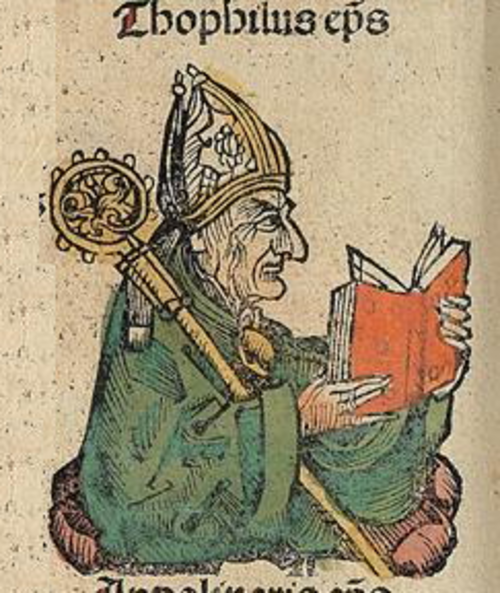
Saint
Theophilus of Antioch
Bishop of Antioch
Bishop of Antioch from 169 to 183, a Christian apologist, author of the treatise To Autolycus.
- Feast
- October 13old style October 26
- Reposed
- 1832nd century
- Place
- Antioch
- Order
- Hierarchs
Life
Saint Theophilus of Antioch was bishop of Antioch in the second half of the second century and one of the earliest Greek Christian apologists. His only surviving work, To Autolycus, defends the faith before the pagans and is the earliest Christian writing known to us that uses the word "Trinity." He belongs to the Church of the first centuries, before the division of East and West.
Few facts about his life are certain. From his own writing we learn that he was born a pagan near the Tigris and Euphrates, that he was well educated in Greek literature, and that he came to Christ by reading the Holy Scriptures, above all the prophets. He was baptized as an adult. He says nothing in his surviving book about his office.
According to Eusebius of Caesarea, Theophilus was the sixth bishop of Antioch, counting from the apostles, after Peter, Evodius, Ignatius, Heron and Eros. The dates are only approximate: he became bishop around 169 and reposed in the 180s, in the reign of Commodus. Eusebius speaks of the zeal with which he and the other chief shepherds of his time drove away the heretics attacking Christ's flock, and he names a book Theophilus wrote against Marcion. Eusebius and Jerome also mention a work against Hermogenes, catechetical writings, and commentaries on the Gospel and Proverbs which Jerome doubted were his. None of these has survived.
To Autolycus has three books. It is addressed to Autolycus, a learned pagan friend who asked to be shown the God of the Christians. Theophilus answers that God is not seen with the eyes of the body but is known through His works and by the soul that is clean, just as the soul of a man cannot be seen yet is known from the life of his body. He explains that Christians are named from the anointing, and are anointed with the oil of God.
In the second book he writes that God made all things through His Word and His Wisdom. He speaks of the first three days of creation before the lights of heaven as images of the Trinity: God, His Word, and His Wisdom. The vocabulary is still early and does not yet have the exact shape of later Church teaching, but it comes from the same faith. In the third book he argues that Moses and the prophets are far older than the Greek philosophers and poets, and he gives a chronology from the creation of the world to the emperor Marcus Aurelius. He also points to the way Christians live, with love of man, chastity and mercy.
The Church numbers Theophilus among her holy teachers. The Russian calendars once placed his memory on 19 December, though he is not in the present Russian menologion, and the Western Church commemorates him on 13 October. No martyrdom and no relics are recorded. His importance lies in his witness to how Christians in Antioch, where the disciples were first called Christians, spoke about God as early as the second century.
Commemorated the same day October 13
 Zlata of MeglenNew MartyrOct 13
 Gerald of AurillacRight-Believing · Count of AurillacOct 13
 Nicetas the PatricianVenerableOct 13
 Carpus of PergamonHieromartyr · Bishop from PergamonOct 13
 Florentius of ThessalonikiMartyrOct 13
 Nicholas ErmolovHieromartyr · ArchpriestOct 13
 Dimitra of KyivVenerable · Founder of Vvedensky Convent, KyivOct 13
- Benedict of CupraMartyrOct 13
- Bosiljka of PasjaneNew MartyrOct 13
- Innocent KikinHieromartyr · PriestOct 13
- AdriasHieromartyr · Bishop of ChalcedonOct 13
- Agathodorus of SardisMartyrOct 13