Hieromartyr
Nicholas Popov
Cleric martyred for the faith of Christ.
Life
Holy Hieromartyr Nicholas Popov was a priest of the Cossacks on the Don and was killed by the Reds near Morozovskaya station in the spring of 1919.
Family and calling
He was born on 6 May 1864 in the family of the state councillor Khariton Ivanovich Popov of the stanitsa of Cherkassk of the Don Host, and Alexandra Petrovna, daughter of a priest of the stanitsa of Migulinskaya. The family had nine children. His father, a Cossack burning with love of his land, lived over ninety years and dedicated his life to studying the history and culture of the Don; he was one of the initiators and the first director of the Museum of the Don Cossacks. From his mother and his priest grandfather, with whom he spent his childhood, Nicholas received the religious foundation: love of the church, prayer, reading and singing. The family later moved to Novocherkassk, where he entered the gymnasium; his schoolmates called him "Kharitonych", for his honesty and faithfulness to his word. After six classes of gymnasium he attended the agricultural school at Kharkov. But in those years he concluded that the root of evils is spiritual ignorance, and at thirty he entered the fifth year of the Don seminary. He finished it in 1893.
The shepherd
He received the parish of the hamlet of Kolodezny in the stanitsa of Migulinskaya, a remote and forsaken place in the steppe, with superstition, drunkenness and ignorance, with a prayer house in place of a church. He gave himself to the ministry: he served with fervour, preached often, held Sunday talks, built a teachers' school with a boarding house, open also to poor children, and bought books and notebooks with his own money. Beside him was his wife, Zinaida Georgievna, with illnesses and trials. His upright stand upset and frightened the wealthy Cossacks, intrigues and slanders began, and he moved to Verkhne-Gnutov, in the stanitsa of Yesaulovskaya. There he restored and painted the church, gilded the domes, organised a choir, built a new school in which he taught daily the children and on Sundays the adults, and his knowledge of medicine proved useful. He was often elected delegate to the diocesan congresses.
Martyrdom
In the winter of 1918-1919 the front came near Verkhne-Gnutov; refugees arrived, food began to run short, an epidemic of typhus broke out, and people died by dozens a day. Despite the entreaties of the villagers, Father Nicholas refused to leave and went to the sick; he fell ill himself. A teacher of the school, his former pupil, found him, tended him and hid him from arrest, then his wife came and took him home. The illness was heavy; only after two months could he rise. He did not wait for full recovery and began to serve at home; the people came to him again. The Red commissar of the revolutionary committee, nicknamed "Makhor", who before the revolution had worked as a carter and had spent time at the priest's table, saw in the search a photograph of his brother, the ataman Peter Kharitonovich Popov, who had led part of the Don Cossacks against the new power. That was enough. Father Nicholas was arrested, but was allowed, under guard, for three days to travel through the hamlets and give Communion to the gravely ill. Before the Annunciation he asked for the Gospel and the icons to be brought to his cell and, with the other prisoners, made the prison a house of prayer. The commissar sent him to Morozovskaya station, where the district revolutionary tribunal sat, which almost always condemned to death. In his farewell letter he asked his relatives to forgive all enemies and to forgive his martyr's death too. Saying goodbye to his wife from the window of the tribunal building, he pointed to the sand: his death would be in a sand quarry near Morozovskaya station.
Only after three months, when the district was freed from the Reds, did relatives search for his body; his daughter, digging through hundreds of graves of those tortured by the Bolsheviks, recognised her father by his body hacked by the executioners. He was buried in the churchyard at Gnutov, which he had loved, behind the altar. The faithful accompanied him with bells and litia; for a long time they went to the grave, until the cruel time levelled it, and later the church too disappeared. His memory was kept by the villagers of Gnutov and by his father, who gathered his letters in his archive. On 17 July 2006 the Holy Synod, at the proposal of the diocese of Rostov-on-Don, numbered the priest Nicholas Popov (1864-1919) in the Synaxis of the New Martyrs and Confessors of Russia.
He is remembered on 26 March, on 11 July (a movable day) in the Synaxis of the Saints of Volgograd, and on 7 February (a movable day) in the Synaxis of the New Martyrs and Confessors, in the new style.
Commemorated the same day March 13
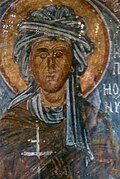 Helena DragašVenerable · Byzantine EmpressMar 13
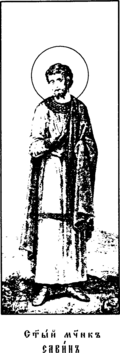 Sabinus of HermopolisMartyr · Martyr of EgyptMar 13
- Christina of PersiaMartyr · Persian noblewomanMar 13
 Cassian the RecluseVenerable · Recluse of the Kiev CavesMar 13
- Gerald of MayoVenerableMar 13
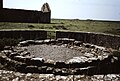 Mochoemoc of LiathmoreVenerable · Abbot of LiathmoreMar 13
- Africanus of CarthageMartyrMar 13
- Alexander of MacedoniaMartyrMar 13
- Alexander of PydnaMartyrMar 13
- AltheusSaintMar 13
- Ansovinus of CamerinoSaint · Bishop of CamerinoMar 13
- CoincheandSaintMar 13