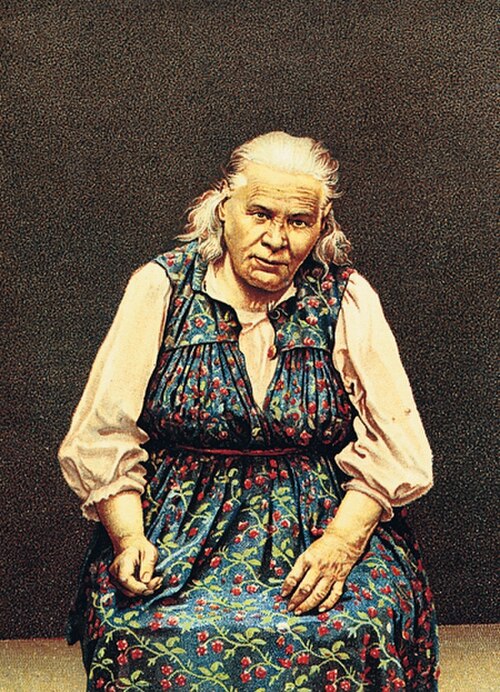
Fool-for-Christ
Paraskeva of Diveevo
Fool for Christ
Fool for Christ and wanderer, famed around 1900, who met Tsar Nicholas II; died in 1915.
- Feast
- September 22old style October 5
- Reposed
- 191520th century
- Place
- Diveyevo
- Order
- Fools-for-Christ
Life
Blessed Paraskeva of Diveevo, known among the people as Pasha of Sarov, was a fool for Christ and a wanderer who struggled for decades in the forests of Sarov and then in the Diveevo Convent, and became famous throughout Russia at the turn of the nineteenth and twentieth centuries. She received in her cell Emperor Nicholas II and Empress Alexandra, and tradition says that she foretold what was to come upon them. The Russian Orthodox Church honours her as a blessed one, and her relics rest in the Diveevo Convent.
Childhood and years of serfdom
Her baptismal name was Irina Ivanovna. She was born between 1795 and 1807 in the village of Nikolskoye in the Spassk district of Tambov province. Her parents, Ivan and Darya, had three sons and two daughters. Irina was a serf on the estate of the Bulygin family.
At seventeen she was married against her will to a neighbour, the peasant Fyodor. She was an exemplary wife, gentle, obliging, respectful and hardworking, and she prayed much. Her husband was also a devout man, and they lived in harmony, but they had no children. Later, when asked what her husband had been like, she would answer that he was "just as foolish as me".
After fifteen years the landowners sold Irina and her husband to their neighbours, the Schmidt family, of German origin, who owned the village of Surkot. Five years later Fyodor died of consumption. Her masters wanted her to marry again, but Irina refused. She remained a servant in the manor, where, according to her biographer Leonid Chichagov, she was cook and housekeeper.
Suffering and flight
When two lengths of linen disappeared from the house, the servants, who feared Irina's honesty, laid the blame on her. At the masters' request the police officer ordered her beaten, and under the beating her ears were torn and her head broken. It later emerged that another woman had stolen the linen and thrown it in the river, where it was found.
Irina fled to a convent in Kyiv, but was caught by the police, imprisoned and sent back under escort. Her masters, wishing to make amends for their cruelty, forgave her and made her a gardener. Two years later she fled again to Kyiv and again was brought back. This time she was driven into the street barefoot, half-dressed and without a crust of bread, and ordered never to show herself again. For five years she wandered about the village, taken by everyone for a madwoman.
Her biographers were convinced that in Kyiv she secretly received monastic tonsure with the name Paraskeva, and that from then on she called herself Pasha. When this happened is not known for certain: some place it after her first flight, others after the second, and others immediately after her husband's death, during a pilgrimage to the Kyiv Caves Lavra. Leonid Chichagov held that the Kyiv monks not only tonsured her but also blessed her for the struggle of foolishness for Christ.
Thirty years in the Sarov forest
The nuns of Diveevo related that Saint Seraphim of Sarov himself had blessed her to live in the deep forests. The researcher Olga Bukova, however, concluded that the two never met.
For almost thirty years Paraskeva lived in the Sarov forest. She dwelt in earthen hollows that she dug for herself. Sometimes she came to Sarov or Diveevo and was often seen at the Sarov monastery mill, where she came to work. She bore every hardship without complaint. The local peasants and pilgrims revered her and brought her food and money, which she at once gave away to the poor.
Once robbers demanded money from her, and because she had none they beat her terribly. For a whole year she hovered between life and death, but she recovered. From then on she suffered from headaches because of the grave injury she had received.
At the Diveevo Convent
In the autumn of 1884 Pasha came to the Holy Trinity Seraphim-Diveevo Convent. It is said that her gift of foresight was then revealed. Approaching the convent gate, she struck a post and said that as she would break that post, so people would begin to die, so that there would hardly be time to dig the graves. Soon afterwards Blessed Pelagia Ivanovna, the convent priest and several nuns died.
For a long time she would not settle in the convent, saying that her path was always to move from place to place. Even in old age she moved from one cell to another, from the convent to its farms, to distant obediences and to Sarov, her old haunts. She went about with a stick she called her "little cane", a bundle of belongings, a sickle on her shoulder and several dolls tucked in her bosom. With her white curls and wonderful blue eyes, the old woman drew everyone's gaze. With her cane she sometimes struck people she met, exposing cheats and thieves. Her bundle held crusts of bread, peas, cucumbers, grass, children's mittens with money tied in the fingers, rags, little wooden crosses and many handkerchiefs.
After the death of Blessed Pelagia, Pasha settled permanently at Diveevo. After several moves she remained in a small house by the convent gate, together with the nun Anna Ivanovna, who ran the convent shop. The nuns hung icons and a lamp there and gave her what she needed. In the room stood a large wooden bed with pillows, on which her dolls lay. She cared for them tenderly, fed them, washed them, sewed clothes for them and dressed them. It was believed that when someone in the convent was about to die, she would take out her favourite doll and dress it as a corpse. She often showed visitors what was to befall them by means of her dolls.
Prayer and work
She stood at prayer all night and lay down only towards morning, and briefly, for at the first glimmer of light she was up again. She joined prayer to all her work, especially to cutting grass, so that in her hidden language "to cut grass for someone" meant to pray for them. If she gave someone a burdock or a weed, it foretold an approaching misfortune. In her cell she knitted stockings or spun, saying the Jesus Prayer inwardly, and so her yarn was highly prized and made into belts and prayer ropes. To a future Archbishop of Voronezh she gave a cloth she had woven herself, from which he made a vestment he wore until his death. She also baked rolls and pies, which she sent to the abbess.
If a nun missed a service, Pasha would shout at her and sometimes teach her a lesson with the cane. She could not bear idle chatter among the young nuns, demanded that they work without ceasing, and could not tolerate untidiness.
In her old age she seldom went to church, and always washed the day before. She usually stood at the entrance or even in the porch, sometimes kneeling through the whole service. She received communion rarely and often prayed in the fields or by the road, falling on her knees. She knew a few prayers by heart but prayed mostly in her own words. She called the Mother of God "Mummy behind the glass". She loved the icons greatly, lighting lamps before them, adorning them with flowers, setting her favourite things before them and kissing them. In spring, summer and late autumn she would leave the convent for the fields or a grove, where she spent several days in fasting, prayer and labour. Witnesses said that she rose above the ground while praying.
The gift of discernment
Some visitors she received lovingly, sat them at table, gave them tea and even bowed to the ground before some, while others she scolded, drove out and threatened with her stick. Her contemporaries saw in this the gift of telling true piety from feigned piety. She often spoke with an unseen interlocutor and referred to herself in the third person. Sometimes she answered not the questions spoken aloud but the hidden thoughts of the person before her. In the days of her struggle with the enemy of salvation she talked without stopping, broke things and cried out.
A contemporary wrote that by her mysterious words and strange deeds she was for the nuns of Diveevo and the pilgrims a living reminder of the highest aim of life: rebuking some, consoling others, correcting the lost, strengthening the weak and protecting the defenceless. Hegumen Seraphim (Kuznetsov), who knew her well, admitted that many of her prophecies, spoken in parables, had been misunderstood.
The meeting with the imperial family
Word of Blessed Pasha reached the imperial court. Her meetings with Empress Alexandra Feodorovna, the Dowager Empress Maria Feodorovna and Grand Duke Sergei Alexandrovich are documented. In the summer of 1903, at the canonisation of Saint Seraphim of Sarov, Emperor Nicholas II and Empress Alexandra visited her at Diveevo. According to tradition she foretold to them the birth of an heir, and to the emperor his abdication, his martyr's death and his glorification among the saints. There are also unconfirmed reports that Grigory Rasputin and Anna Vyrubova tried to make contact with her.
Repose and veneration
Blessed Paraskeva reposed at Diveevo on 22 September 1915, Old Style, at a very great age. Her unusual life drew the attention of many contemporaries, who left recollections of her, and in our own day it has again aroused the interest of believers, historians and writers.
The Russian Orthodox Church numbered her among the saints in 2004 as a blessed one. Her relics now rest in the Church of the Kazan Icon of the Mother of God at the Diveevo Convent and are venerated by crowds of pilgrims. In the little house by the convent gate where she lived, one room is dedicated to her: the cell has been restored as it was in her time and objects that belonged to her are kept there. She is commemorated on 22 September.
Commemorated the same day September 22
 Felix IV of RomeSaint · Bishop of RomeSep 22
 MauriceMartyr · Leader of the Theban LegionSep 22
 Maurice and the Theban LegionHoly MartyrsSep 22
 Candidus of AgaunumMartyr · Commander of the Theban LegionSep 22
 Phocas of SinopeHieromartyr · Bishop of SinopeSep 22
 Jonah of YashezeroVenerable · Founder of Yashezero MonasterySep 22
 Septimius of IesiHieromartyr · First bishop of IesiSep 22
- Kosmas the ZographiteVenerable · Monk of Zographou MonasterySep 22
 Sophia of ShamordinoVenerable · First abbess of ShamordinoSep 22
 Anthony the New of VeriaVenerable MartyrSep 22
 Benjamin VoskresenskyHieromartyr · Bishop of RomanovSep 22
- Aedh son of SenachSaintSep 22