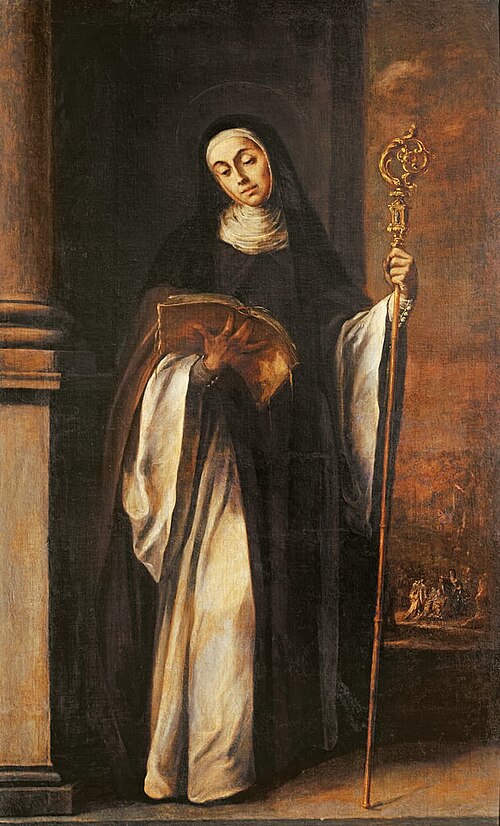
Venerable
Paula of Rome
Disciple of Blessed Jerome
Roman noblewoman and disciple of Jerome, who lived as a nun in Bethlehem and died in 404.
- Feast
- January 26old style February 8
- Reposed
- 4065th century
- Place
- Bethlehem
- Order
- Venerables
Life
The holy venerable Paula of Rome was a woman of senatorial birth, disciple of Blessed Jerome, who lived as a nun at Bethlehem and was one of the first abbesses of a convent. She fell asleep on 26 January, in the year 404 by some sources, 406 by others. She is commemorated on 26 January.
Her earlier life
Paula was born at Rome, on 5 May 347, in one of the richest senatorial families, which claimed descent from Agamemnon; she was the daughter of Rogatus and Blesilla, of the great clan of the Furii Camilli. At sixteen she was married to the nobleman Toxotius, with whom she had four daughters, Blesilla, Paulina, Eustochium and Rufina, and a son, also Toxotius. About her early life we know from Jerome, who says in Letter 108 that she led a life of luxury and held great rank at Rome; she dressed in silk and was carried about the city by slaves. According to tradition, the present church of Saint Jerome in Rome stands on the site of her former house, where she hosted Jerome when he was secretary to Pope Damasus and translated the Bible into Latin.
Her calling
At thirty-two she was widowed. She continued to look after her family, but grew ever more drawn to the faith. Through the influence of Saint Marcella and her circle of women, she entered a group like a convent. She met and learned from Paulinus, bishop of Antioch, and Epiphanius, bishop of Salamis. In 382 she met Jerome, who had come to Rome with Epiphanius and Paulinus. Born in Dalmatia, Jerome had studied in youth at Rome, had travelled to Germany and Aquileia and had lived some years in the East as an ascetic and scholar.
The pilgrimage
The encounter with Jerome and the two Eastern bishops awakened in her the longing for a hermit life in the Holy Land. In 385 she set out for the East with her daughter Eustochium and Jerome, gathering around her a circle of wealthy and devout virgins and widows who wished to fulfil the ascetic ideal. With a great company, men and women, she visited all the holy places, experiencing with great depth the biblical sites and events. Of these Jerome writes in his letter to Eustochium. She was free to go, since she was a widow with a great fortune, had a son as heir and two of her daughters had married into noble families. On the journey they visited monks and ascetics, among them Paulinus of Nola, Melania the Elder, Rufinus of Aquileia and Isidore the Confessor.
At Bethlehem
In the end she settled at Bethlehem and built, with Jerome, a double monastery: one for her and her nuns, another for Jerome and his monks, where Jerome lived and wrote, and she was abbess. She added a hostel for pilgrims, beside the road. The building took three years, and in that time she lived in the hostel of another monastery at Bethlehem. Her hospitality emptied her entire fortune, leaving her daughter with great debts. In the letter written after her death, Jerome praises Paula’s dedication, her asceticism, her prayer and her care for the poor and sick, on whom she spent her wealth.
Her family
Paulina she married to the senator Pammachius; Blesilla soon became a widow and died in 384; Rufina died in 386; Eustochium went with her mother to the East and died in 419, having succeeded Paula as abbess. After her came Paula’s granddaughter, Paula the Younger, who joined Eustochium in 404 and in 420 closed Jerome’s eyes. Her son, Toxotius, at first a pagan, was baptized in 385 and married in 389 Laeta, daughter of the pagan priest Albinus. These names recur often in Jerome’s letters, inseparable from Paula’s.
Repose and veneration
Paula fell asleep at Bethlehem. Her fame as a saint had spread so far that at the funeral several bishops were present, among them the patriarch of Jerusalem, John II, with whom she had earlier had frequent disputes over the governing of the diocese. The tombs of Paula, Jerome and Eustochium lie beneath the basilica of the Nativity at Bethlehem. Her daughters Blesilla and Eustochium are also venerated as saints.
Commemorated the same day January 26
 George KossovConfessor · Archpriest and elderJan 26
 XenophonVenerable · Monk of the Lavra of Saint SabbasJan 26
 Sophia SeliverstovaVenerable Martyr · NunJan 26
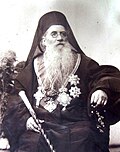 Joseph NaniescuSaint · Metropolitan of MoldaviaJan 26
- John PopovNew Martyr · Theologian, professor at the Moscow AcademyJan 26
- Joseph the ConfessorConfessor · Archbishop of ThessalonicaJan 26
- Simeon the OldVenerable · Hermit of SyriaJan 26
- Alphonsus of AstorgaSaint · Bishop of AstorgaJan 26
- AmmonasVenerableJan 26
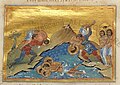 Ananias of PhoeniciaHieromartyrJan 26
- Ansurius of OrenseSaint · Bishop of OrenseJan 26
- Arcadius of ConstantinopleVenerableJan 26