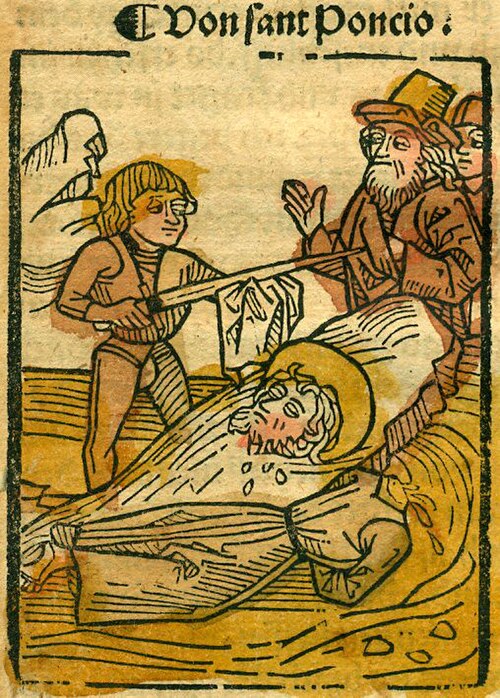
Saint
Pontius the Deacon
Deacon of Saint Cyprian
Deacon of Carthage and disciple of Cyprian, who wrote the Life of Cyprian soon after his death.
- Feast
- October 25old style November 7
- Reposed
- 3003rd century
- Place
- Carthage
Life
Saint Pontius was a deacon of the Church of Carthage and a disciple of Saint Cyprian, bishop of Carthage, then a Latin Christian writer. He died in the mid-third century. He is known as the author of the Life of Cyprian, written shortly after Cyprian's martyrdom. The Church remembers him on 25 October, and the Latin calendars on 8 March.
Only one account of Pontius survives, a brief mention by Saint Jerome in On Famous Men, chapter 68. The other information comes from his own writing. It shows that he wrote partly from what he himself witnessed or heard from older people, that he accompanied Cyprian into exile at Curubis, now Korba, and that he remained at his side until his death. From the preface it appears he knew of no other account of Cyprian's martyrdom. He was also well educated, with knowledge of the Bible and of rhetoric. One scholar noted that an inscription from the little town of Curubis names a magistrate called Pontius and suggested that the praise of the town in the work comes from local patriotism, but others reject this or regard it as unprovable.
The manuscripts give the work the title Life of Cyprian, while Jerome calls it the Life and Passion of Cyprian. It is divided into two parts, one on his life and one on the events leading to his martyrdom. In the preface Pontius expresses regret that there were detailed accounts of the martyrdoms of lay Christians but none of a bishop like Cyprian, who would have had much to tell even without martyrdom. Chapters 3 to 10 relate Cyprian's work after his conversion, and chapters 11 to 19 the hearings before two proconsuls and his martyrdom. Though he knew Cyprian personally, the work has few details, because Pontius at times merely alludes to things his readers knew. He uses his own memories, such as the prophetic dream Cyprian had in 257 when sent to Curubis, Cyprian's own writings and a record of the proconsul's hearing. He was also influenced by the Passion of Saints Perpetua and Felicity. The Life takes on a defensive tone in treating Cyprian's election as bishop, which some Carthaginians contested, and his decision to go into hiding in the Decian persecution rather than undergo martyrdom. Some scholars date it to 259, others a little later.
Commemorated the same day October 25
 TabithaApostle · Disciple of JoppaOct 25
 Crispin and CrispinianHoly MartyrsOct 25
 Gavinus of TorresMartyr · Martyr of Torres in SardiniaOct 25
 Marcian and MartyriusHoly Martyrs · NotariesOct 25
 Martyrius of the Kiev CavesVenerable · Deacon of the Kiev CavesOct 25
 Matrona VlasovaConfessor · Nun of DiveevoOct 25
 MartyriusVenerableOct 25
- Anastasius of SalonaMartyrOct 25
- AnastasiusSaintOct 25
- Angilram of MetzSaint · Bishop of MetzOct 25
- Asterius of SardiniaSaintOct 25
- Avakum of CherkasyVenerableOct 25