Apostle
Tabitha
Disciple of Joppa
Disciple of Joppa, known for her charity, raised from the dead by the Apostle Peter.
- Feast
- October 25old style November 7
- Reposed
- 1001st century
- Place
- Jaffa
- Order
- Apostles
Life
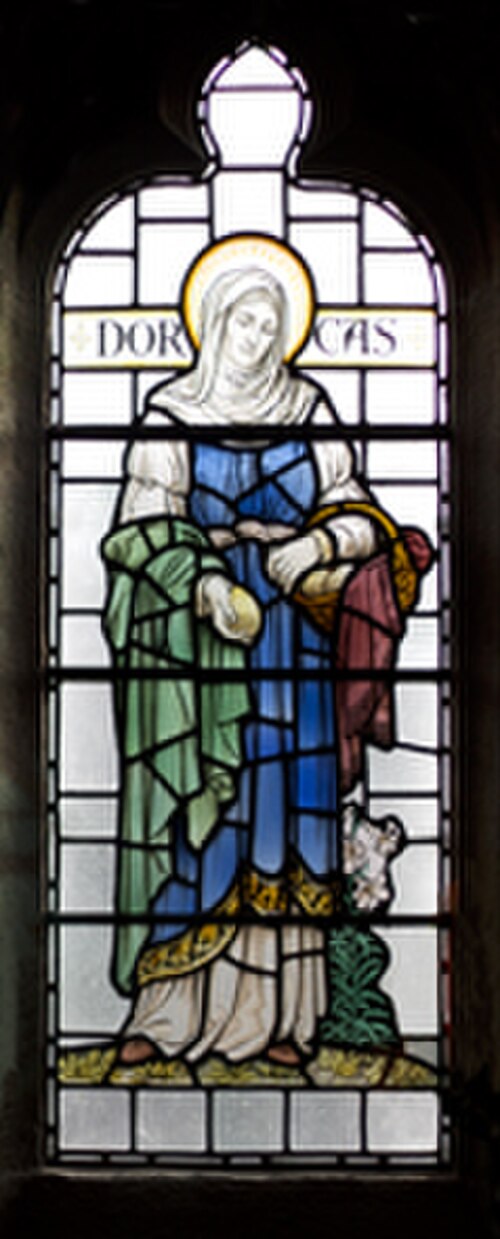
Saint Tabitha, called Dorcas in Greek, was a disciple of the Lord at Joppa, famed for her good works and almsgiving, whom the holy apostle Peter raised from the dead. She is commemorated on 25 October by the old calendar, that is, 7 November by the new.
Her name
Her Aramaic name, Tabitha, and her Greek one, Dorcas, both mean “gazelle”. It seems she used the Greek form because she lived in a port city, where many spoke Greek. Dorcas was a common name at the time, among Jews and Greeks alike.
Her works
Her story is found in chapter 9 of the Acts of the Apostles. Tabitha lived at Joppa, today Jaffa, a seaport now absorbed into Tel Aviv. The book shows her full of good works and almsgiving and beloved of the Christian community there. It is not known whether she was herself poor or a widow, but what Scripture testifies of her remains this: she sewed clothes with her own hands for those in need.
The raising
One day she fell ill and died, and her body was prepared for burial. The believers learned that Peter was nearby, at Lydda, and sent for him. When he reached Joppa he went into the room where the dead woman lay, surrounded by weeping widows. They showed him the tunics and garments that Tabitha had made while she lived, a witness to her goodness. Peter put everyone out, prayed and said, “Tabitha, arise.” She opened her eyes and, seeing him, sat up. He gave her his hand and lifted her up, then called the believers and the widows and presented her alive. The miracle became known throughout Joppa and many believed in the Lord.
The places and her memory
The house of Simon the tanner, where she died and was raised, can still be visited in Tel Aviv-Jaffa. Her tomb, according to a tradition, lies in Jaffa, in a garden that belongs to a Russian Orthodox church. From ancient times societies of women were named after her, gathering, mending and distributing clothes to the poor, and in the nineteenth century such societies, called Dorcas societies, appeared again in the West. Saint Basil the Great gives her as an example to widows who can labour in good works.
Commemorated the same day October 25
 Crispin and CrispinianHoly MartyrsOct 25
 Pontius the DeaconSaint · Deacon of Saint CyprianOct 25
 Gavinus of TorresMartyr · Martyr of Torres in SardiniaOct 25
 Marcian and MartyriusHoly Martyrs · NotariesOct 25
 Martyrius of the Kiev CavesVenerable · Deacon of the Kiev CavesOct 25
 Matrona VlasovaConfessor · Nun of DiveevoOct 25
 MartyriusVenerableOct 25
- Anastasius of SalonaMartyrOct 25
- AnastasiusSaintOct 25
- Angilram of MetzSaint · Bishop of MetzOct 25
- Asterius of SardiniaSaintOct 25
- Avakum of CherkasyVenerableOct 25