Saint
Revealed Saints of Cephalonia
A group of saints of Cephalonia, called in the Greek synaxarion those who were revealed.
- Feast
- June 7old style June 20
- Era
- 14th century
- Place
- Cephalonia
Life
The Revealed Saints of Cephalonia are three confessors, Gregory, Theodore and Leo, who lived as ascetics on the island of Cephalonia and whose relics were discovered in a miraculous way. For this reason they are called "the Revealed" (Phanentes).
Life
According to two Latin synaxaria of the fourteenth century, written by the Venetian Pietro Calò and by the bishop Pietro Natali, the three came from the eastern part of the Roman Empire and were soldiers in the imperial army. They were distinguished by virtue and by faith in God. At that time the Arian heresy was spreading, and the heretical emperor Constantius II (337-361) had ordered all his subjects to accept it. Fearing they would be compelled, they left Sicily, together with other Greek soldiers, and fled to Cephalonia. Learning there that the decree was in force also in the place from which they had come, they preferred to part from the others and to stay on the island. Gregory was elderly, white-haired and full of wisdom, Theodore was about thirty, and Leo shone in his youth. They resolved to give themselves to God and looked for a place suited to their struggle. The valley called Sami, in the eastern part of the island, opposite Ithaca, proved to be the right place. In a small dense thicket they found the ruins of a half-destroyed church. There they lived in struggle, praying unceasingly and fighting as true soldiers of Christ, until, after kneeling and praying, they gave their souls to God.
Discovery of the relics
Their bodies remained unknown for a long time, until Providence willed to reveal them in a miraculous way. A rich man of the island, called Michael, suffered from elephantiasis, a form of leprosy. He gave a large part of his fortune to doctors, without success. One night three men with the faces of angels appeared to him in a dream and told him he would be healed only if he found their unburied bodies. A swineherd told him that, following a pig that had strayed from the herd, he had entered a thicket and seen three unburied and incorrupt bodies, from which a wonderful fragrance came. Michael went there, saw the holy relics in light, and prayed to the saints with tears. The leprosy disappeared on the spot, and he returned home healthy. For this the saints received the name "Phanentes", that is, "the Revealed". Local tradition says that the relics were found in a cave on Mount Avlochori and that the monastery of the Revealed Saints was built then.
The monastery
The monastery was built, the Latin synaxaria say, at the expense of the healed Michael. It stands on the summit of the southern acropolis of ancient Sami, at 226 m, and its foundation dates before 1264. After the Norman conquest of Cephalonia in 1185 its decline began: the Venetians took the relics to Venice, where they are kept in a marble sarcophagus in the church of the Holy Prophet Zacharias. At the end of the fifteenth century the monastery was restored and shone until the eighteenth century. The religious policy of the English in the Ionian Islands led, in the early nineteenth century, to its desolation, completed by the earthquakes of 1953.
The saints are commemorated on the Sunday of All Saints, 56 days after Pascha.
Commemorated the same day June 7
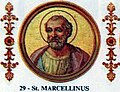 Marcellinus of RomeSaint · Bishop of RomeJun 7
 Cyriacus of RomeHieromartyr · Deacon of RomeJun 7
 Andronik of PermHieromartyr · Archbishop of PermJun 7
 Joannicius RudnevSaint · Metropolitan of Kiev and GaliciaJun 7
 Daniel of ScetisVenerableJun 7
 Paisios BasiasVenerableJun 7
- Benjamin LukaninHieromartyr · PriestJun 7
- Abramius of KozheozeroVenerableJun 7
- Alexander MakhetovHieromartyrJun 7
- Alexander OsetrovHieromartyrJun 7
- Alexander PreobrazhenskyHieromartyrJun 7
- Alexander ZuevMartyrJun 7