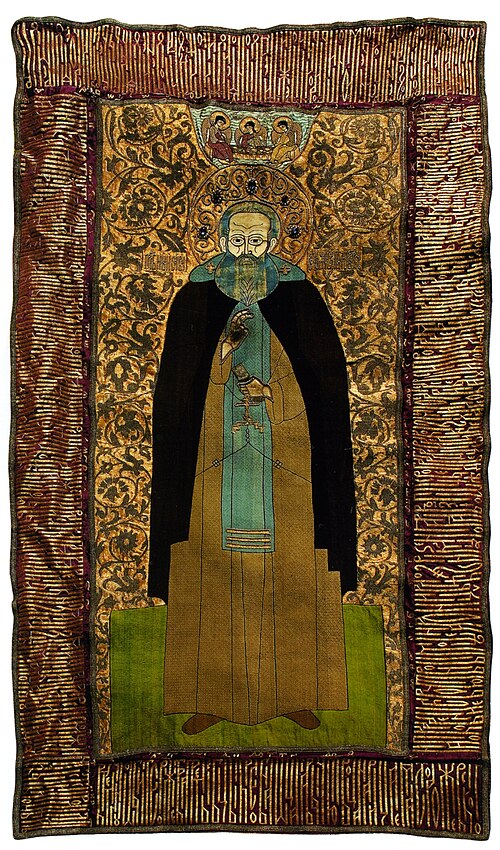
Venerable
Sabbas of Storozhi
Founder of the Zvenigorod Monastery
Founder and first abbot of the Nativity of the Theotokos Monastery in Zvenigorod; died in 1407.
- Feast
- December 3old style December 16
- Reposed
- 140715th century
- Order
- Venerables
Life
Venerable Sabbas of Storozhi, also called Sabbas of Zvenigorod, was one of the first disciples of Saint Sergius of Radonezh, founder and first abbot of the monastery of the Nativity of the Mother of God at Zvenigorod, named after him Savvino-Storozhevsky, healer and wonderworker. He fell asleep in 1407. The Russian Church remembers him on 3 December (the day of his repose), on 19 January and on 23 August, days of the finding of his relics.
Disciple of Sergius
It is known that Sabbas spent most of his life at the Trinity monastery, with Sergius of Radonezh, being chosen confessor of the brotherhood, including Sergius himself. After Sergius' death (1392) he was for a time abbot of the Trinity, when Nikon, to whom Sergius had left the abbacy, withdrew into seclusion. He was the spiritual father of the widow of Dmitry Donskoy, Evdokia (in monasticism Euphrosyne), and of their third son, Yuri of Zvenigorod. According to some scholars, Grand Prince Dmitry asked him to organize the Dormition monastery on the river Dubenka, in thanksgiving for the victory over Mamai, but there are doubts, since another Sabbas was abbot there. He loved silence, avoided talk with people, ate only vegetables, wore coarse clothing and slept on the floor.
The monastery on Storozhi
The first wooden church of the Nativity of the Mother of God on Storozhi hill near Zvenigorod began to be built as early as the early 1390s, with Sabbas' blessing and under the patronage of Prince Yuri Dmitrievich. According to the chronicles, in 1395 Sabbas blessed the prince for the campaign in Volga Bulgaria, which ended in complete victory and the taking of fourteen cities, among them Great Bolgar, Dzhuke-Tau and Kazan. Right after the campaign the means appeared for the great building done at Zvenigorod between 1396 and 1405. The founding of the monastery can be placed in 1396-1398. In 1398, in the midst of the building and after the death of the bishop of Zvenigorod, Daniel, Sabbas left the Trinity and came, at Prince Yuri's invitation, to Zvenigorod, with the Smolensk icon of the Mother of God. In those years the stone church on Gorodok, in the Zvenigorod kremlin, was going up, and later (after Sabbas' death) the Trinity cathedral in Sergius' monastery and the Nativity cathedral at Savvino-Storozhevsky. For painting them the young icon painter Andrei Rublev was invited. In the view of the historian K. P. Kovalev, with Sabbas' blessing he created the unique “Zvenigorod Chin,” part of which was found in 1918-1919 at Gorodok, including the famous “Saviour of Zvenigorod” (now in the Tretyakov Gallery). It is supposed that the elder Sabbas may have blessed Andrei Rublev to paint the icon of the “Trinity.”
Repose, canonization and miracles
Saint Sabbas fell asleep in 1407. He was venerated first locally, then canonized on the initiative of the brotherhood and of Metropolitan Makarios, at the Council of 1547. Tsar Alexei Mikhailovich gave special importance to the monastery, and on his initiative the finding of the abbot's relics took place in 1652; then the monastery was rebuilt, with an appearance preserved to this day, and it received first in Rus' the rank of lavra. The tsar often went on foot to venerate the saint's relics. Many miracles are linked with the monastery and with Sabbas' name, two of which, after his death, entered history. The first is the saving of Tsar Alexei Mikhailovich from a bear on a hunt. The second is the saint's appearance to Napoleon's stepson Eugène de Beauharnais, in the days when the French seized Moscow, in 1812: Beauharnais, at the request of the elder who appeared to him, did not plunder the monastery, passed safely through the era of the Napoleonic wars, as Sabbas had foretold, and his descendants became related to the tsar's family. Today the monastery stands third in Russia by number of pilgrims, after the Trinity-Sergius Lavra and Diveevo.
On 17 March 1919 Sabbas' relics were opened by decision of the district congress of workers' and peasants' deputies, and the official report described them: “a doll of cotton wool; in the cotton wool 33 badly decayed and broken bones.” On 5 April 1919 they were taken from the monastery, which was closed. Until the early 1930s they were kept at the Lubyanka, then were given to a resident of Zvenigorod, Mikhail Uspensky, who bequeathed that they be returned to the Church. His heirs gave them in 1985 to the Danilov monastery in Moscow, and in August 1998 they were solemnly moved to the Nativity cathedral of Savvino-Storozhevsky.
Commemorated the same day December 3
 ZephaniahProphet · The ProphetDec 3
 Birinus of DorchesterSaint · Bishop of DorchesterDec 3
 John the SilentSaint · Bishop turned hermitDec 3
 Emma of LesumSaint · CountessDec 3
- Gabriel II of ConstantinopleHieromartyr · Patriarch of ConstantinopleDec 3
 Theodore Scribo of AlexandriaHieromartyr · Patriarch of AlexandriaDec 3
- Abbo of AuxerreSaint · Bishop of AuxerreDec 3
- AgapiusMartyrDec 3
- Agricola of PannoniaMartyrDec 3
- Andrew KosovskyHieromartyrDec 3
- Angelis of ChiosNew MartyrDec 3
- Anthemius of PoitiersSaintDec 3