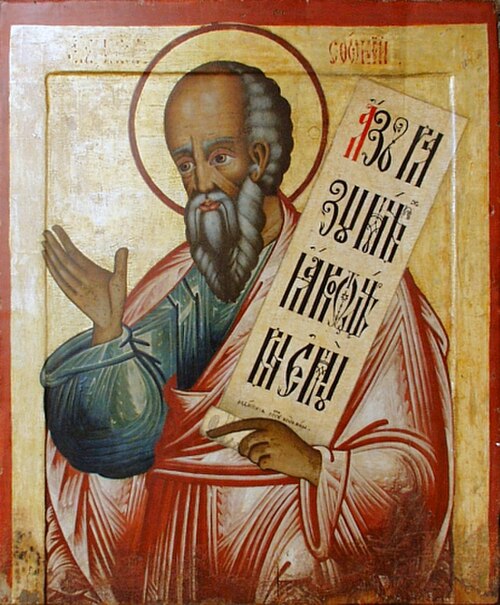
Prophet
Zephaniah
The Prophet
One of the twelve minor prophets, who preached in Judah in the time of King Josiah.
- Feast
- December 3old style December 16
- Born
- 701 BC7th century BC
- Place
- Jerusalem
- Order
- Prophets
Life
Saint Zephaniah the Prophet is the ninth of the twelve minor prophets of the Old Testament, who preached in Judah in the time of King Josiah. His book, of three chapters, is the only source about him. The Orthodox Church commemorates him on 3 December.
The name Zephaniah means in Hebrew "the Lord has hidden" or "the Lord has protected"; Blessed Jerome interpreted it as "watchman of the Lord." His book says that it is "the word of the Lord that came to Zephaniah the son of Cushi, son of Gedaliah, son of Amariah, son of Hezekiah," in the days of Josiah (1:1). The length of the genealogy suggests that Hezekiah is probably the king of that name, so that the prophet would be his great-great-grandson and a distant relative of Josiah. The synaxarion says that he was of the tribe of Simeon, from Mount Sarabatha, but this belongs to tradition.
Josiah reigned from 640 to 609 before Christ. Zephaniah appears to have prophesied before the great reform of 621, when the Book of the Law was found in the Temple. The kings Manasseh and Amon had spread in Jerusalem the worship of Baal, the host of heaven and foreign gods. Zephaniah was one of those who prepared Josiah's reform. It was also a hard time for the world: Assyria was weakening, and peoples from the north, the Scythians, threatened the East. A few decades later, in 586, Jerusalem would fall to the Babylonians.
The book first announces the day of the Lord, "a day of wrath, a day of distress and anguish," which will come on the whole earth, but above all on Judah and Jerusalem, where Baal is worshipped. Then it announces judgment on the neighbouring nations (the Philistines, Moabites, Ammonites, Ethiopians, Assyrians and Nineveh) and urges the humble: "Seek the Lord, all you humble of the land... perhaps you may be hidden on the day of the Lord's anger" (2:3). The third part rebukes Jerusalem, the oppressing city, with its princes, judges, prophets and priests, then announces a humble remnant that will be saved, and a song of joy: "Sing aloud, O daughter of Zion... The Lord your God is in your midst, a mighty one who will save" (3:14-17). The Church hears in these words the announcement of the coming of the Lord.
According to the synaxarion, he died and was buried in his own house, awaiting the general resurrection. In the West the words of Zephaniah 1:15-16 ("that day is a day of wrath") lie behind the Latin chant Dies irae.
Commemorated the same day December 3
 Birinus of DorchesterSaint · Bishop of DorchesterDec 3
 John the SilentSaint · Bishop turned hermitDec 3
 Emma of LesumSaint · CountessDec 3
- Gabriel II of ConstantinopleHieromartyr · Patriarch of ConstantinopleDec 3
 Sabbas of StorozhiVenerable · Founder of the Zvenigorod MonasteryDec 3
 Theodore Scribo of AlexandriaHieromartyr · Patriarch of AlexandriaDec 3
- Abbo of AuxerreSaint · Bishop of AuxerreDec 3
- AgapiusMartyrDec 3
- Agricola of PannoniaMartyrDec 3
- Andrew KosovskyHieromartyrDec 3
- Angelis of ChiosNew MartyrDec 3
- Anthemius of PoitiersSaintDec 3