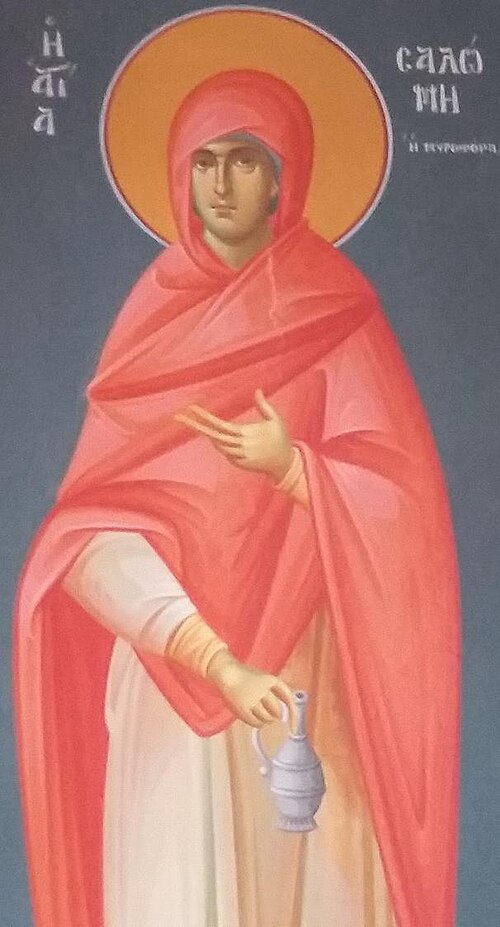
Apostle
Salome
Myrrhbearer
Woman who followed Christ, one of the myrrhbearers and, according to tradition, mother of the apostles James and John.
Life
Saint Salome the Myrrh-bearer was one of the women who followed the Lord Jesus Christ from Galilee and, according to tradition, the wife of Zebedee and mother of the holy Apostles James and John. She was present at the Crucifixion and was among the myrrh-bearers. The Church commemorates her on the Sunday of the Myrrh-Bearing Women and on 3 August.
In the Gospels
The name Salome is the Greek form of a Hebrew name from the word for "peace" (shalom) and was a common name. The Evangelist Mark names her three times: among the women who watched the Crucifixion from afar, who, when Jesus was in Galilee, "followed him and ministered to him" (15:40-41), among those who bought spices after the Sabbath (16:1), and among those who went to the tomb. The Evangelist Matthew, in the same scenes, mentions "the mother of the sons of Zebedee" (27:56) in her place, and the Fathers understood that she is the same person.
Matthew also tells of a request the mother of the sons of Zebedee made of the Lord, with her two sons: that one might sit at His right hand and the other at His left in His kingdom (20:20-28). The Lord answered that they would drink His cup, but that the places are given to those for whom the Father has prepared them. The other ten apostles were angry, and Christ showed them that to be great is to serve.
At the tomb
On the morning of the Resurrection, Salome went at sunrise toward the tomb with Mary Magdalene and Mary the mother of James, carrying the spices. They wondered who would roll away the stone. When they arrived they saw the stone rolled back and a young man dressed in white, who told them that Jesus of Nazareth, the Crucified, had risen and that the disciples and Peter would meet the Lord in Galilee (Mark 16:1-8). Mark says that the women fled, seized with fear and amazement.
Traditions
The Greek Synaxarion calls her a first cousin of the Mother of God and says that, with other women, she supported the needs of the disciples from her means. It also recalls her grief when Herod beheaded her son James, and says that she fell asleep in peace. In apocryphal writings a Salome appears as a witness of the virgin birth. In the medieval West the legend of the "Three Marys" spread, but it is not an Orthodox tradition.
Veneration
On the third Sunday after Pascha, the Sunday of the Myrrh-Bearing Women, the Church honours Salome, Mary Magdalene, Mary of Clopas and the other women who brought spices to the tomb, together with Joseph of Arimathea and Nicodemus. Her own commemoration is on 3 August. The Church of Rome remembers her on 24 April.
Commemorated the same day August 3
 Anthony the RomanVenerable · Founder of Antoniev MonasteryAug 3
 RazhdenMartyr · Persian nobleman of GeorgiaAug 3
- DalmatiusVenerable · Archimandrite of the Dalmatian MonasteryAug 3
 The Nine Kherkheulidze BrothersHoly MartyrsAug 3
 Vyacheslav LukaninHieromartyr · DeaconAug 3
- Theoclete the WonderworkerVenerableAug 3
- Achilleus of ConstantinopleSaintAug 3
- Aodhan of Cluain CairpreSaintAug 3
 Aspren of NaplesSaint · Bishop of NaplesAug 3
- AuratianusMartyrAug 3
- Benno of MetzVenerableAug 3
- Cosmas of PharanVenerable · Hermit of PalestineAug 3