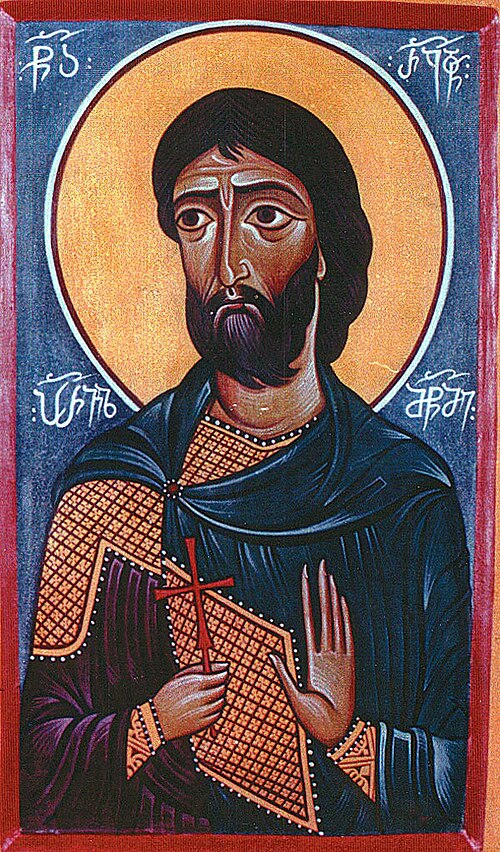
Martyr
Razhden
Persian nobleman of Georgia
Persian nobleman in the service of King Vakhtang I of Iberia, converted and martyred around 457.
Life
Saint Razhden (Ražden, the Persian or the First Martyr), martyr, was a Persian nobleman in the service of King Vakhtang I Gorgasali of Iberia (Georgia), converted to Christianity and crucified by the Persians in the year 457 at Tsromi. He is one of the first martyrs of Georgia and is venerated by all the Orthodox Churches. He is commemorated on 3 August by the old calendar, which is 16 August by the new.
The earliest account
The earliest mention of him is in the History of King Vakhtang Gorgasali, part of the old Georgian historical compilation attributed to Juansher, composed in the eighth or eleventh century, which tells of his martyr's death in the war of the Sassanids against Vakhtang I. In the 1720s the Georgian catholicos Besarion Orbelishvili transformed the short account into hagiography, adding details. Another catholicos of the eighteenth century, Anton I, included a rewritten passion in his collection of Georgian martyrdoms in the 1760s. The name Razhden is of Iranian origin.
Life
Razhden was the tutor of the Persian princess Balendukht, daughter of Shah Hormizd, married to the king of Iberia, Vakhtang Gorgasali. With her he moved in 452 to Iberia, where he received the Christian faith and entered the king's service, as a capable soldier. In 456 the new shah Peroz demanded that Iberia break the alliance with Byzantium. Refused, he set his army against it. Razhden then became governor of Mtskheta and took part in defending the capital and nearby fortresses. For four months he fought stubbornly with the enemy army and drove it from the capital. During a sortie by an Iberian detachment from the fortress of Armazi, he was betrayed and brought to Peroz.
According to the old Georgian chronicle, the shah asked him about his origin and the reason for abandoning his former faith and people. He answered that it was true he had abandoned his homeland and its gods, made to serve people, but now served the one true and living God, in three persons and one being, whose Son became incarnate of the Virgin Mary and suffered, died and rose on the third day, and will come at the end of the world to judge the living and the dead. Then he began to be tortured. According to tradition, in the night the Saviour Himself appeared to him and healed all his wounds. Then the Persians decided to crucify him. Wishing to increase his suffering, they asked for archers, and he, pierced by poisoned arrows like Saint Sebastian, died on the cross at Tsromi in 457. According to Besarion, the king of the Persians himself pressed him to renounce, he was freed for a time through the mediation of Georgian nobles to bid farewell to his family, returned voluntarily to captivity and was crucified with five criminals.
The relics
He was taken down from the cross and buried near the place of the crucifixion. Soon, by order of King Vakhtang Gorgasali, the relics were moved to Nikozi, where they still rest in the cathedral of Nikozi, in which the king installed a bishop. According to the History of Vakhtang, the king also built a church in his honour in the suburb of Ujarma. His life was compiled by Mikhail Sabinin in the Paradise of Georgia, 1882, and the passion was translated into Latin by Paul Peeters in 1914.
Commemorated the same day August 3
 SalomeApostle · MyrrhbearerAug 3
 Anthony the RomanVenerable · Founder of Antoniev MonasteryAug 3
- DalmatiusVenerable · Archimandrite of the Dalmatian MonasteryAug 3
 The Nine Kherkheulidze BrothersHoly MartyrsAug 3
 Vyacheslav LukaninHieromartyr · DeaconAug 3
- Theoclete the WonderworkerVenerableAug 3
- Achilleus of ConstantinopleSaintAug 3
- Aodhan of Cluain CairpreSaintAug 3
 Aspren of NaplesSaint · Bishop of NaplesAug 3
- AuratianusMartyrAug 3
- Benno of MetzVenerableAug 3
- Cosmas of PharanVenerable · Hermit of PalestineAug 3