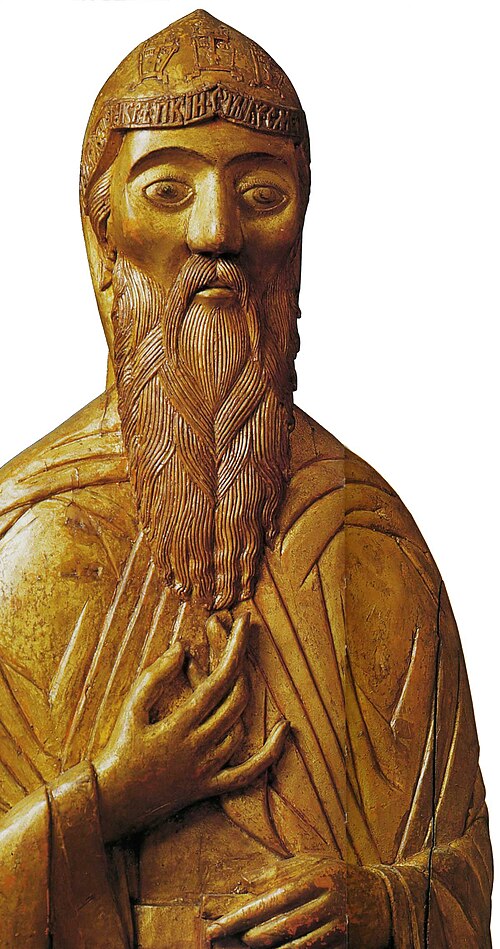
Venerable
Anthony the Roman
Founder of Antoniev Monastery
A native of Rome, founder of the Antoniev Monastery in Novgorod; died in 1147.
- Feast
- August 3old style August 16
- Reposed
- 114712th century
- Place
- Veliky Novgorod
- Order
- Venerables
Life
Saint Anthony the Roman was the founder of the Antoniev Monastery in Novgorod, Russia. Born in Rome around 1067, he reposed on 3 August 1147. The Russian Church honours him as the father of monasticism in Novgorod.
Life
Most of what is known of him comes from a life written in the second half of the sixteenth century, largely legendary but supported at some points by the Novgorod chronicles. According to it, he was born in Rome of Orthodox parents. At eighteen he was left an orphan, gave his goods to the poor and received the monastic habit. He applied himself to learning Greek and to reading the Holy Scriptures and the writings of the holy Fathers.
When Orthodox believers began to be persecuted, Anthony left the devastated monastery and prayed for a year, by some accounts fourteen months, on a rock by the sea. According to tradition, the rock on which he stood broke away and bore him over the sea, the Neva, Lake Ladoga and the Volkhov, all the way to Novgorod. The account places his arrival in September 1106, on the eve of the Nativity of the Mother of God. At first he spoke with the locals through an interpreter, then, after praying, understood the Russian language. With the blessing of Bishop Nikita of Novgorod, he founded a monastery dedicated to the Nativity of the Mother of God, using what remained of his goods, found, the life says, in a barrel caught by fishermen, to buy the land and adorn the church.
The monastery
A stone church was laid down in 1117 and consecrated in 1119. In 1131 Saint Nifont, bishop of Novgorod, appointed him hegumen. He led the community for sixteen years, and before his death named the monk Andrew as his successor, to whom the writing of his life is attributed. He was buried in the monastery. The chronicles speak of the building of the church, his appointment as hegumen and his death, and a testament of the saint survives in several copies.
Veneration
Honoured at first locally, Anthony was canonized in 1597, and his relics were placed in the monastery's cathedral of the Nativity of the Mother of God. In 1860 they were moved into a new shrine. In 1927, during the anti-religious persecution, the shrine was opened and the relics handed to an atheist museum and thought lost. In 2016 a researcher completed a twenty-year study of the relics kept in the Cathedral of Saint Sophia in Novgorod. The story of the voyage on the rock entered Russian folklore. Some scholars note that his link to Rome does not appear in the sources before the mid-sixteenth century, and that in the Middle Ages the word "Roman" could also mean a man from other lands of the German Empire.
The saint is commemorated on 3 August, the day of his repose, and on 17 January, together with Saint Anthony the Great, whose name he bears.
Commemorated the same day August 3
 SalomeApostle · MyrrhbearerAug 3
 RazhdenMartyr · Persian nobleman of GeorgiaAug 3
- DalmatiusVenerable · Archimandrite of the Dalmatian MonasteryAug 3
 The Nine Kherkheulidze BrothersHoly MartyrsAug 3
 Vyacheslav LukaninHieromartyr · DeaconAug 3
- Theoclete the WonderworkerVenerableAug 3
- Achilleus of ConstantinopleSaintAug 3
- Aodhan of Cluain CairpreSaintAug 3
 Aspren of NaplesSaint · Bishop of NaplesAug 3
- AuratianusMartyrAug 3
- Benno of MetzVenerableAug 3
- Cosmas of PharanVenerable · Hermit of PalestineAug 3