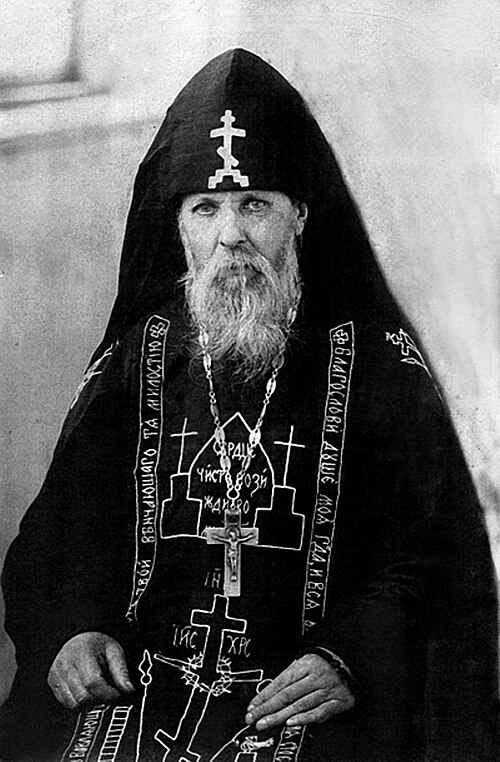
Venerable
Seraphim of Vyritsa
Elder of Vyritsa
Russian hieroschemamonk, elder and clairvoyant at Vyritsa, died in 1949 and canonized in 2000.
- Feast
- March 21old style April 3
- Reposed
- 194920th century
- Place
- Vyritsa
- Order
- Venerables
Life
Saint Seraphim of Vyritsa was a hieroschemamonk of the Russian Orthodox Church, a great elder and clairvoyant who is widely venerated throughout the Orthodox world. He was born in 1866 in a village of the Yaroslavl region, became a wealthy merchant in Saint Petersburg, embraced monastic life after the revolution and reposed in 1949 at Vyritsa near Leningrad. The Church remembers him for his life of prayer and self-sacrifice, for the multitudes he comforted, and for his unceasing prayer for Russia during the war years.
Childhood and years in trade
He was born on 31 March 1866 into a peasant family in the village of Vakhromeyevo, in the Rybinsk district of Yaroslavl province, and was baptized Basil. His parents were Nicholas Ivanovich and Chionia Alimpievna Muravyov.
When he was ten his father died, and soon afterwards his sister Olga. The boy had to go to Saint Petersburg to earn a living. According to some accounts, while still a child he learned from a schema-monk how his life would unfold.
Arriving in the capital in 1876, he became an errand boy in one of the shops of the Gostiny Dvor. Later he found a spiritual father in the elder Barnabas (Merkulov), a hieromonk of the Gethsemane Skete of the Holy Trinity-Saint Sergius Lavra.
In 1882 he became a shop assistant, and in 1892 he opened his own business, becoming a major fur merchant of the second guild. He set up a firm for buying and selling furs, and much of his goods went abroad, to Germany, Austria-Hungary, England, France and other countries. His yearly income averaged about 90,000 roubles, and his biographers agree that even as a businessman he lived a thoroughly righteous life.
He married Olga Ivanovna Netronina in 1890 (other sources say 1894). From 1895 he was a full member of the Society for the Spread of Commercial Knowledge in Russia and attended its higher commercial courses, and from 1905 he belonged to the Yaroslavl Charitable Society.
In 1906 he bought a large two-storey summer house at Tyarlevo, between Tsarskoye Selo and Pavlovsk, which until 1920 was the family's main home, since staying in the capital had become dangerous.
The couple had two children, Nicholas and Olga. Their daughter died in infancy. Their son Nicholas, born in 1895, became a Catholic in 1914 and led a troubled life. He visited his father at Vyritsa in 1934, and on the eve of the war he was arrested, accused of espionage and shot at Sverdlovsk on 4 September 1941.
Monastic life
On 13 September 1920 Basil Muravyov petitioned the spiritual council of the Alexander Nevsky Lavra to be received into the brotherhood. He was accepted as a novice and given the obedience of sacristan. The vicar of the Lavra at that time was Archimandrite Nicholas (Yarushevich).
At the same time his wife Olga became a novice at the Resurrection Novodevichy Convent in Petrograd, taking the name Christina. The couple gave everything they had to the monasteries, and to the Lavra alone Basil gave 40,000 roubles in gold coin.
On 29 October 1920 he was tonsured a monk with the name Barnabas, the name of his spiritual father. On 11 September 1921 Saint Benjamin (Kazansky), Metropolitan of Petrograd, ordained him a hieromonk.
At the end of 1926 Father Barnabas received the great schema with the name Seraphim, in honour of Saint Seraphim of Sarov, and became the confessor of the Lavra. Many people came to him for confession and counsel.
Illness weighed on him more and more. He suffered from rheumatism, blocked veins in his legs and intercostal neuralgia. Probably in the spring of 1930, on the advice of doctors and with the blessing of Saint Seraphim (Chichagov), he left his cell in the Lavra and moved to Popovka, to the summer house of Archpriest Leonid Bogoyavlensky, rector of the Trinity-Izmailovsky Cathedral. He lived there for about two years in a small cell-like cottage at the far end of the garden.
Elder at Vyritsa
In 1933 he moved to the settlement of Vyritsa, where he lived for the rest of his life. His illnesses caused him almost unbearable suffering, especially in his legs, but he bore them with courage. His former wife, who was living as a nun, came to live with him, and she reposed in 1945. From 1935 the nun Joanna (Vera Shikhobalova) helped them in the house.
Soon streams of pilgrims began to come to the elder from Vyritsa, from Leningrad and from other cities, seeking comfort, blessing and advice. Despite his illness Father Seraphim laboured in prayer, fasting and vigil. On Mondays, Wednesdays and Fridays he took no food at all, and sometimes he ate nothing for several days at a time.
In the garden of the house at 7 Pilny Prospekt lay a granite boulder. On this stone, before an icon of Saint Seraphim of Sarov fastened to an apple tree, the elder prayed for years. Tradition says that his prayer lasted a thousand days and a thousand nights, after the example of his patron of Sarov.
In August 1941, in the first days of the German occupation, the church of the Kazan Icon of the Mother of God was opened at Vyritsa, and Hieroschemamonk Seraphim was one of its parishioners. He went on living in the Tomberg family's house, where he received visitors.
During the war he continued his labour on the stone in the garden, praying for the deliverance of Russia from her enemies, sometimes for hours at a time. He was led or carried to the place of prayer every day and in any weather. It is also told that he prayed before the icon known as "I Am With You and No One Is Against You", painted by the nuns of Leushino with the blessing of Saint John of Kronstadt.
In 1945 he lived briefly in the Smirnov house and then moved to the house of L. G. Yefimova at 39 Maisky Prospekt, where he rented several rooms until his death. At the end of his life he was cared for by his cell attendant Seraphima.
Shortly before his death he received a delegation of Leningrad seminarians, among them the young Alexei Ridiger, to whom he foretold that he would become patriarch. Ridiger later became Patriarch Alexy II.
Teachings and sayings
When someone was seriously ill, he gave a blessing to take a tablespoon of holy water every hour and to sprinkle food with it. He said there was no stronger medicine than holy water and blessed oil, and he advised sprinkling food with Theophany water, which, he said, sanctifies everything.
He wrote no books. A few poems have come down from him, together with the text known as "It Was From Me", signed by the elder, in which God speaks to the soul and shows that everything in a person's life, joys and sorrows alike, comes from His providence.
His spiritual children also wrote down many of his sayings about times to come. Among them is the warning that a time would come when not persecution but money and the lures of this world would turn people away from God, and the promise of a spiritual flowering of Russia with churches and monasteries reopened. He also said that Vyritsa would become a place of pilgrimage.
Russian Orthodox clergy have urged restraint toward these sayings, however. Archpriest Maxim Kozlov recalled that only the prophecies of Holy Scripture are unconditional, and Father Georgy Murzin pointed out that such words have reached us at second or third hand and should not be received lightly.
Repose
On the last day of his life, according to those close to him, he was granted a vision of the Most Holy Theotokos, who in radiant light pointed toward heaven with her right hand. The elder read the akathist to the Mother of God, received Communion from Father Alexis and prayed that the Lord would save and have mercy on the whole world.
He reposed on 21 March (3 April, New Style) 1949, the fourth Sunday of Great Lent, when Saint John of the Ladder is commemorated.
Glorification and veneration
Long before his canonization, photographs of the elder and the text "It Was From Me" circulated among believers, even in his native region. Bishop Benjamin of Rybinsk recalled that for a long time he had not known that the revered elder of Vyritsa came from the Rybinsk area.
In August 2000 the Council of Bishops of the Russian Orthodox Church glorified him among the venerable saints, in the Synaxis of the New Martyrs and Confessors of Russia. The rite of glorification in the diocese of Saint Petersburg was celebrated on 1 October 2000 in the Kazan church at Vyritsa by Metropolitan Vladimir (Kotlyarov), with Archbishop Proclus of Simbirsk and about thirty clergy.
In the same year a wooden chapel was built over his grave. Beside him rests his former wife, the schema-nun Seraphima.
In 2005 and 2006 crosses were set up at the site of the former village of Vakhromeyevo, where the Muravyov house had stood. In 2016 a memorial plaque was placed on the house in Saint Petersburg where he lived from 1914 to 1917, and in 2022 a monument to him was blessed in the great courtyard of the Gostiny Dvor, where he had begun work as a boy.
His grave at Vyritsa is now a place of pilgrimage for believers from all over the Orthodox world. Saint Seraphim of Vyritsa is commemorated on 3 April (21 March, Old Style).
Commemorated the same day March 21
 Serapion of ThmuisSaint · Bishop of ThmuisMar 21
 Thomas I of ConstantinopleSaint · Patriarch of ConstantinopleMar 21
 Enda of AranVenerable · Abbot on AranMar 21
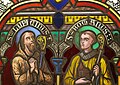 Lupicinus of CondatVenerable · Abbot in the Jura MountainsMar 21
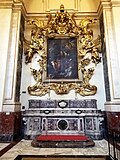 Berillus of CataniaSaint · First bishop of CataniaMar 21
- Vladimir VvedenskyHieromartyr · PriestMar 21
- Amator of AlexandriaSaintMar 21
- Domninus of RomeMartyrMar 21
- GeorgeNew MartyrMar 21
- James the ConfessorVenerable · Confessor of SicilyMar 21
- Justinian of ValenciaSaint · Bishop of ValenciaMar 21
- Luicheall son of CiaranSaintMar 21