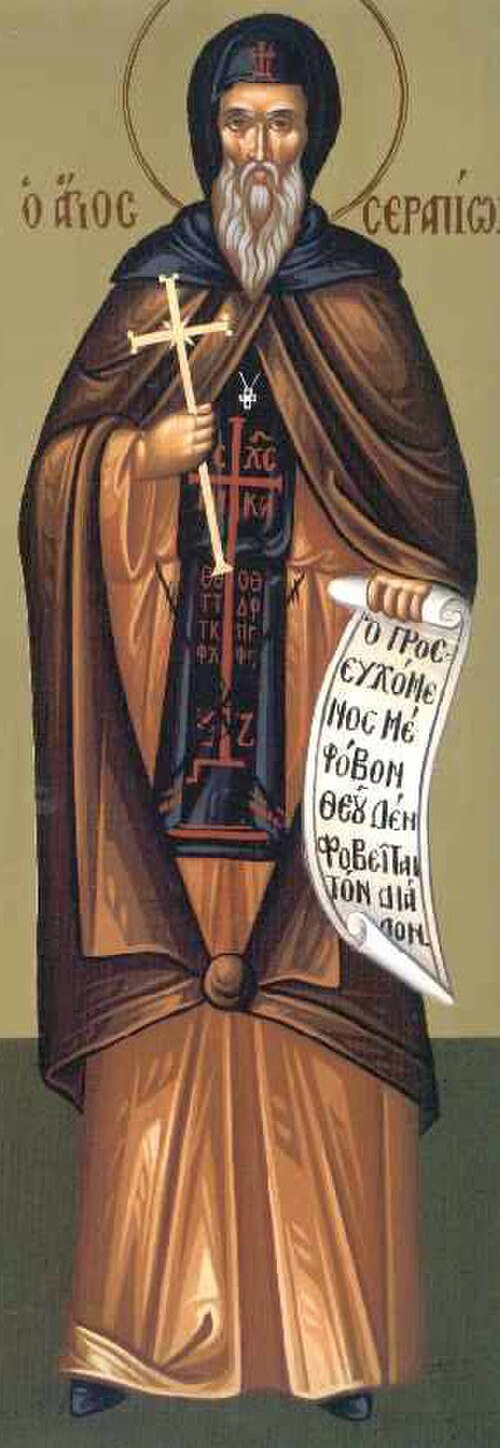
Saint
Serapion of Thmuis
Bishop of Thmuis
Monk and bishop of Thmuis in Lower Egypt, a church writer of the fourth century.
Life
Saint Serapion of Thmuis was a monk and bishop of Thmuis in Lower Egypt, a church writer of the fourth century. He was a comrade in arms of Saint Athanasius the Great against Arianism. He is commemorated as a confessor on 21 March.
The monk
Before becoming a monk, he studied at Alexandria. He became abbot of the monasteries of Arsinoe, which at one time held as many as eleven thousand monks. The historians Sozomen and Palladius called him the Great. He was a companion and disciple of Saint Anthony the Great, who at his deathbed left him one of his two sheepskin cloaks, the other going to Athanasius. In the Sayings of the Desert Fathers he is quoted in four places, as Abba Serapion, and Evagrius Ponticus gave him the name Angel of the Church of Thmuis.
A story in the Sayings tells that he paid a fallen woman but, instead of sinning, prayed all night before her and brought her to the faith, so that she became a nun in a monastery, living in great ascetic labours.
The bishop
Later he was ordained bishop of Thmuis, a see he kept to the end. Jerome said in his work On Illustrious Men that he was called the Scholastic, for his learning. He was one of the most faithful helpers of Athanasius in the struggle against the Arians in Alexandria, and he took care of Athanasius's see during one of his exiles. He took part in the council of Serdica, in 343. In 355 or 356 (according to one source, 353) Athanasius sent him at the head of a delegation to the emperor Constantius II to rebut the charges of the Arians. At his request Athanasius wrote him four dogmatic letters, one on the Son of God and three on the Holy Spirit, regarded as among the earliest Christian texts devoted exclusively to the Holy Spirit. At that time, between 358 and 362, he also sent him a letter on the death of Arius. In 359 (according to some sources earlier, in 350) the Arian George, rival patriarch of Alexandria, drove him from his see and sent him into exile. This lies at the basis of his veneration as a confessor. He died after 362, according to one Serbian source about 366.
His writings
Little of his work has survived. Jerome mentioned a treatise against the Manichaeans, commentaries on the Psalms and several letters. The treatise on the Psalms is lost. There remain the treatise on the Manichaeans, a letter to Bishop Eudoxius, a letter to the monks of Alexandria on the worth of the monastic life and the letter on the Father and the Son. The most precious is the Euchologion, with thirty prayers for the Eucharist, baptism, ordination, anointing with oil and burial. The Euchologion was discovered for world scholarship in 1894 by the Russian professor A. Dmitrievsky, in a tenth-century manuscript in the library of the Great Lavra on Athos. It was later published again, in 1898, by Wobbermin.
He is said to have said: do not think illness is heavy, only sin is heavy, for illness follows us only as far as the grave, while sin follows the sinner beyond the grave.
Veneration
The Orthodox Church commemorates him on 21 March, and some sources also give 7 March and 7 February. He is also commemorated as a confessor in the Roman Martyrology on 21 March.
Commemorated the same day March 21
 Thomas I of ConstantinopleSaint · Patriarch of ConstantinopleMar 21
 Enda of AranVenerable · Abbot on AranMar 21
 Lupicinus of CondatVenerable · Abbot in the Jura MountainsMar 21
 Seraphim of VyritsaVenerable · Elder of VyritsaMar 21
 Berillus of CataniaSaint · First bishop of CataniaMar 21
- Vladimir VvedenskyHieromartyr · PriestMar 21
- Amator of AlexandriaSaintMar 21
- Domninus of RomeMartyrMar 21
- GeorgeNew MartyrMar 21
- James the ConfessorVenerable · Confessor of SicilyMar 21
- Justinian of ValenciaSaint · Bishop of ValenciaMar 21
- Luicheall son of CiaranSaintMar 21