Saint
Simeon Milyukov
Metropolitan of Smolensk
Metropolitan of Smolensk and Dorogobuzh, who died on 4 January 1699.
Life
Saint Simeon Milyukov was metropolitan of Smolensk and Dorogobuzh, who died on 4 January 1699. He is venerated in the Russian Church as a hierarch and is commemorated on 4 January and on 10 June, in the Synaxis of the Siberian Saints (by the Julian calendar). Our sources do not give the date of his canonization.
Beginnings
He was born into a merchant family in Tobolsk and bore in the world the surname Milyukov or Molyukov. No information has been found about his birth date or youth. It is supposed that he was educated in one of the monasteries which were then the centres of learning in Siberia. It is not known in which monastery he received the monastic habit. According to the church historian Bishop Ambrose (Ornatsky), he was archimandrite of the Boris and Gleb Monastery in Rostov; according to documents, in the years 1672 to 1674 he was archimandrite of the Caves Ascension Monastery in Nizhny Novgorod.
On 14 September 1674 he was summoned to Moscow and appointed abbot of the Spaso-Andronikov Monastery. He drew the attention of Tsar Alexis Mikhailovich, and on 9 April 1676 he was ordained, in the Dormition Cathedral of the Kremlin, bishop of Smolensk and Dorogobuzh, with elevation to the rank of archbishop.
Ministry at Smolensk
The Smolensk region had long been under Polish rule; from 1639 Orthodox worship had ceased and all churches had been given to Catholics or Uniates. Arriving in the diocese, Simeon renewed the services in the churches that remained and began the building of a new cathedral, completed long after his death, in 1772. He was often in Moscow on church business and enjoyed the tsar's favour. In 1678 he took part in a council on questions of rites, which removed from the ranks of the saints the schemanun and blessed Princess Anna of Kashin. In 1681 he took part in the burial of the monk Nikon, who had fallen from the patriarchate and the priesthood, carried out by episcopal rite under Metropolitan Cornelius, because Patriarch Joachim had refused to bury him as a bishop and to commemorate him as a patriarch; after the burial he received from the tsar a costly mitre from the treasury of the former patriarch. On 1 September of the same year he was raised to the rank of metropolitan, the first of the Smolensk bishops so styled, and on 30 September he consecrated, in the presence of the tsar, the cathedral church of the Dormition of the Mother of God in Florishcheva Hermitage.
At the end of 1681 he was among the participants of a council in Moscow who asked the tsar for severe penalties against the Old Believers. In 1682 he took part in the consecration of Saint Mitrofan of Voronezh.
Trials and end
The tsar's favour and Simeon's rise aroused the displeasure of Patriarch Joachim. After the death of Tsar Alexis, intrigues began against the metropolitan. In 1686 Simeon did not wait for the coronation of the tsareviches Ivan and Peter and, after the burial of Tsar Feodor Alexeevich, left the capital at once; this was used to deprive him of the rank of metropolitan and send him to the Trinity Lavra of Saint Sergius. After two years, by a decree of the patriarch, he was returned to his see in the same rank.
In 1696, being ill, he asked to retire, but the search for a successor dragged on, and he died on 4 January 1699 on his see. He was buried at the Trinity monastery; in the 1930s his remains were moved to the city cemetery, and on 7 March 1996 they were solemnly reburied in the crypt of the Dormition Cathedral of Smolensk.
Commemorated the same day January 4
 ApollosApostle · Apostle of the SeventyJan 4
 Symeon of JerusalemHieromartyr · Bishop of JerusalemJan 4
 EpaphroditusApostle · Envoy of the Church of PhilippiJan 4
 CleopasApostle · Disciple on the road to EmmausJan 4
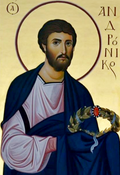 Andronicus of PannoniaApostle · Bishop of PannoniaJan 4
 EpaphrasApostle · Companion of the Apostle PaulJan 4
 EvodiusApostle · Bishop of AntiochJan 4
 Apelles of SmyrnaApostle · Bishop of HeracleaJan 4
 AchaicusApostle · Of CorinthJan 4
 AmpliatusApostle · Greeted by the Apostle PaulJan 4
 Crispus of CorinthApostle · Bishop of ChalcedonJan 4
 Quartus of BerytusApostle · Bishop of BeirutJan 4