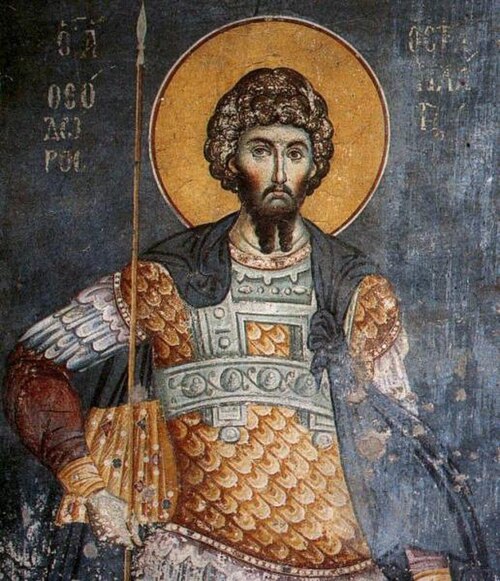
Great Martyr
Theodore Stratelates
The General of Heraclea
Roman general of Heraclea Pontica, great martyr, put to death around the year 319.
- Feast
- February 8old style February 21
- Reposed
- 3194th century
- Place
- Heraclea Pontica
- Order
- Great Martyrs
Life
Saint Theodore Stratelates, great martyr, was a Roman general of Heraclea Pontica, put to death for his faith in Christ in the time of Emperor Licinius, on 8 February 319. He is regarded as protector of the Christian army and is commemorated on 8 February, and the translation of his relics is celebrated on 8 June.
Life Theodore was of Greek descent and was born in the city of Euchaita in Asia Minor, according to the Life. In the longer version of the Life it is told that he killed a giant serpent that terrorized the countryside, armed with a sword, and so became known for his courage. He became stratelates, that is general, at Heraclea, a city by the Black Sea. By his pure life and gentle conduct he won the love of the inhabitants, and many pagans came to believe in Christ on seeing him.
When Licinius, co-emperor with Constantine, began to persecute the Christians, he heard of Theodore and summoned him to sacrifice to the gods. Theodore answered wisely, asking him to come to Heraclea and bring the idols with him, so that they might honour them before the people. The emperor came, and Theodore asked that all the gold and silver idols of the city be brought to him. In the night he smashed them and gave the pieces to the poor.
Martyrdom Licinius, enraged, ordered him tortured: he was beaten with ox sinews and leaden rods, burned with fire, scraped with sharp potsherds, then crucified and shot with arrows, and his eyes were put out. Throughout, according to tradition, he kept saying, Glory to Thee, my God. In the night an angel appeared to him, took him down from the cross and healed him completely. In the morning the servants sent to throw the body into the sea found him in health and believed in Christ, and many others believed on seeing the miracle. Theodore did not wish to flee a martyr's death: he presented himself of his own will before Licinius and was beheaded, on 8 February 319, on a Saturday, at the third hour. His sufferings were described by his servant Varus (Uarus), a witness of it all.
Theodore had told Varus to lay his body at Euchaita, on his ancestral estate. The relics were brought to Euchaita from Heraclea and later, according to tradition, to Constantinople, to the church of Blachernae. Saint Anastasius of Sinai tells that in a church of Saint Theodore near Damascus a Saracen shot an arrow at the painted image of the saint, and blood flowed from the painting; soon after, the whole group of Saracens died. Anastasius says he saw that church himself and the traces of blood.
Veneration His veneration spread widely in the Middle Ages, as patron of soldiers, and before the relics of Saint Mark reached Venice, Theodore was patron saint of the city. Much was also written about him in ancient Russian literature, and Saint Demetrius of Rostov united the versions of the Life in his book. There is an old confusion between Theodore Stratelates and Saint Theodore the Recruit of Amasea: the stories about them later diverged into two traditions, and Western scholars often hold that there was only one Theodore. The Orthodox Church commemorates both, on different days, and depicts them differently: the first with a beard divided in two points. He is commemorated on 8 February.
Commemorated the same day February 8
 ZechariahProphet · The ProphetFeb 8
 Sava II of SerbiaSaint · Archbishop of SerbiaFeb 8
Juventius of PaviaSaint · Bishop of PaviaFeb 8
 CointhaMartyr · Martyr of AlexandriaFeb 8
 Honoratus of MilanSaint · Archbishop of MilanFeb 8
- Alexander AbissovHieromartyr · PriestFeb 8
- Victor of NaplesSaint · Bishop of NaplesFeb 8
- Lyubov of RyazanFool-for-ChristFeb 8
- TheogniusVenerable · Monk in PalestineFeb 8
- Andrew DobryninHieromartyrFeb 8
- AnthusaSaintFeb 8
- CeraVenerableFeb 8