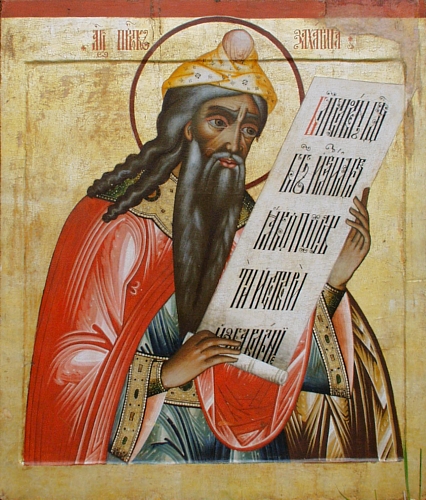
Prophet
Zechariah
The Prophet
One of the twelve minor prophets, author of the book that bears his name, after the Babylonian exile.
- Feast
- February 8old style February 21
- Reposed
- 52 BC0th century BC
- Order
- Prophets
Life
The Holy Prophet Zechariah is the eleventh of the twelve minor prophets of the Old Testament, also called the Sickle-Seer. He prophesied after the return of the people from the Babylonian exile, in the time of Darius, king of the Persians, and his book contains many announcements about the Messiah and about the last days of the Saviour's life on earth. The Church commemorates him on 8 February.
Family and time
His book calls Zechariah the son of Berechiah, the son of Iddo (Zechariah 1:1), while the book of Ezra calls him the son of Iddo, that is, the grandson, according to a custom of Scripture. He is not to be confused with Iddo the seer of the time of Solomon. He descended from the tribe of Levi and seems to have been a priest (Nehemiah 12:4 and 16). The Romanian synaxarion says that he was the son of Berechiah, born in Gilead and came from the land of the Chaldeans as an old man, while other Orthodox sources say that he was called to prophetic service while young. The two reports show that tradition is not of one voice.
His prophetic work began in the second year of Darius the Great, in 520 before Christ, in the eighth month (Zechariah 1:1). He was a contemporary of the prophet Haggai and of Zerubbabel (Ezra 5:1). His greatest concern was the building of the second temple. The book shows the prophet in the first eight chapters, and in chapters 9 to 14 he no longer appears.
Visions of the night
Zechariah saw, in one night, a man on a red horse among the myrtle trees, and the angels of the Lord who had walked to and fro through the earth. He saw then four horns, a man with a measuring line in his hand for Jerusalem, the high priest Joshua in filthy garments, cleansed by the angel, the golden lampstand with seven lamps and two olive trees, and a flying scroll. The flying scroll, in the form of a sickle cutting through the air, gave him the name of Sickle-Seer, because it showed the punishment of those who steal and swear falsely (Zechariah 5:1 to 3).
The hymns of the Church call him a spectator of supra-worldly visions, and the synaxaria say that, enlightened by dawnings from above, he saw the future as if it were present.
Announcements about Christ
The Lord promises through him a Branch, which the Fathers have interpreted as Christ, and in Greek the Branch is Anatole, the Dayspring, a name the Church sings in the hymns of the Nativity (Zechariah 6:12). The book of Zechariah is among the richest in messianic announcements. It speaks of the humble King who enters Jerusalem on a donkey: Rejoice greatly, O daughter of Zion; behold, your King is coming to you, righteous and having salvation, lowly and riding on a donkey (9:9), words the Gospel recalls at the Lord's entry into Jerusalem, on Palm Sunday.
It speaks of the thirty pieces of silver thrown into the house of the Lord for the potter (11:12 and 13) and of the buying of the potter's field, which the Gospel of Matthew links, under the name of Jeremiah, with the betrayal of the Lord. It speaks of His piercing: They shall look on Him whom they have pierced (12:10), words quoted in the Gospel of John, and of the scattering of the disciples from Gethsemane (13:7). The book also mentions the darkening of the sun at the hour of the Crucifixion (14:6 and 7), according to the interpretation of the synaxaria.
His end and relics
According to tradition, Zechariah reached a great age and was buried near Jerusalem, beside his illustrious contemporary and companion, the prophet Haggai. His death is placed around 520 before Christ. His tomb was found in the year 415, in a village near Eleutheropolis, according to the historian Sozomen. At the prophet's feet lay the body of a child dressed in royal garments. His relics were moved to Constantinople, to the church of Saint James the Brother of the Lord.
The Orthodox Church commemorates the Holy Prophet Zechariah on 8 February. The Roman Catholic Church remembers him on 6 September, and the Armenian Church on 31 July, with the other minor prophets.
Commemorated the same day February 8
 Theodore StratelatesGreat Martyr · The General of HeracleaFeb 8
 Sava II of SerbiaSaint · Archbishop of SerbiaFeb 8
Juventius of PaviaSaint · Bishop of PaviaFeb 8
 CointhaMartyr · Martyr of AlexandriaFeb 8
 Honoratus of MilanSaint · Archbishop of MilanFeb 8
- Alexander AbissovHieromartyr · PriestFeb 8
- Victor of NaplesSaint · Bishop of NaplesFeb 8
- Lyubov of RyazanFool-for-ChristFeb 8
- TheogniusVenerable · Monk in PalestineFeb 8
- Andrew DobryninHieromartyrFeb 8
- AnthusaSaintFeb 8
- CeraVenerableFeb 8