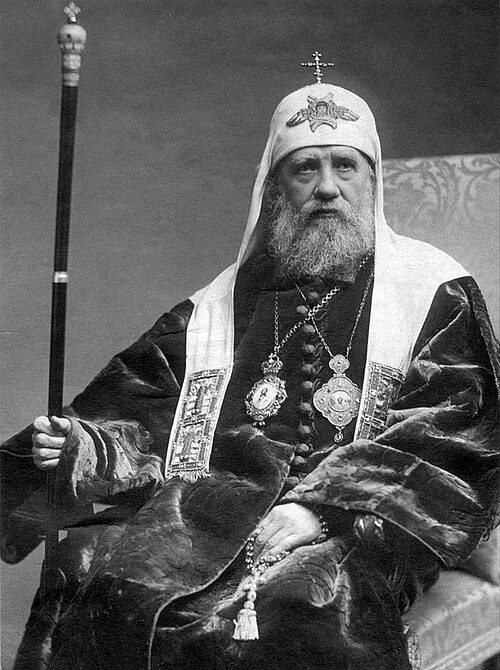
Saint
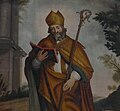
Tikhon of Moscow
Patriarch of Moscow
First patriarch of Moscow after the restoration of the patriarchate in 1917, who defended the Church under Soviet rule.
Life
The Holy Hierarch and Confessor Tikhon, in the world Vasily Ivanovich Bellavin, was the first patriarch of Moscow after the restoration of the patriarchate in Russia, in 1917, and shepherded the Russian Church in the hard years of Soviet rule. He was canonized as a confessor, in 1981 by the Russian Church Outside Russia and in 1989 by the Moscow Patriarchate. His repose is commemorated on 25 March, and other commemorations fall on 26 September and 5 November, in memory of his glorification and of his election as patriarch, old style.
Childhood and calling
He was born on 19 January (31 January, new style) 1865, in the village of Klin in the Toropets district, in the diocese of Pskov, in the family of the priest Ioann Timofeevich Bellavin. His three brothers died young, and his mother reposed in 1904. At nine he entered the church school at Toropets, and in 1878 the seminary at Pskov. In 1888, at twenty-three, he graduated from the Theological Academy of Saint Petersburg, still a layman. He then returned to Pskov, where he taught dogmatic and moral theology. In 1891, at twenty-six, he became a monk and took the name Tikhon, in honour of Saint Tikhon of Zadonsk.
Bishop in America
He was consecrated bishop of Lublin on 19 October 1897. On 14 September 1898 he was appointed bishop of the Aleutian Islands and Alaska and went to America, where he later became a naturalized citizen. He travelled through the emerging Orthodox communities, in New York, Chicago and the mining towns of Pennsylvania and Ohio. In 1900 he reorganized the diocese and named it the Diocese of the Aleutian Islands and North America. He had two auxiliary bishops, Innocent in Alaska and Saint Raphael Hawaweeny in Brooklyn. On 22 May 1901 he blessed the cornerstone of Saint Nicholas Cathedral in New York, and in 1902 he consecrated the church of Saint Nicholas in Brooklyn for Syrian Orthodox immigrants. In 1903 he consecrated the church of Saint Vladimir in Chicago. In 1905 he received the rank of archbishop, moved his residence to New York and blessed the founding of Saint Tikhon's Monastery in Pennsylvania.
The patriarch
In 1907 he returned to Russia as bishop of Yaroslavl, and in 1913 he passed to the see of Vilnius. During the war and the revolution, on 21 June 1917 he was elected bishop of Moscow, and on 14 August 1917 he was raised to metropolitan. The Local Council of the Russian Church, the first since the seventeenth century, decided to restore the patriarchate, after almost two hundred years of synodal rule. On 5 November 1917, old style, Tikhon was chosen the eleventh patriarch of Moscow and all Russia and was enthroned on 21 November (4 December) 1917. He governed the Church under the new atheist regime.
Trials
After the Bolsheviks came to power, the patriarch faced persecution. He escaped a failed attempt on his life, was imprisoned and ill-treated, but remained known for his confession of the faith, for his opposition to the totalitarian regime and for his guidance of Christians in those times. In 1922 he was arrested by the Soviet authorities and suspended from his see. He was released in 1923, under pressure from abroad.
Repose and veneration
He reposed in the Lord at Moscow, on 7 April 1925, that is, 25 March, old style. Some thought that he had been poisoned. The Bishops' Council of the Russian Church Outside Russia canonized him as a confessor on 1 November 1981, and the Bishops' Council of the Russian Church glorified him on 9 October 1989.
Commemorated the same day March 25
 IsaacRighteous · The PatriarchMar 25
 The Wise ThiefMartyr · The Thief on the CrossMar 25
- Savvas the New of KalymnosVenerable · Patron of KalymnosMar 25
- Aelfwold of SherborneSaint · Bishop of SherborneMar 25
- Barontius and DesideriusHoly VenerablesMar 25
- Columba daughter of BaoitSaintMar 25
- DulaMartyrMar 25
- Dulas of NicomediaMartyrMar 25
- Enan son of MuadanSaintMar 25
 HermelandVenerableMar 25
 Humbert of MaroillesVenerableMar 25
- KennochaVenerableMar 25