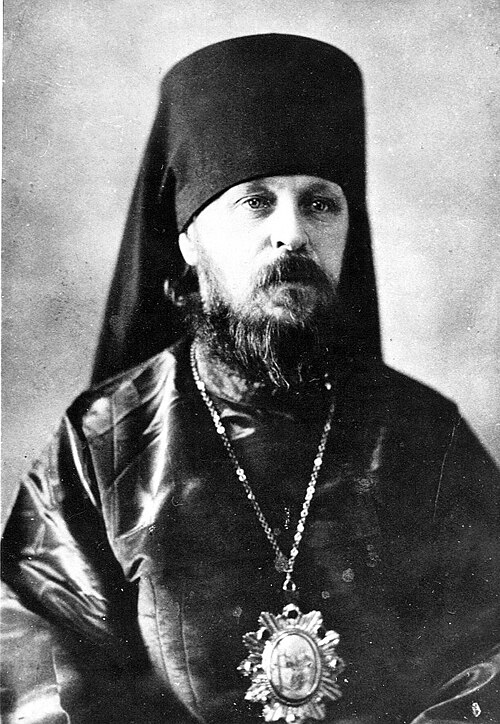
Confessor
Viktor Ostrovidov
Bishop of Izhevsk and Votkinsk
Bishop of Izhevsk and Votkinsk, a figure of the Josephite movement, born in 1875 and died in 1934; glorified as a confessor.
- Feast
- April 19old style May 2
- Reposed
- 193420th century
- Place
- Neritsa
- Order
- Confessors
Life
Saint Victor (Ostrovidov), Bishop of Izhevsk and Votkinsk, hieroconfessor, was a learned monk, missionary and Russian hierarch of the first half of the twentieth century who passed through prisons, exile and the Solovki camp and died in banishment in the village of Neritsa in the Russian north in 1934. He was one of the leading figures of the Josephite movement, which rejected the 1927 Declaration of loyalty to the Soviet state signed by Metropolitan Sergius (Stragorodsky), and within it he led a distinct current named after him, the Victorians.
He was glorified as a hieroconfessor by the Russian Orthodox Church Outside Russia in 1981 and by the Russian Orthodox Church in 2000. He is commemorated on 19 April (2 May), the day of his repose, and on 18 June (1 July), the day his relics were found.
Childhood and schooling
He was born on 20 May (1 June) 1875 in the village of Zolotoye in the Kamyshin district of the Saratov province and was baptised Konstantin. His father Alexander was a reader at the village church of the Holy Trinity, and his mother was named Anna. His brothers and sisters were Sergei, Maria, Alexander, Lydia, Venedikt and Nikolai.
He graduated from the Kamyshin theological school in 1893, the Saratov seminary in 1899 and the Kazan Theological Academy in 1903 with the degree of candidate of theology.
Monk and missionary
On 28 June 1903 he was tonsured a monk with the name Victor, and on 30 June he was ordained hieromonk and appointed superior of the Holy Trinity dependency of the Saratov Transfiguration monastery in the town of Khvalynsk. There he carried out missionary work among the Chuvash.
From 1905 to 1908 he served in the Russian Ecclesiastical Mission in Jerusalem, on which he later reported to the Kiev missionary congress of 1908. From January 1909 he was supervisor of the Arkhangelsk theological school, and from October of that year a hieromonk of the Alexander Nevsky Lavra in Saint Petersburg. On 22 November 1910 he was appointed superior of the Holy Trinity monastery at Zelenets, in the capital's diocese, with the rank of archimandrite. He received the pectoral cross in 1909 and the Order of Saint Anne, second class, in 1913.
He wrote several works: a study of man (1905), three lectures on the heroes of Maxim Gorky entitled Discontented People (1905), and an article, The New Theologians, published in 1912 under the pseudonym The Wanderer in an Old Believer journal. In it he criticised the teaching on salvation of Archimandrite Sergius (Stragorodsky), the future metropolitan, and of Archbishop Anthony (Khrapovitsky). He later wrote that he had warned them even then that their error would shake the Church, because they could not conceive of the Church without its outward organisation, and that he long felt their displeasure.
On 21 February 1918, in the first months of Bolshevik rule, he was appointed vicegerent of the Alexander Nevsky Lavra.
Bishop in the diocese of Vyatka
By decision of Saint Tikhon, Patriarch of Moscow, and the Holy Synod of 2/15 December 1919, the see of Urzhum was founded, and Archimandrite Victor was chosen to lead it. On 8 January 1920 he was consecrated Bishop of Urzhum, vicar of the diocese of Vyatka.
In 1919 and 1920 he was briefly arrested several times. In 1920 the Vyatka revolutionary tribunal sentenced him to prison until the end of the war with Poland on the charge of agitating against medicine: during a typhus epidemic he had urged his flock to pray more fervently for deliverance from the disease. He was released after five months. From 1920 he was Bishop of Slobodskoy, and from 14 September 1921 Bishop of Glazov, always as a vicar of the Vyatka diocese.
He firmly opposed the Renovationist movement. He begged his flock, and above all the clergy, not to follow the schismatic assembly that called itself the Living Church, which he called rather a dead body, and to have no communion with the graceless bishops and priests it ordained. On 21 July 1922 the Renovationist administration retired him, accusing him of a counter-revolutionary stance during the confiscation of church valuables.
Arrests and exile
On 12 (25) August 1922 he was arrested and taken to prison in Moscow. On 23 February 1923 he was sentenced to three years of exile, which he spent in a small village in the Narym region of the Tomsk province. From there he wrote letters of blessing to the faithful, published much later. In 1926 he returned to the Vyatka diocese.
On 14 May 1926 he was arrested for the fifth time, for allegedly organising an illegal diocesan chancery, and on 20 August 1926 he was sentenced to three years of banishment in Glazov, in the Votyak region. During his short stay in Moscow after leaving prison he met Metropolitan Sergius, deputy locum tenens of the patriarchal throne, and, in keeping with his place of exile, was appointed bishop of the new diocese of Izhevsk and Votkinsk, with the temporary administration of the Vyatka diocese. Metropolitan Sergius raised the Izhevsk vicariate to an independent diocese on 16 September 1926, chiefly to put an end to the church unrest there. On 1 October 1926, released from Butyrka prison, Bishop Victor arrived in Glazov, where he lived in a room beneath the bell tower of the Saint Nicholas cathedral.
Against the Declaration of 1927
Bishop Victor received Metropolitan Sergius's Declaration of 1927 with great sorrow. Soon there followed a decision to divide the diocese of Votkinsk among five neighbouring dioceses, and in July 1927 he himself was transferred to be Bishop of Shadrinsk, vicar of the Ekaterinburg diocese, with the right to administer it. In October 1927 he wrote to the metropolitan, criticising the Declaration and asking him not to abolish the see of Votkinsk.
On 16 December 1927 he informed him that he refused the appointment to Shadrinsk. In the letter he called the Declaration a mockery of their confession of God's truth and a renunciation of their own salvation, and in an accompanying letter to the faithful he called it a betrayal of the Truth and urged them to keep away from communion with its signatories unless they repented. That same month the administration of the Votkinsk diocese, with his approval, resolved to break off liturgical and canonical communion with Metropolitan Sergius and the bishops of like mind until they repented and renounced the Declaration.
After Bishop Onisim (Pylaev) was appointed to Izhevsk, the church administration in Glazov resolved on 22 December to remain under Bishop Victor, styling him Bishop of Glazov and Votkinsk, but he chose to keep the title of Izhevsk and Votkinsk until a diocesan congress could meet. On 23 December 1927 the Synod of Metropolitan Sergius suspended him from serving, but he did not recognise the decision. When Bishop Onisim suspended the clergy who had separated, Bishop Victor sent two telegrams to the Protection cathedral in Izhevsk ordering the break of communion with the metropolitan and refusal to obey the new bishop.
In early 1928 he began corresponding with the Josephites of Leningrad, and in March he composed a sharp Epistle to Pastors criticising the removal of arrested and exiled bishops from their sees.
Solovki
On 4 April 1928 he was arrested in Glazov, accused of spreading typewritten anti-Soviet writings, above all an epistle urging the faithful not to fear or obey the godless power but to suffer for the faith, as Saint Philip the Metropolitan and Saint John the Baptist had suffered of old. On 18 May 1928 he was sentenced to three years in the camps. Before leaving he entrusted his parishes to Bishop Dimitry (Lyubimov) of Gdov, who then led the Josephite movement.
From July 1928 he was held in the Solovki Special Purpose Camp, where he worked as a bookkeeper at a rope factory. He took part in the secret services celebrated by imprisoned bishops and priests, among them Bishops Nektary (Trezvinsky), Hilarion (Belsky) and Maxim (Zhizhilenko). The report that he was reconciled there with Metropolitan Sergius is not supported by the sources. In the spring of 1930 he was moved to the mainland, to Mai-Guba.
Those who knew him in the camp kept a bright memory of him. Professor I. M. Andreevsky recalled that he was small of stature, gentle and friendly to all, with a serene smile and shining eyes; he used to say that every person must be consoled with something, and he knew how to console everyone, with a kind word or a small gift. When the first steamer arrived in spring and he received many parcels from the mainland, he gave them all away, keeping almost nothing for himself.
The future academician Dmitry Likhachev, also a prisoner at Solovki, remembered that the Josephites were the majority there and that almost all the young believers were with them, largely because of Bishop Victor. He described him as a very learned man who nonetheless looked like a village priest: thin beard, rosy cheeks, blue eyes, always smiling, wearing over his cassock a woman's knitted cardigan sent by someone from his flock. A radiance of kindness and cheerfulness came from him, Likhachev said; he wanted to help everyone and could, because everyone loved him and trusted his word.
Last exile and repose
On 10 April 1931 his sentence was changed to three years of exile in the Northern Territory. Released from the camp on 11 July 1931, he was sent into exile at Onega and later lived in the village of Karavannaya near Ust-Tsilma. On 13 December 1932 he was arrested again, and on 10 May 1933 he was sentenced to a further three years of exile in the remote village of Neritsa in the same district. There he fell gravely ill with meningitis and reposed on 2 May 1934. He was buried in the village cemetery.
Glorification and relics
His name was included in the working list of the New Martyrs and Confessors of Russia prepared for the canonisation carried out by the Russian Church Outside Russia in 1981, although that canonisation was not made by name and the list was published only in the late 1990s.
On 1 July 1997, after sixty-three years in marshy ground, his relics were found incorrupt in the Neritsa cemetery. They were taken to Moscow, and on 2 December 1997 they were placed in the church of Saint Alexander Nevsky of a Holy Trinity convent. In August 2000 the Jubilee Council of Bishops of the Russian Orthodox Church numbered him among the New Martyrs and Confessors of Russia for veneration throughout the Church.
Since 2005 his relics have rested in the Transfiguration convent in Vyatka. A church in his honour has been built in the village of Votcha in the Komi Republic, and at Urzhum, his first episcopal see, a chapel was built in his honour with the blessing of Metropolitan Chrysanthos of Vyatka, marking ninety years since his arrival there and the beginning of his confession.
Commemorated the same day April 19
 ExpeditusMartyr · Centurion of MeliteneApr 19
 Alphege of CanterburyHieromartyr · Archbishop of CanterburyApr 19
 Tryphon of ConstantinopleSaint · Patriarch of ConstantinopleApr 19
 George the ConfessorSaint · Bishop of Antioch in PisidiaApr 19
 John PalaiolavritesVenerableApr 19
 Gerold of WalsertalVenerable · Hermit in VorarlbergApr 19
- Agathangelos of EsphigmenouNew Martyr · Monk of EsphigmenouApr 19
- Agathangelus of SmyrnaVenerable MartyrApr 19
- Antoninus of NicomediaMartyrApr 19
- AristonicusMartyrApr 19
- BassusMartyr · Martyr of AfricaApr 19
- CallimachusMartyrApr 19