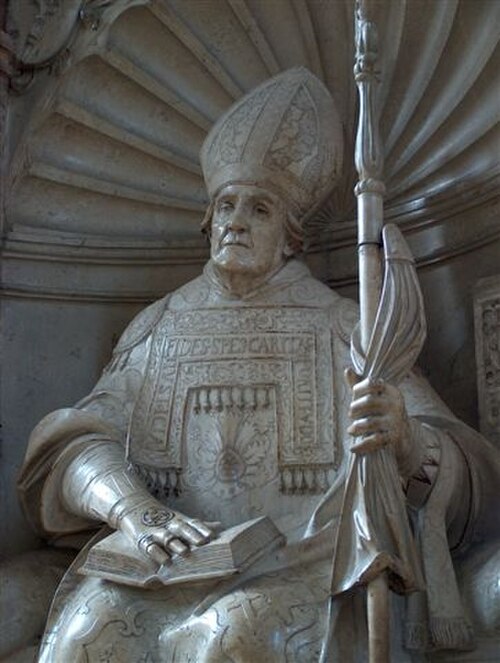
Saint
Willibald of Eichstätt
Bishop of Eichstätt
An English missionary, pilgrim to the Holy Land and first Bishop of Eichstätt, reposed in 787.
Life
Early life
Saint Willibald of Eichstätt was born in Wessex on 21 October around the year 700 and became the first bishop of Eichstätt in Bavaria. His father, Richard the Pilgrim, was a chieftain of Wessex, and his mother, Wuna, is said to have been a sister of Saint Boniface. His brother was Saint Winibald and his sister Saint Walburga. His life is known chiefly from the Hodoeporicon (Itinerary), written in the eighth century by Huneberc, an Anglo-Saxon nun of Heidenheim who knew him personally, from Willibald's dictation shortly before his death.
At three he fell gravely ill, and his parents, praying, vowed to give him to the monastic life if he were spared. The child lived, and at five he entered the Benedictine monastery of Waldheim, where Abbot Egwald brought him up.
In 721 he set out on pilgrimage to Rome with his father and brother. They passed through Rouen and reached Lucca, where the father fell ill and died. Willibald and Winibald went on to Rome, where they visited the Lateran and Saint Peter's; there both fell gravely ill but recovered. In 724 Willibald set out by sea to the East, by way of Sicily and Greece, and reached Asia Minor, at Ephesus, where he saw the tomb of Saint John the Evangelist. He then passed through Cyprus and Syria and, between 723 and 727, travelled through the Holy Land: Nazareth, Bethlehem, Egypt, Cana, Capernaum and Jerusalem, where he arrived on 11 November 725. He went to the Great Lavra of Saint Sabbas and to many other places. He was the first known Englishman to visit the Holy Land.
On the way back he stayed almost two years in Constantinople, in a cell near the church of the Holy Apostles, and visited Nicaea. He then sailed for Sicily and reached Naples about seven years after he had left Italy.
Willibald joined the Benedictine community of Monte Cassino, where he remained over ten years (about 729 to 739) and served as sacristan, dean and porter, telling the community of his journeys. In 738 Boniface asked Pope Gregory III to send him to help in the mission in Germany. At Eichstätt he was ordained priest by Boniface on 22 July 741. In 742 he founded with Winibald the double monastery of Heidenheim, where Winibald was the first abbot and, after his death, Walburga became the first abbess. In 746 Boniface consecrated him bishop of Eichstätt. Here his missionary labours bore their greatest fruit. He shepherded the diocese for more than four decades, living in the monastery and receiving guests from all over Europe who came to hear of his journeys and of his monastic life.
He reposed around 787. His shrine is in Eichstätt Cathedral, where his body and the relics brought from his travels are kept. The Catholic Church keeps his feast on 7 July, and the Orthodox calendar commemorates him on 7 June, as a saint of the West before the Great Schism (a saint of the undivided Church), by the New Calendar.
Commemorated the same day June 7
 Marcellinus of RomeSaint · Bishop of RomeJun 7
 Cyriacus of RomeHieromartyr · Deacon of RomeJun 7
 Andronik of PermHieromartyr · Archbishop of PermJun 7
 Joannicius RudnevSaint · Metropolitan of Kiev and GaliciaJun 7
 Daniel of ScetisVenerableJun 7
 Paisios BasiasVenerableJun 7
- Benjamin LukaninHieromartyr · PriestJun 7
- Abramius of KozheozeroVenerableJun 7
- Alexander MakhetovHieromartyrJun 7
- Alexander OsetrovHieromartyrJun 7
- Alexander PreobrazhenskyHieromartyrJun 7
- Alexander ZuevMartyrJun 7