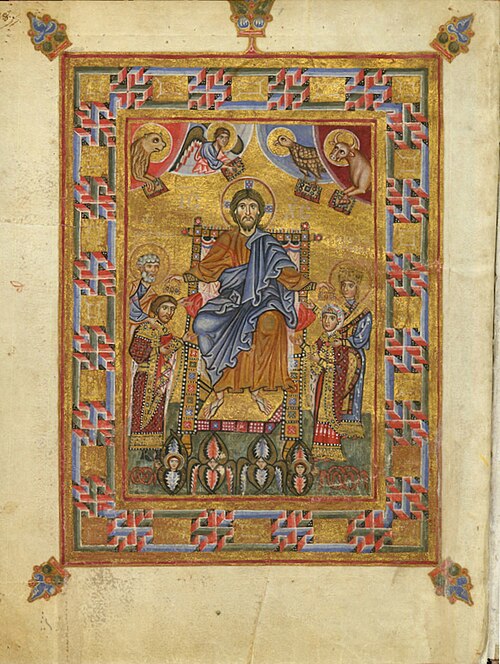
Right-Believing
Yaropolk Iziaslavich
Prince of Turov
Prince of Turov and Volhynia from 1078 until his death in 1086, son of Grand Prince Iziaslav I of Kiev.
- Feast
- November 22old style December 5
- Reposed
- 108611th century
- Place
- Zvenyhorod
Life
The Holy Right-Believing Prince Yaropolk Iziaslavich, in baptism Peter, was prince of Turov and Volhynia from 1078 until his death, in 1086 or 1087. He was treacherously killed on the way to Zvenigorod. The Russian Church honours him as a saint, commemorating him on 22 November (5 December, new style).
He was born around 1043, the son of the grand prince of Kiev, Iziaslav Yaroslavich, and the Polish princess Gertruda, daughter of King Mieszko II, and grandson of Yaroslav the Wise. In 1073, when Iziaslav was driven out of Kiev by his brothers Sviatoslav and Vsevolod, Yaropolk went with his father to the West. The German king Henry IV refused to help them, and they went to Pope Gregory VII, who supported them and received them as vassals. Documents of Yaropolk's audience with the pope are preserved in the Trier Psalter, which also contains a miniature portrait of Yaropolk and his wife Irina (Kunigunde). By the papal bull of 17 April 1075, power at Kiev was to remain with Iziaslav and his son Yaropolk, but the plan to change the order of succession was not carried out. In 1076 Yaropolk returned with his father to Kiev and received Vyshgorod. In 1078, in the fight against the Sviatoslavichi, his father died; the new grand prince, Vsevolod, gave Yaropolk Volhynia (centred on Volodymyr-Volynskyi) and Turov.
During his reign he had to fight constantly with the exiled Rostislavichi, who wanted to obtain a holding, and he was in conflict with Vsevolod and his son Vladimir Monomakh. In 1084 the Rostislavichi drove him out of Volodymyr; Monomakh returned the town to him, but gave Dorogobuzh to another exile, David Igorevich, and Yaropolk came to lose Volodymyr. In 1086, with support from Poland, he made peace with Monomakh and took his seat again at Volodymyr-Volynskyi, but the same winter, marching against the Rostislavichi, he was killed by treachery near Zvenigorod by a retainer of his, Neradets. He was buried in the monastery of Saint Demetrius at Kiev. Neradets fled to Rurik Rostislavich, and rumour laid the blame on the Rostislavichi. The Russian chronicles remember him as very pious and generous to the Church. He was married to Kunigunde of Orlamünde, daughter of Count Otto I of Weimar, and left two sons, Yaroslav and Vyacheslav, and a daughter, Anastasia, married in 1090 to Gleb of Minsk.
Commemorated the same day November 22
 CeciliaMartyr · of RomeNov 22
 Michael of TverPassion-Bearer · Grand Prince of VladimirNov 22
- Callistus II XanthopoulosSaint · Patriarch of ConstantinopleNov 22
 ApphiaApostle · Martyr of ColossaeNov 22
 Pragmatius of AutunSaint · Bishop of AutunNov 22
 Alexei BenemanskyHieromartyr · ArchpriestNov 22
- Benignus of MilanSaint · Archbishop of MilanNov 22
 Michael the SoldierRighteousNov 22
- Iakovos Tsalikis of EviaVenerable · Abbot of the Monastery of Saint DavidNov 22
- Procopius the ReaderMartyr · Martyr of Caesarea in PalestineNov 22
- MenignusMartyrNov 22
- AbbasVenerableNov 22