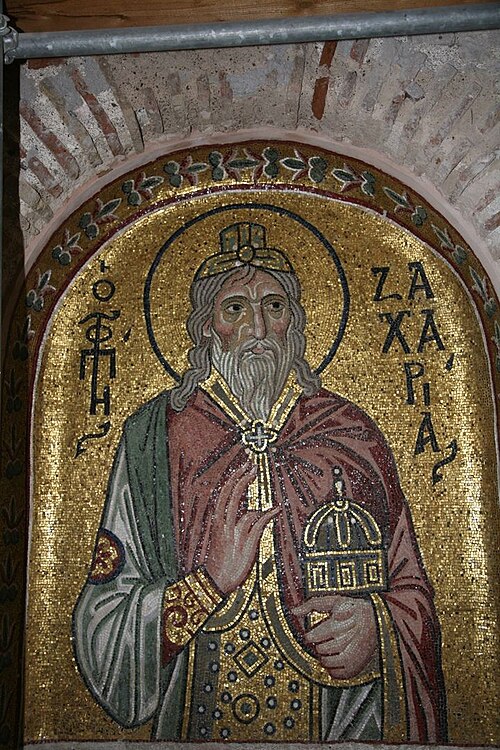
Prophet
Zechariah
Father of John the Baptist
Priest in Jerusalem, husband of Elizabeth and father of the Forerunner John the Baptist.
- Feast
- September 5old style September 18
- Born
- 100 BC1st century
- Place
- Jerusalem
- Order
- Prophets
Life
The Holy Prophet and Priest Zechariah was a priest in Jerusalem in the days of King Herod, the husband of the righteous Elizabeth and the father of Saint John the Baptist, the Forerunner of the Lord. He must not be confused with the Old Testament prophet Zechariah, author of the book that bears the name. We know his life mainly from the Gospel of Luke. The Church keeps his memory on 5 September, together with Elizabeth, and the Greek Church also commemorates them on 24 June, with the Nativity of Saint John the Baptist.
The childless priest
The Gospel of Luke tells that in the days of King Herod there lived a priest named Zechariah, of the course of Abijah, and his wife Elizabeth was also of the line of Aaron. Both were righteous before God and walked blamelessly in all the commandments and ordinances of the Lord. They had no children, because Elizabeth was barren and both were advanced in years, which was then regarded as a punishment. The synaxarion calls Zechariah the son of Barachiah, and Elizabeth a relative of the Virgin Mary (Luke 1:36); the Russian synaxarion and the OCA say she was the sister of Saint Anna, mother of the Theotokos.
The Gospel speaks of a town in the hill country of Judah. Tradition links them to the village of Ein Kerem, a few kilometres west of Jerusalem, where a monastery of Saint John the Baptist is shown on the place of his birth. The Gospel says nothing about the place of Zechariah's death or tomb.
The angel's announcement
Service at the temple was divided among the priestly courses descended from those appointed by King David. In the week of Zechariah's course the lot fell to him to offer the incense. While he served at the altar of incense, an angel of the Lord appeared and told him that his wife would bear a son, to be named John, who would be great before the Lord and go before Him in the spirit and power of Elijah. Thinking of their age, Zechariah asked for a sign. The angel, who named himself Gabriel, said that because he had not believed he would be mute until the day these words were fulfilled. Coming out to the people waiting before the temple, he could not give the blessing.
Elizabeth conceived, and in her sixth month the Virgin Mary came to her and stayed almost three months. On the eighth day, at the circumcision, the relatives wanted to name the child after his father, but Elizabeth said he would be called John, and Zechariah wrote the same name on a tablet. Then his tongue was loosed and, filled with the Holy Spirit, he blessed the Lord God of Israel (Luke 1:57-79).
The song of Zechariah
The song of Zechariah, called the Benedictus, announces the salvation of the people and the horn of salvation raised in the house of David. To his son he says that he will be called the prophet of the Most High and will go before the face of the Lord to prepare His ways. The Church sings it at Matins as the ninth ode of the canon, beside the song of the Theotokos. Luke adds that the child grew and became strong in spirit and was in the wilderness until the day of his showing to Israel.
His death
The Gospel does not tell of Zechariah's death. Tradition, resting on the Gospel of James (the Protoevangelium), a work of the second century, says that at the slaughter of the infants of Bethlehem Herod also sought John. The synaxarion says that Elizabeth hid with the child in the hills and, seeing her pursuers, prayed with tears, and the mountain opened and hid her. The soldiers sent by Herod looked for Zechariah, who was serving in the temple, but he refused to tell where his son was and was stabbed between the temple and the altar. Elizabeth died forty days after her husband, and John remained in the wilderness until his showing to Israel.
The Church links this killing to the words of the Saviour in Matthew 23:35 about the blood of the righteous shed between the temple and the altar. Origen suggested that the Zechariah son of Barachiah there may be the father of the Forerunner. Josephus mentions a priest Zechariah killed by the Zealots in the temple, but that is a different person.
Relics and veneration
Traditions differ about where his relics lie. Christian tradition cited by Wikipedia places his tomb, with that of Elizabeth, at Sebastia near Nablus. A fourth-century Greek inscription on the monument called the Tomb of Absalom in Jerusalem, deciphered in 2003, reads: this is the tomb of Zechariah, the martyr, the holy priest, the father of John; some scholars connect it with him, others with another Zechariah. The church of San Zaccaria in Venice claims to hold his body, beside that of Saint Athanasius of Alexandria, and his relics are said to have been brought to Hagia Sophia in Constantinople in 415. The Greek Church remembers the discovery of his relics on 11 February.
Zechariah and Elizabeth are named in the prayers of the Mystery of Crowning, where the Lord is asked to bless the newly married as He received the two of them. The Armenian Church also honours Zechariah on 5 September, and in Islam he is a prophet, Zakariya, the father of Yahya (John).
Commemorated the same day September 5
 ElizabethRighteous · Mother of John the BaptistSep 5
 Athanasius of Brest-LitovskVenerable Martyr · Monk of BrestSep 5
 Rhais of AlexandriaMartyr · Martyr of AlexandriaSep 5
 Vaclav ČiklHieromartyr · Priest of PragueSep 5
 Vladimir PetrekHieromartyr · Priest of PragueSep 5
- AbdasSaintSep 5
- Abdias of PersiaMartyrSep 5
- Acontius of PortusMartyrSep 5
- Alvitus of LeónSaint · Bishop of LeónSep 5
 BertinVenerable · Abbot of SithiuSep 5
- DubhscuileSaintSep 5
- Eighty PriestsSaintSep 5