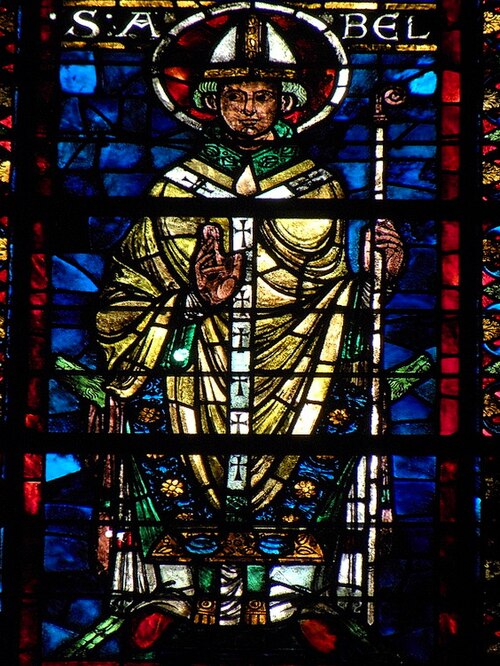
Saint
Abel of Reims
Bishop of Reims
Benedictine monk and companion of Boniface, bishop of Reims in Francia in the eighth century.
Life
The Holy Hierarch Abel of Reims was a Benedictine monk, companion of Saint Boniface and bishop of Reims, in Francia, in the eighth century. He is mentioned in sources between 744 and 747 and fell asleep, according to some sources, on 5 August 764. His feast is on 5 August.
Origins
In the late tenth century Folcuin wrote that Abel had been a monk at the abbey of Lobbes (now in Belgium) while Bishop Ermino (died 737) was abbot there, and that he had been born in Ireland. Saint Boniface, however, in a letter to a priest in the English kingdom of Mercia, insisted that Abel had been born and raised in England. The historian Wilhelm Levison suggested there were two men of the same name, but Eugen Ewig accepts the identification by Boniface as more accurate. If Folcuin's later testimony has any basis, it may be that Abel, like Ecgberht (died 729), had once visited Ireland and formed a close association with it.
Bishop of Reims
In March 744 Boniface presided over the Council of Soissons, and the acts of the council record that Abel was elected archbishop (of an unspecified see). In the same year Pope Zacharias confirmed the decision by sending him the pallium, which conferred episcopal authority. Pope Zacharias recalled that, with the support of Pepin the Short, Boniface had removed certain clerics unworthy of their office and promoted in their place Grimo, Abel and Hartbert to the metropolitan sees of Rouen, Reims and Sens. The event has been interpreted as a return to the provincial system of administration of Gaul, by which Boniface meant to prevent powerful laymen from appointing the archbishops for their own worldly ends. Abel is next named in the sources as one of Boniface's "fellow bishops" who around 746 sent a letter of exhortation to Aethelbald, king of Mercia, as part of their wider missionary efforts. It seems that Milo, bishop of Trier (though only a layman), in effect controlled a number of episcopal sees, while Abel remained in office only as suffragan bishop. In 751 Boniface wrote once more to Pope Zacharias, lamenting the injustices of lay control over the Church, but his ambitions to change this were not realised in his lifetime.
It is unknown when Abel gave up his position or died. The ninth-century Life of Saint Remigius, written by Hincmar, archbishop of Reims, says that Milo drove Abel out of the see in favour of Tilpin; the date given is 748, but it may be that Tilpin only succeeded in 762 or 763, at Abel's death. It has been suggested that Abel may have retired in his later years to Lobbes Abbey to become abbot. According to the Greek sources, he resigned in 748 and is venerated as patron of the blind and of the disabled.
Commemoration
Abel has been recognized at various times as a saint in the Catholic Church. In the early modern period his name was inserted in a number of martyrologies, under a variety of dates, though he was not a martyr; among them the seventeenth-century martyrology of Gabriel Bucelin, the Martyrologium Gallicanum (1637) of Andre du Saussay and that of John Mabillon. The Bollandists include a Life of Abel under 5 August, compiled by John Pinius.
Commemorated the same day August 5
 FabianHieromartyr · Bishop of RomeAug 5
 AnterusSaint · Bishop of RomeAug 5
 Oswald of NorthumbriaRight-Believing · King of NorthumbriaAug 5
 Euthymius I of ConstantinopleSaint · Patriarch of ConstantinopleAug 5
 Emygdius of Ascoli PicenoHieromartyr · Bishop of Ascoli PicenoAug 5
 Nonna of NazianzusRighteous · Mother of Gregory the TheologianAug 5
 EusigniusMartyr · Roman soldier of AntiochAug 5
 Memmius of ChâlonsSaint · First bishop of ChâlonsAug 5
 Venantius of ViviersSaint · Bishop of ViviersAug 5
 Job of UshchelyeVenerable Martyr · Founder of Job Monastery at UshchelyeAug 5
 Evdokia SheykovaNew Martyr · Blessed oneAug 5
 Simon ShleevHieromartyr · Bishop of UfaAug 5