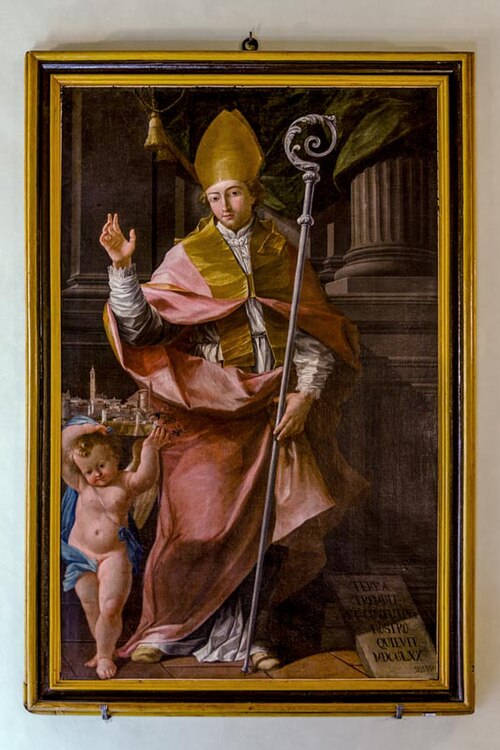
Hieromartyr
Emygdius of Ascoli Piceno
Bishop of Ascoli Piceno
Martyr bishop, killed by tradition in the Diocletian persecution, patron of Ascoli Piceno.
Life
Saint Emygdius was bishop of Ascoli Piceno in Italy, killed according to tradition in the persecution of Diocletian, around 303. He is patron of the city. The Church remembers him on 5 August. He is invoked against earthquakes.
According to his Life, probably written in the eleventh century by a monk of Frankish origin, he was a pagan of Trier who became a Christian. He went to Rome and healed the paralysed daughter of his host Gratianus, who had received him in his house on Tiber Island, and Gratianus's family became Christian. He also healed a blind man. The Romans, thinking him a son of Apollo, took him by force to the temple of Asclepius on the island, where he healed many sick. He declared himself a Christian, tore down the pagan altars and broke the statue of Asclepius. He brought many to faith, angering the city prefect. Pope Marcellus I, or Marcellinus, made him bishop and sent him to Ascoli Piceno. On the way he converted many more and made water gush from a rock by striking it with his staff.
The governor Polymius tried to force him to worship Jupiter and the goddess Angitia, patroness of the city, and offered him his daughter Polisia in marriage. Emygdius baptized her in the waters of the Tronto, with many others. Enraged, Polymius beheaded him at the place now occupied by the temple of Sant'Emidio Rosso, together with Eupolus (Euplus), Germanus and Valentius (Valentinus). It is told that Emygdius rose and carried his head to a mountain where he had built an oratory, now Sant'Emidio alle Grotte. After his martyrdom his followers stormed Polymius's palace and pulled it down.
His veneration is ancient, shown by churches dedicated to him from the eighth century. His relics were moved from the catacomb of Sant'Emidio alle Grotte to the crypt of the cathedral, probably around 1000, under Bishop Bernardo II. In 1703 a violent earthquake struck the Marche but spared Ascoli, which was attributed to him. Since then he has been invoked against earthquakes, and the city dedicated a church to him in 1717. Other towns chose him as patron, raising statues, such as L'Aquila in 1732 and Cingoli in 1747. It is told that a dazzling vision of him deterred Alaric from destroying Ascoli in 409, that in 1038 the plague brought by the troops of Conrad II stopped when Bishop Bernardo I called on his aid, and that in 1943 he protected the city from German movements against the partisans.
Commemorated the same day August 5
 FabianHieromartyr · Bishop of RomeAug 5
 AnterusSaint · Bishop of RomeAug 5
 Oswald of NorthumbriaRight-Believing · King of NorthumbriaAug 5
 Euthymius I of ConstantinopleSaint · Patriarch of ConstantinopleAug 5
 Abel of ReimsSaint · Bishop of ReimsAug 5
 Nonna of NazianzusRighteous · Mother of Gregory the TheologianAug 5
 EusigniusMartyr · Roman soldier of AntiochAug 5
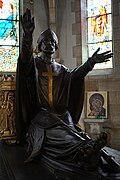 Memmius of ChâlonsSaint · First bishop of ChâlonsAug 5
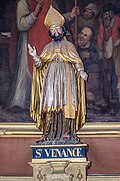 Venantius of ViviersSaint · Bishop of ViviersAug 5
 Job of UshchelyeVenerable Martyr · Founder of Job Monastery at UshchelyeAug 5
 Evdokia SheykovaNew Martyr · Blessed oneAug 5
 Simon ShleevHieromartyr · Bishop of UfaAug 5