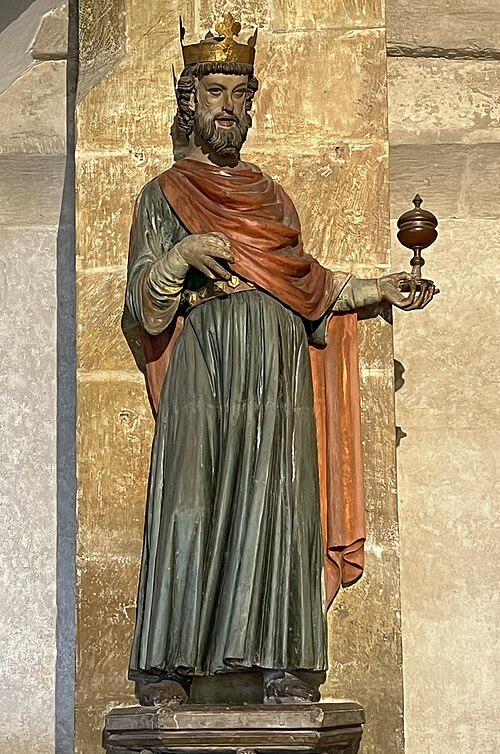
Right-Believing
Oswald of Northumbria
King of Northumbria
King of Northumbria from 634 to 642, who supported the spread of Christianity and died in battle.
- Feast
- August 5old style August 18
- Reposed
- 6427th century
- Place
- Oswestry
Life
Saint Oswald was king of Northumbria from 634 to 642, a pious man who supported the spread of Christianity and died in battle. His veneration was especially strong in the Middle Ages. He is commemorated on 5 August. The Venerable Bede, who wrote about a century after his death, is the main source about him and regards him as a saintly king.
Exile and victory
He was born around 604, son of Æthelfrith of Bernicia and Acha of Deira. After his father was killed, around 616, by Raedwald of East Anglia, the Deiran Edwin, Acha’s brother, became king of Northumbria, and Oswald and his brothers fled north. He spent his youth in the Scottish kingdom of Dál Riata, on the island of Iona, where he was taught and baptized; he may have fought in Ireland. In 633, after Cadwallon, king of Gwynedd, allied with the pagan Penda of Mercia, killed Edwin at Hatfield Chase, Northumbria fell apart into Bernicia and Deira. Oswald’s brother Eanfrith, who became king of Bernicia, was killed by Cadwallon in 634, after seeking peace. Then Oswald, at the head of a small army (perhaps with help from the Scots and the Picts), met Cadwallon at Heavenfield, near Hexham. According to tradition, before the battle he set up a wooden cross, knelt and held it upright until enough earth had been thrown in for it to stand; then he prayed and asked the army to pray with him. According to Adomnán’s Life of Saint Columba, which Abbot Ségéne had heard from Oswald himself, on the night before the battle Oswald had a vision of Columba, who said to him, “Be strong and act manfully; behold, I will be with you.” Oswald told the vision to his counsellors, and all resolved to be baptized after the battle. The Britons were routed, though more numerous, and Cadwallon was killed.
His reign
After Heavenfield Oswald reunited Northumbria, which Edwin had ruled, and was, for eight years, the most powerful king in Britain. Adomnán calls him “emperor of all Britain”. Once on the throne, he sent to the Scots, among whom he and his brothers had been baptized, asking for a shepherd to teach the English people the faith. The Scots sent Bishop Aidan. The king gave him, to live on, the island of Lindisfarne, near the Scottish border, where there was a monastery and a bishop’s see. Aidan knew little of the English language, so Oswald often interpreted his sermons. Chroniclers say he was kind, merciful and generous to the poor and to travellers. In 635 he was godfather at the baptism of Cynegils, king of Wessex, and then took his daughter as wife. In 638 he captured Din Eidyn (Edinburgh) and the British kingdom of Gododdin.
Death and veneration
Penda of Mercia had grown ever stronger. Oswald attacked him, but at Maserfield (today Oswestry, “Oswald’s tree”, after the cross) the Northumbrian army was crushed, and the king died, on 5 August 642, in the thirty-eighth year of his life. Penda ordered his body cut in pieces and set on stakes, as a trophy. Later his bones were found and taken to the monastery of Bardney, by Queen Osthryth, daughter of Oswiu, Oswald’s brother, and wife of Æthelred of Mercia. Oswald left a son, Æthelwald. His veneration spread widely in the Middle Ages.
Commemorated the same day August 5
 FabianHieromartyr · Bishop of RomeAug 5
 AnterusSaint · Bishop of RomeAug 5
 Euthymius I of ConstantinopleSaint · Patriarch of ConstantinopleAug 5
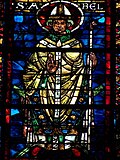 Abel of ReimsSaint · Bishop of ReimsAug 5
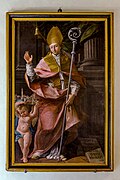 Emygdius of Ascoli PicenoHieromartyr · Bishop of Ascoli PicenoAug 5
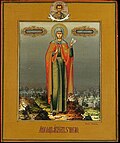 Nonna of NazianzusRighteous · Mother of Gregory the TheologianAug 5
 EusigniusMartyr · Roman soldier of AntiochAug 5
 Memmius of ChâlonsSaint · First bishop of ChâlonsAug 5
 Venantius of ViviersSaint · Bishop of ViviersAug 5
 Job of UshchelyeVenerable Martyr · Founder of Job Monastery at UshchelyeAug 5
 Evdokia SheykovaNew Martyr · Blessed oneAug 5
 Simon ShleevHieromartyr · Bishop of UfaAug 5