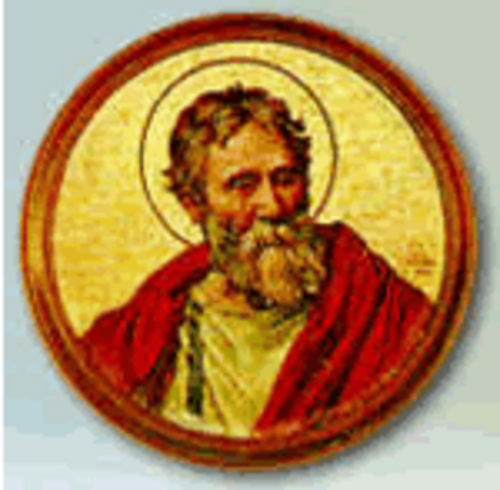
Saint
Agatho of Rome
Bishop of Rome
Bishop of Rome from 678 to 681, in the time of the Sixth Ecumenical Council.
- Feast
- February 20old style March 5
- Reposed
- 6817th century
- Place
- Rome
- Order
- Hierarchs
Life
Saint Agatho of Rome was bishop of Rome from 27 June 678 until his death on 10 January 681. His name is tied to the Sixth Ecumenical Council, which condemned Monothelitism on the basis of the confession of faith that he sent to Constantinople. Both the Orthodox and the Roman Catholic Churches venerate him as a saint. The Orthodox Church commemorates him on 20 February (old style Menaion; 5 March in the civil calendar of the Julian Churches), while Rome keeps his memory on 10 January.
Early life
The details of his early life are uncertain. It is written that he was born around 577 in Palermo in Sicily, of Greek origin, and that his parents died while he was young. The Orthodox synaxarion says that he came of pious Christian parents who gave him an excellent education, and that after their death he distributed his inheritance to the poor and became a monk. Tradition says that for three years he kept a stone in his mouth in order to learn silence. Raids on Sicily by the Arabs had driven many of the island's clergy to Rome, and he may have been among them. In Rome he served for some years as treasurer of the Roman Church, and in 678 he succeeded Pope Donus.
Care for the Churches
Soon after his election Bishop Wilfrid of York came to Rome. He had been deposed from his see by Archbishop Theodore of Canterbury, who had divided his large diocese and set three bishops over the new sees. Agatho gathered a synod in the Lateran to examine the case. It was decided that the diocese of Wilfrid should indeed be divided, but that Wilfrid himself should name the new bishops.
In his time the city of Ravenna, independent since 666, recognised again the authority of the bishops of Rome. Agatho also negotiated with Emperor Constantine IV about the interference of the court in papal elections, and the emperor promised to abolish or lessen the tax that a new pope had to pay to the imperial treasury on his consecration.
The Sixth Ecumenical Council
The great event of his pontificate was the end of the Monothelite controversy. Constantine IV wished to heal the division and had written to Pope Donus proposing a conference, but Donus had died before the letter arrived. Agatho gladly took up the offer. He held councils in the West so that his legates could present the common faith of the Western Church, and in March 680 the pope and some 150 bishops declared Monothelitism a heresy. He then sent a large delegation to Constantinople.
The legates and the patriarchs gathered in the imperial palace on 7 November 680. After the Monothelites had presented their case, a letter of Agatho was read, which confessed that in Christ there are two wills, one divine and one human. Patriarch George of Constantinople accepted the confession, as did most of the bishops. The Sixth Ecumenical Council proclaimed the two wills in Christ and condemned the heresy, together with the persons who had upheld it, among them Pope Honorius I. The council ended in September 681, and Agatho, who died in January, did not see its decrees.
Repose and veneration
He reposed in Rome on 10 January 681, after a pontificate of about two and a half years. Church records say that he reached the age of 103 or 104, but modern research doubts this and thinks that Agatho the pope has been confused with a monk of the same name. His biographer Anastasius says that the number of his miracles earned him the title of wonderworker. The Orthodox sources give 679 as the year of his election and 682 as the year of his death, differing from the dates given in the Western accounts.
Commemorated the same day February 20
 Yaroslav the WiseRight-Believing · Grand Prince of KievFeb 20
 Leo of CataniaSaint · Bishop of CataniaFeb 20
 Cornelius of Pskov-PechoryVenerable Martyr · Abbot of Pskov-Pechory MonasteryFeb 20
 Agathon the WonderworkerVenerable · Monk of the Kiev CavesFeb 20
- Zenobius of AntiochSaintFeb 20
 Serapion of AlexandriaMartyrFeb 20
- AnianusSaintFeb 20
- Anthony of ValaamVenerable MartyrFeb 20
- Athanasius of ValaamVenerable MartyrFeb 20
- Athanasius of ValaamVenerable MartyrFeb 20
- BessarionVenerableFeb 20
- Cindeus of PisidiaSaintFeb 20