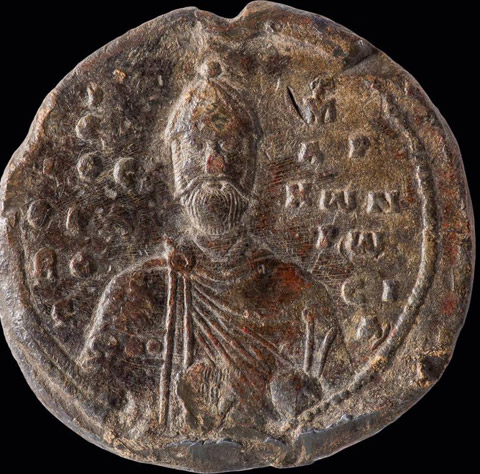
Right-Believing
Yaroslav the Wise
Grand Prince of Kiev
Grand Prince of Kiev from 1019 to 1054, builder of churches and of Saint Sophia Cathedral in Kiev.
- Feast
- February 20old style March 5
- Reposed
- 105411th century
- Place
- Vyshhorod
Life
Yaroslav the Wise, called George at Baptism, was Grand Prince of Kiev from 1019 to 1054, a son of Saint Vladimir the Great. Under him Kievan Rus reached the height of its power and cultural flowering: he raised Saint Sophia Cathedral in Kiev, supported Metropolitan Hilarion, gave the first code of laws of the Eastern Slavs, and spread books and schools. The Russian Orthodox Church honours him as a right-believing prince, with commemoration on 20 February (old style), which is 4 March in the civil calendar.
Youth
He was born around 978, most probably of Vladimir and Rogneda of Polotsk, though some historians doubt this. He was lame, probably from an arrow wound, which the examination of his bones in the twentieth century also confirmed. His father sent him in his youth to Rostov, and in 1010 or 1012 he was moved to Novgorod after the death of his brother Vysheslav. There he founded the town of Yaroslavl on the Volga. According to the tradition of the chronicle, when he baptized the Volga country the pagans set a bear in his path, which the prince overcame with an axe.
Relations with his father soured when Vladimir prepared Boris to succeed him. In 1014 Yaroslav refused to send tribute to Kiev and brought in Varangians, but Vladimir's illness and death, in July 1015, stopped the war.
The struggle for Kiev
After Vladimir's death Sviatopolk, called the Accursed, seized the throne and, according to the chronicle, had his brothers Boris, Gleb and Sviatoslav killed. Boris and Gleb are honoured as passion-bearers. Warned by his sister Predslava, Yaroslav marched with the Novgorodians and the Varangians against Sviatopolk, who was helped by the Pechenegs and his father-in-law, King Boleslaw of Poland. He defeated him in 1016, but Sviatopolk returned with Poles and took Kiev, forcing Yaroslav back to Novgorod. The Novgorodians, the chronicles say, cut up his boats so that he could not flee overseas and persuaded him to carry on. In 1019 he finally defeated Sviatopolk on the river Alta, at the very place where Boris had been killed, and remained grand prince.
In gratitude Yaroslav gave the Novgorodians liberties and privileges, from which the Novgorod republic began to take shape. In 1024 his brother Mstislav defeated him at Listven, and in 1025 the land was divided between them along the Dnieper. After Mstislav died in 1036, Yaroslav remained sole ruler. A shadow on his reign is that he imprisoned his youngest brother Sudislav for life.
Reign and building
In 1019 he married Ingegerd, daughter of the king of Sweden, to whom he gave Ladoga as a wedding gift. He kept alliances with the Scandinavian countries, and his daughters married into ruling houses of Europe: Elisiv to Harald Hardrada of Norway, Anastasia to Andrew I of Hungary, Anne to Henry I of France. In 1030 he took the fortress on the site of present-day Tartu in Estonia and named it Yuryev, after Saint George, his patron. He built a chain of forts against the Pechenegs, and after his great victory over them at Kiev in 1036 he laid the foundation of Saint Sophia Cathedral in 1037, on the site of the battle. In the same period he raised the monasteries of Saint George and Saint Irene, named for his patron and his wife's, and the Golden Gate of Kiev, with the church of the Annunciation above it. In 1043 the Rus fleet sent against Constantinople was scattered by a storm, and in 1046 peace was made with Byzantium.
Books, law and the Church
Yaroslav loved books, saying, according to the chronicler, that they are rivers that water the world with wisdom. He gathered translators and copyists, had Greek books translated into Slavonic and placed them in the library of Saint Sophia. Singers brought from Byzantium taught the Rus the chant of the eight tones. According to some late sources he opened a school at Novgorod for three hundred boys. The Russkaya Pravda, the first written collection of laws of Rus, given to the Novgorodians in 1016, is attributed to him, as is a Church Statute after the Byzantine nomocanon.
In 1051 he had Hilarion, a Rus priest, the first of his people in that see, chosen metropolitan of Kiev in place of a Greek. Hilarion's Sermon on Law and Grace, delivered in 1038, is regarded as the first work of Old East Slavic literature. In his time, Nestor says, the faith multiplied, monks increased and monasteries appeared.
Repose
The chronicler describes him as lame but of good mind and brave in battle, strict in manner and simple in life, merciful to the needy. Before his death he divided his lands among his sons and left Iziaslav at Kiev, commanding them to love one another, for if they came to hate one another, they would lose the land of their fathers. He fell asleep on 20 February 1054 at Vyshhorod near Kiev and was laid in a marble sarcophagus in Saint Sophia. The sarcophagus was opened in 1936 and 1939, and in 2009 it was found to hold only the skeleton of a woman, which shows that his remains were lost.
Veneration
His name was entered in the calendar of the Russian Orthodox Church in 2005, with the blessing of Patriarch Alexy II, according to the Azbuka site, while another source says that he was canonized in 2016 by the Synod of the Russian Church. His commemoration is on 20 February, the day of his repose. He is also recalled in the synaxis of the saints of Rostov and Yaroslavl and of the saints of Novgorod.
Commemorated the same day February 20
 Agatho of RomeSaint · Bishop of RomeFeb 20
 Leo of CataniaSaint · Bishop of CataniaFeb 20
 Cornelius of Pskov-PechoryVenerable Martyr · Abbot of Pskov-Pechory MonasteryFeb 20
 Agathon the WonderworkerVenerable · Monk of the Kiev CavesFeb 20
- Zenobius of AntiochSaintFeb 20
 Serapion of AlexandriaMartyrFeb 20
- AnianusSaintFeb 20
- Anthony of ValaamVenerable MartyrFeb 20
- Athanasius of ValaamVenerable MartyrFeb 20
- Athanasius of ValaamVenerable MartyrFeb 20
- BessarionVenerableFeb 20
- Cindeus of PisidiaSaintFeb 20