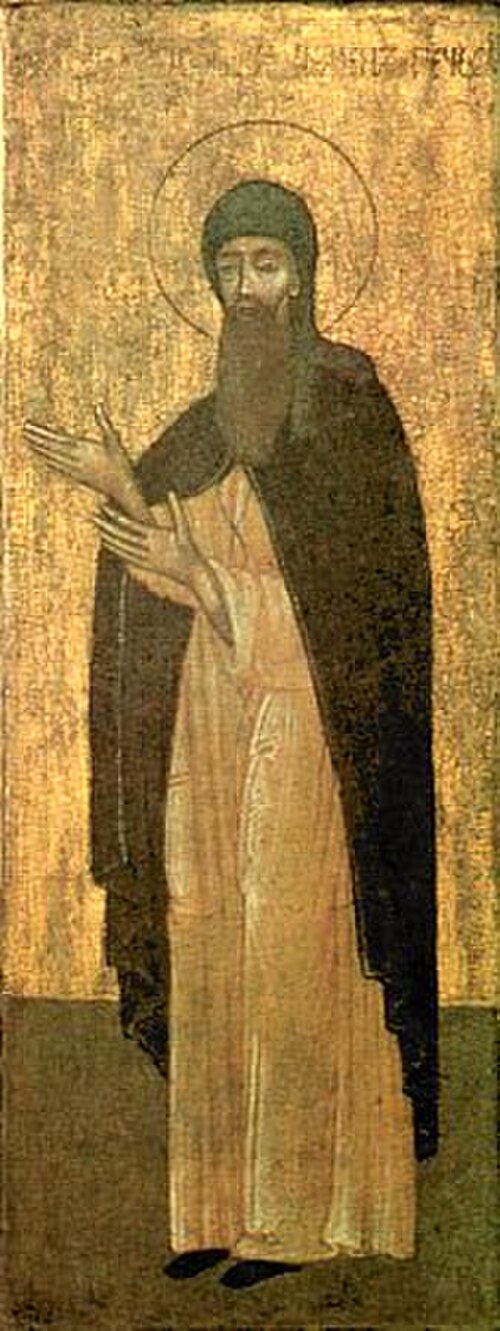
Venerable Martyr
Cornelius of Pskov-Pechory
Abbot of Pskov-Pechory Monastery
Abbot of the Pskov-Pechory monastery from 1529 to 1570, by tradition killed by Ivan the Terrible.
- Feast
- February 20old style March 5
- Reposed
- 157016th century
- Place
- Pskovo-Pechersky Dormition Monastery
- Order
- Martyrs
Life
Saint Cornelius of Pskov-Pechory, Venerable Martyr, was abbot of the Dormition monastery at Pechory near Pskov from 1529 to 1570, its renewer and man of letters. According to the common view he was killed in 1570 by Tsar Ivan the Terrible, and the Church honours him as a venerable martyr. Born in 1501 at Pskov, he is commemorated on 20 February and on the fourth Sunday after Pentecost, with the Synaxis of the Saints of Pskov-Pechory and of the Saints of Pskov.
Beginnings
According to his life, Cornelius was born at Pskov into a boyar family. He studied at the Mirozh monastery, where he came to love the spiritual and monastic life, but after his studies he returned home. He made the final decision to become a monk after a journey to the Pechory monastery, recently founded. He was tonsured no earlier than 1523, and through his asceticism he won the respect of the brethren, so that in 1529, at the age of twenty-eight, he was chosen abbot.
Abbacy
Under him the number of brethren grew from fifteen to two hundred, a number no abbot after him ever had. The monastery began to develop vigorously. From 1547 it became a centre of Pskov chronicle writing, and workshops of icon painting (the monks had first learned iconography at Mirozh) and pottery appeared, and bells began to be cast. In the first half of the sixteenth century, through his labours, a school of books and writing took shape in the monastery, collecting liturgical, secular and hagiographical manuscripts. The library was enriched also from foreign manuscripts; in 1561 the Ordering of the Litanies came from Athos.
During the Livonian War his missionary work showed itself: in the reconquered lands he founded Orthodox churches, helped the war's victims, and the names of the fallen were entered in the monastery's synodikon for remembrance. It is said that in 1560, after the service of the Dormition feast, he sent to the Russian armies besieging the fortress of Fellin a prosphora and holy water, and that the same night the fortress caught fire and was taken.
Many building works were carried out under him: the caves were dug further, the wooden church of the Forty Martyrs of Sebaste was moved beyond the monastery wall, to the guest court in the Pechory settlement, and in 1541 a stone church of the Annunciation was built in its place. Between 1558 and 1565, at the command of Tsar Ivan the Terrible, he surrounded the monastery with a mighty stone wall with nine towers and three gates and built above the main gate a stone church of Saint Nicholas. He also built the church of the Hodegetria at the Pechory metochion in Pskov (1538) and the Holy Trinity church and the church of the Nativity of Christ in nearby monastery villages.
Writings
His reading and learning were praised already by his contemporaries. Archbishop Theodosius of Novgorod wrote of him that he knew the divine Scripture from end to end. His literary legacy comprises three works. The "Tale of the Pskov-Pechory Monastery" was written in 1531, to counter false rumours about the monastery's beginnings, with the blessing of the fathers who had been abbots before him and of the priests Dorotheus and Gerasimus, who had lived when the new monastery was built; it tells of the discovery of the caves, the founding of the monastery, the first monk, Jonah, the building of the old monastery under Abbot Misail and details of monastic life then. The second is the Third Pskov Chronicle, begun after the ordinary chronicling in the town ceased in the middle of the century, in which he recorded not only events in Pskov but also news of all Russia, mainly about military operations. The third is a description of the miracles of the Pechory icon of the Mother of God. In his memory the "Cornelius Orthodox Educational Readings" are held each year at Pechory.
Death
The Church, which numbered him among the venerable martyrs, and most historians believe he was killed by Tsar Ivan IV during his expedition to Pskov. According to the Third Pskov Chronicle, in 1570 Cornelius met Ivan the Terrible at the head of the Pskov clergy and served a thanksgiving service in the Trinity cathedral, and then, when the tsar came to his monastery, he was killed. The story is that Ivan, going to Livonia or returning from there, came to the monastery, where the abbot met him; his eyes fell on the strong fortifications built at the expense of Cornelius, who was of boyar stock, and they seemed suspicious to him; past times came to mind, his heart boiled, and he killed him with his staff.
Among the earlier sources that speak of his killing are Andrei Kurbsky's "History of the Grand Prince of Moscow", which says that at the tsar's command Cornelius, abbot of Pechory, a holy man known for his service, was killed; the "Tale of the Pskov-Pechory Monastery" of the late sixteenth century, according to which on 20 February 7078 (1570) Cornelius was sent by the earthly king to the heavenly one; and the tsar's synodikon of the disgraced, which begins its list of the people of Pskov put to death by Ivan with his name. The cause of the killing is held to be his alleged support of the disgraced Prince Kurbsky, with whom the monastery corresponded (three letters from Kurbsky to the monastery of 1563 and 1564 survive, addressed rather to the librarian, Vassian Muromtsev, from whom Kurbsky wanted books for his dispute with Ivan). They could have served as the basis of an accusation against Cornelius and Vassian.
According to a chronicle kept at the Trinity-Sergius Lavra, the tsar repented at once and carried Cornelius's body in his arms to the monastery. The path from the monastery to the church of the Dormition, on which the venerable's blood dripped, is called the "Bloody Way". Some scholars, such as A. B. Postnikov, and church historians, such as Metropolitan John Snychev and Hegumen Alexis Prosvirin, interpret the words of the Tale, that he was sent "by the earthly king to the heavenly one", rather as a sign that Ivan escorted him on his last journey and gave him royal honour after death. They also note that the view of a killing became widespread only in the 1820s at the urging of Archbishop Eugene Bolkhovitinov and acquired further legendary details in the second half of the twentieth century, and that Kurbsky's testimony is partisan. Their hypothesis is that Cornelius's death merely coincided with Ivan's visit to Pskov. In any case the tsar remained the monastery's chief benefactor both in the abbot's lifetime and after his death.
Relics and veneration
Cornelius's body was buried in the monastery caves. In 1690, at the command of Metropolitan Marcellus of Pskov and Izborsk, the relics, which had come to be venerated as healing, were moved to the great church of the Dormition and placed in a new coffin in the church wall; the composition of his service is linked with this occasion. The shrine was renewed several times: on 17 December 1872 the relics were moved to a silvered copper shrine and in 1892 to a more richly adorned one. In the town of Pechory, in the square before the monastery, stands a statue of the saint, consecrated on 4 October 2012 by Metropolitan Eusebius of Pskov and Velikiye Luki.
Commemorated the same day February 20
 Agatho of RomeSaint · Bishop of RomeFeb 20
 Yaroslav the WiseRight-Believing · Grand Prince of KievFeb 20
 Leo of CataniaSaint · Bishop of CataniaFeb 20
 Agathon the WonderworkerVenerable · Monk of the Kiev CavesFeb 20
- Zenobius of AntiochSaintFeb 20
 Serapion of AlexandriaMartyrFeb 20
- AnianusSaintFeb 20
- Anthony of ValaamVenerable MartyrFeb 20
- Athanasius of ValaamVenerable MartyrFeb 20
- Athanasius of ValaamVenerable MartyrFeb 20
- BessarionVenerableFeb 20
- Cindeus of PisidiaSaintFeb 20