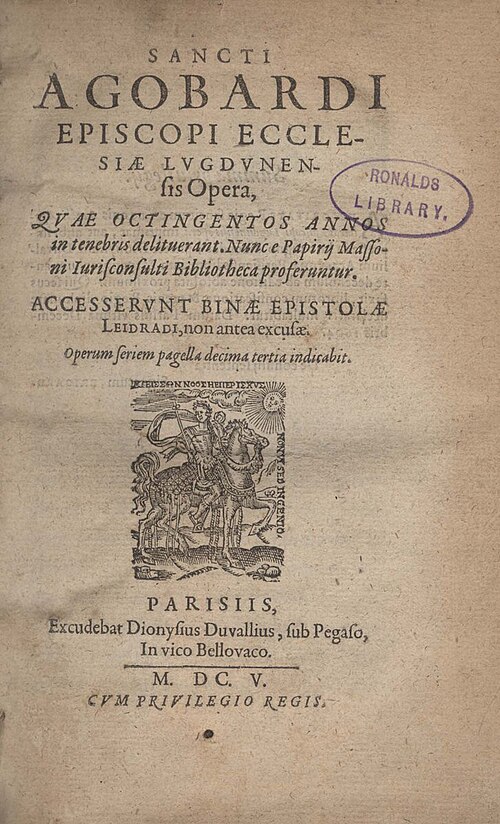
Saint
Agobard of Lyon
Archbishop of Lyon
Spanish-born priest and archbishop of Lyon in the Carolingian Renaissance, author of treatises; died 840.
Life
Agobard of Lyon was a cleric of Spanish origin, archbishop of Lyon in the time of the Carolingian renaissance. He is venerated as a saint mainly in the West and is commemorated on 6 June. He was an important scholar, the author of treatises on many subjects, and a man at the centre of the political disputes of his day. His writings against the Jews remain, however, a painful page of his history.
Beginnings
He was born about 769 to 779, according to some sources in Spain (perhaps Catalonia). About 792 he came to Lyon, where he was ordained priest, according to one source in 804, and won the esteem of Archbishop Leidrad. Later he was ordained chorbishop, that is, assistant bishop. In 814 Leidrad, advanced in years, withdrew to a monastery and named him successor. The emperor Louis the Pious did not object, but some bishops protested at a synod held at Arles, because the old bishop was still living. Leidrad died in 816 and the dispute faded, leaving Agobard archbishop.
His writings
Agobard fought against ordeals, that is, trial by fire or water, and in 818 wrote against the Adoptionism of Felix of Urgel. He also wrote against pagan practices, among them the belief that evil people can raise hail and thunder, and on the duties of the clergy. In the ninth century he took a critical position towards the veneration of icons, and in this his teaching does not agree with that of the Orthodox Church.
In his writings against the Jews, among them De baptismo Judaicorum mancipiorum, he called for restricting the freedoms enjoyed by the Jews of the Frankish kingdom and used harsh language, which reinforced Christian prejudices of the Middle Ages. Historians note that he knew the Judaism of his day well but at the same time perpetuated stereotypes. This is not the side of him that the Church honours, and an honest account must say so.
Political disputes
Agobard opposed the emperor on the question of church lands and of the succession. He accused him of abandoning the Ordinatio imperii of 817, which aimed at the unity of Church and empire. In the two rebellions against Louis, in 830 and 833, he supported Louis's son Lothair I. After Louis was restored, Agobard was suspended by the council of Thionville and exiled, and the chorbishop Amalarius of Metz took his place. Amalarius introduced liturgical reforms full of allegorical symbolism, which Agobard thought theatrical and showy. Amalarius was condemned in 838, and Agobard returned to Lyon, supported by his disciple Florus, and undid his reforms. One source says that he was removed from his see between 835 and 838.
Death and veneration
He died at Saintes on 6 June 840 and is venerated as a saint, with his commemoration on this date. He was succeeded at Lyon by Amulo.
Commemorated the same day June 6
 Bessarion the GreatVenerable · Desert FatherJun 6
 Claudius of BesançonSaint · Bishop of BesançonJun 6
 Eustorgius IISaint · Archbishop of MilanJun 6
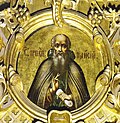 Paisius of UglichVenerable · Founder of the Protection MonasteryJun 6
- Ceratus of GrenobleSaint · Bishop of GrenobleJun 6
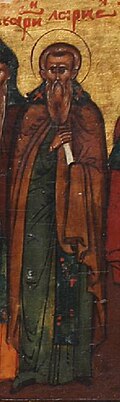 Hilarion the NewVenerableJun 6
 Gregory of NovgorodSaint · Archbishop of Novgorod and PskovJun 6
- BranwaladerSaintJun 6
- Thecla, Mariamne, Martha, Mary and EnataHoly Martyrs · Martyrs of PersiaJun 6
- Jonah of KlimenetsVenerable · Founder of Klimenets MonasteryJun 6
- Valeria, Kyriake and Maria of CaesareaHoly Martyrs · Martyrs of CaesareaJun 6
- Alexander of FiesoleHieromartyr · Bishop of FiesoleJun 6