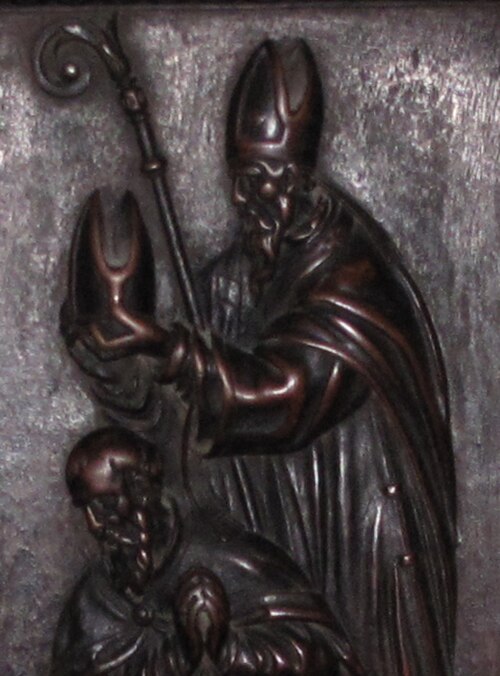
Saint
Eustorgius II
Archbishop of Milan
Archbishop of Milan from about 511 to 518.
Life
Eustorgius II was archbishop of Milan from about 511 (or 512) to 518. Our sources show him venerated as a saint in the Catholic Church, with commemoration on 6 June, and not in the Orthodox. The Greek source says that he was of Greek descent and called Lorenzo.
Two letters of King Theodoric the Great about Eustorgius remain to us: the first, addressed to the count and senator Adilas, urges Eustorgius to take under his protection the estates owned by the Church of Milan in Sicily, and the second, addressed directly to Eustorgius, asks him to restore the bishop of Aosta, unjustly accused of treason by some clergy; Eustorgius was also asked to judge the slanderers. The Greek source dates the letter to 510 or 511 and says that the king reassured Eustorgius, sending a governor to the island to watch over the safety of the Milanese and their property.
In a letter of his own, Avitus of Vienne (died 518) thanks Eustorgius for the financial support given to free some Italian prisoners captured by the Arian Burgundians; according to the Greek source, on two occasions Eustorgius wrote to Avitus sending money to ransom Italian prisoners captured by the Burgundian king Gundobad, and Avitus praises him for his philanthropy and likens him to his holy predecessors. According to Ennodius, bishop of Pavia (died 521), Eustorgius restored the water ducts of the Baptistery of Santo Stefano, whose ruins are still visible under the cathedral of Milan.
Eustorgius died on 6 June 518. His remains were interred in the chapel of Saint Sixtus beside the city's basilica of San Lorenzo Maggiore. His feast is celebrated on 6 June in that basilica and, together with all the holy bishops of Milan, on 25 September. According to the Catalogus archiepiscoporum Mediolanensium, he governed the Church of Milan for 7 years, after Laurentius I and before Magnus, and traditionally his tenure is placed in the years 512 to 518. Traditions make him a Greek priest who lived in Rome before his ordination as bishop, and attribute to him the conversion of a Saint Florian, a native of Pannonia, who later became deacon of the Church of Milan and then bishop of Seville.
Commemorated the same day June 6
 Agobard of LyonSaint · Archbishop of LyonJun 6
 Bessarion the GreatVenerable · Desert FatherJun 6
 Claudius of BesançonSaint · Bishop of BesançonJun 6
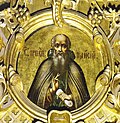 Paisius of UglichVenerable · Founder of the Protection MonasteryJun 6
- Ceratus of GrenobleSaint · Bishop of GrenobleJun 6
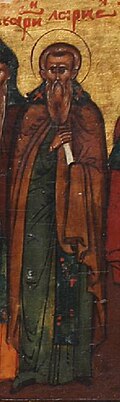 Hilarion the NewVenerableJun 6
 Gregory of NovgorodSaint · Archbishop of Novgorod and PskovJun 6
- BranwaladerSaintJun 6
- Thecla, Mariamne, Martha, Mary and EnataHoly Martyrs · Martyrs of PersiaJun 6
- Jonah of KlimenetsVenerable · Founder of Klimenets MonasteryJun 6
- Valeria, Kyriake and Maria of CaesareaHoly Martyrs · Martyrs of CaesareaJun 6
- Alexander of FiesoleHieromartyr · Bishop of FiesoleJun 6