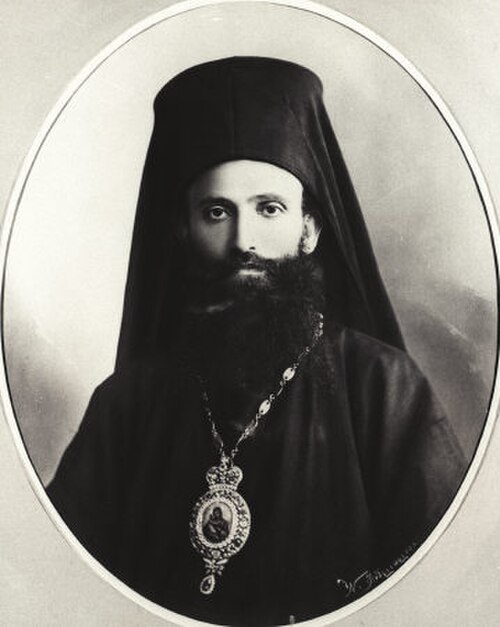
Hieromartyr
Aimilianos of Grevena
Metropolitan of Grevena
Metropolitan of Grevena, killed in 1911, regarded in Greek history as a national martyr.
- Feast
- September 30old style October 13
- Reposed
- 191120th century
- Place
- Aimilianos
- Order
- Martyrs
Life
Metropolitan Aimilianos Lazaridis of Grevena (1877 to 1911) was a Greek hierarch from Asia Minor, of the Ecumenical Patriarchate, known in Greek historiography as a "national martyr". He served at Thessaloniki, at Constantinople and at Monastir (today Bitola), was elected in 1910 metropolitan of Grevena, in western Macedonia, and was killed in October 1911, at the age of 34, together with his deacon and a companion. But the circumstances of his death remain surrounded by differing political interpretations. Our sources mention no canonization of him by the Ecumenical Patriarchate or any other Church; the people of Grevena honour him as a new martyr.
Childhood and training
He was born in 1877 at Permata, in the province of Iconium in Asia Minor, in a large family (nine children) of Orthodox Greeks who spoke Turkish (Karamanlides), like all the Greeks of the region. He studied at the Theological School of Halki. He served as archdeacon in the metropolises of Cyzicus and Thessaloniki (from November 1903). On 10 October 1904 he received the rank of archimandrite and was named protosyncellus of the Metropolis of Thessaloniki. There he rendered important services in the Macedonian Struggle, collaborating with the Greek consul at Thessaloniki, Lambros Koromilas, and the Macedonian fighter Athanasios Souliotis. In 1906 he joined the "Thessaloniki Organization" of Souliotis, which coordinated the action of the Greeks in the Macedonian Struggle. Greek historiography mentions him as an "unarmed Macedonian fighter", that is, a fighter for the union of Macedonia with Greece.
At Constantinople and Monastir
He was then called by the Ecumenical Patriarchate to Constantinople and named parish priest and preacher at the church of the Holy Trinity at Pera, in the Stavrodromi district, where he distinguished himself by kindness and piety. He was then named assistant bishop to the metropolitan of Pelagonia, Joachim Phoropoulos, with residence at Monastir, under the title of bishop of Petra, consecrated on 26 October 1906 in the Cathedral of Saint George at Constantinople. He taught religion at the Greek gymnasium at Monastir. In the hard years of the Macedonian Struggle at the start of the twentieth century he resisted the attempts of the Turkish authorities to install priests of the Bulgarian Exarchate in Greek churches. An episode became known in which Aimilianos, with the faithful, shut himself in the church of the village of Klabutista, preventing its handover to the Bulgarian Exarchate, and answered the Turkish gendarmes who had surrounded the church that they would take him out of it only dead. The British Blue Book of that time says the killers were the chief weapon of the Bulgarian committees and that the Greeks were chiefly their victims.
The Young Turk movement of 1908, proclaiming liberty, equality and justice, was welcomed by him at first, the more so as it largely brought bloodshed in Macedonia to an end. In 1909 he was named assistant bishop of the Metropolis of Xanthi, for the Kavala part. On 16 March 1910, at 33, he was elected metropolitan of the city of Grevena, in western Macedonia.
At Grevena
Metropolitan Aimilianos of Grevena was a pillar of Macedonian Hellenism, defending the identity of the inhabitants of the surrounding area. He supported in a real way the effort to sustain and preserve the Orthodox Greeks, necessary even after the formal end of the Macedonian Struggle. To support his flock he toured all the villages, preaching the Gospel and encouraging the Christians. He cared for the founding and maintenance of Greek schools and Orthodox churches. He also watched over harmonizing the curriculum between the schools of the town and those of the countryside, the choosing and supplying of books to pupils, and the hiring and payment of a teacher for the town school of Grevena. Unlike Pelagonia, where the contest was Greek and Bulgarian, here he also met Romanian propaganda among the Romance-speaking Vlachs (Aromanians).
He kept a firm stance toward the Ottoman authorities and denounced the violence and beatings endured by the Christians. He even dared, with his episcopal commissioner, to visit Bekir Agha to counsel him. To the prefect of Trikala, on whom the Grevena region then depended, he wrote warmly of the fate of the peasants, which had become hopeless: how could he inspire life in men who, morally and materially, because of their stripping, had become corpses. His activity stood in the way of the aims of the Turkish authorities and of the organs of Romanian and Bulgarian propaganda, and attempts to intimidate him had no effect.
Martyrdom
On 30 September 1911 (by one source, 1 October), going to the church of the village of Gridades, where he was to celebrate, he was killed together with the deacon Demetrius and the companion and muleteer Athanasius. The Greek sources say the killers were Bulgarian komitadjis and Vlachs with Romanian sympathies, and the Russian ones that they were killed by Turkish soldiers at the instigation of agents of Romanian propaganda. The Bulgarian source says he was killed probably on orders of Romanian propaganda and with the help of the Young Turk regime, and names as instigator the commander of the Grevena gendarmerie, Bekir Fikri Pasha. The crime took place in a forest, in secret, and Aimilianos and his suite were regarded by the inhabitants as "disappeared". On 3 October 1911 the council of elders of Grevena publicly expressed anxiety about the metropolitan's fate, and the next day announced it had found personal objects of his. After searches by the inhabitants, Aimilianos's body was found in a neighbouring forest on 6 October 1911, with those of his two companions. He was buried on Sunday, 8 October 1911, at Grevena. His funeral was filmed by the Manaki brothers, born in the Grevena region and pioneers of cinema in the Balkans.
His memory
The poet Georgios Souris dedicated a poem to the martyr hierarch. Among the many memorial speeches that of Chrysostomos of Smyrna stands out: when hierarchs burn themselves like candles before the idol of the fatherland, and their martyr's death becomes a cause of life and glory and the foundation of a holier life, their memory is not in harmony with tears and sorrow but with pride and exultation. The people of Grevena honour his memory as a new martyr. His bust is set in the central square of the town. Streets bear his name in the municipalities of Nea Smyrni and Nea Ionia in Athens, founded by refugees from Asia Minor. The village of Gridades, today called Aimilianos, bears his name. At Agii Theodori a monument and a church have been built in honour of Metropolitan Aimilianos.
Commemorated the same day September 30
 Gregory the IlluminatorHieromartyr · Bishop of Greater ArmeniaSep 30
 HripsimeGreat MartyrSep 30
 Faith, Hope, Love and their Mother SophiaHoly MartyrsSep 30
 Gregory of PelshmaVenerable · Founder of Pelshma MonasterySep 30
 GayaneVenerable Martyr · Armenian abbessSep 30
- Alexander OrlovHieromartyr · ArchpriestSep 30
- 32 Virgin MartyrsMartyrSep 30
- 70 Martyrs Slain with RhipsimeMartyrSep 30
- Airinne of BreachmhaghSaintSep 30
- Alexander ShishinHieromartyrSep 30
- Alexandra ChervyakovaVenerable MartyrSep 30
- Alexis SerebrennikovMartyrSep 30