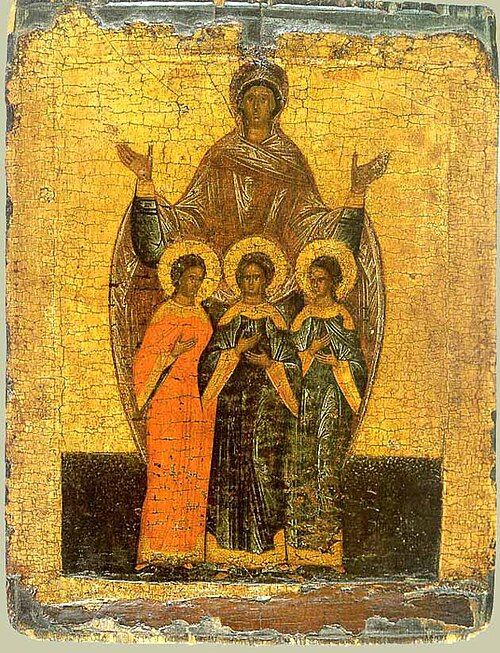
Holy Martyrs
Faith, Hope, Love and their Mother Sophia
Three sisters and their mother Sophia, who confessed Christ and were put to death in the 2nd century.
- Feast
- September 30old style October 13
- Era
- unknown
- Order
- Martyrs
Life
The holy martyrs Faith, Hope and Love (in Greek Pistis, Elpis, Agape; in Latin Fides, Spes, Caritas) and their mother Sophia ("Wisdom") are venerated as martyrs; according to tradition they lived in the second century at Rome (death in 137) and suffered in the time of the emperor Hadrian. They are commemorated on 30 September (by the new calendar, 17 September Old Style) in the Orthodox Church. They are not found in the oldest martyrologies, and the first testimonies of veneration are from the seventh century (in the West from the second part of the sixth century). According to the Bollandists and current critical scholarship, they are rather personifications of Christian virtues than real persons; their story, as the Passion tells it, is regarded as unhistorical. We say here what the tradition says.
The story
According to the Passion, Sophia was a widow of Milan, who came to Rome and stayed with a wealthy woman, Phessamnia. Her daughters, Faith, Hope and Love, had been brought up by their mother in Christian piety. Learning of it, the emperor Hadrian tried to turn them from the Christian way and to force them to worship the goddess Diana, first by the promise of rich gifts, then with threats. They confessed their faith in Christ firmly. The emperor ordered them subjected to harsh tortures, but they bore them wondrously and died only by beheading or being struck with the axe. On the day of death Faith was twelve, Hope ten and Love nine. The emperor gave the tormented bodies of Sophia's daughters to her, and she buried them with honour, on the Appian Way, and died after three days, praying at their grave.
The Greek names of the daughters, Pistis, Elpis and Agape, were translated into Old Slavonic; only the name of their mother, Sophia ("Wisdom"), remained untranslated.
Veneration and the views of scholars
Their tomb in the crypt beneath the church later raised in honour of Saint Pancras was long a place of pilgrimage, according to documents of the seventh century, among them an itinerary of the holy places of Rome preserved at Salzburg and the list of oils gathered from the tombs of the martyrs and sent to Queen Theodelinda in the time of Gregory the Great. Relics of Sophia of Milan or of Sophia of Rome were moved in 778 to the women's convent at Eschau in Alsace, from where the veneration spread to Germany; she is regarded as patroness of widows. The scholar Saxer points out that from about the fourth century Christians often took at baptism mystical names of Christian virtues, and Sophia, Sapientia and Fides are found as names of Christian women in the catacomb inscriptions, and that the veneration of the three saints named for the theological virtues probably arose in the sixth century on the basis of such inscriptions. Earlier editions of the Roman Martyrology commemorated them on 1 August, and Sophia on 30 September; the present text has no feast for them.
Commemorated the same day September 30
 Gregory the IlluminatorHieromartyr · Bishop of Greater ArmeniaSep 30
 HripsimeGreat MartyrSep 30
 Gregory of PelshmaVenerable · Founder of Pelshma MonasterySep 30
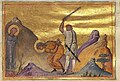 GayaneVenerable Martyr · Armenian abbessSep 30
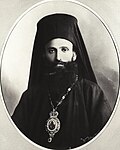 Aimilianos of GrevenaHieromartyr · Metropolitan of GrevenaSep 30
- Alexander OrlovHieromartyr · ArchpriestSep 30
- 32 Virgin MartyrsMartyrSep 30
- 70 Martyrs Slain with RhipsimeMartyrSep 30
- Airinne of BreachmhaghSaintSep 30
- Alexander ShishinHieromartyrSep 30
- Alexandra ChervyakovaVenerable MartyrSep 30
- Alexis SerebrennikovMartyrSep 30