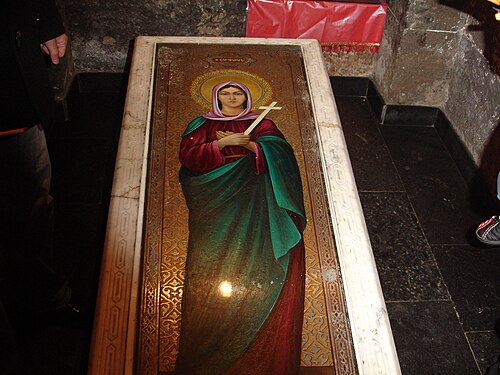
Great Martyr
Hripsime
Virgin of Roman origin tied to the Christianization of Armenia, killed with her companions around 290.
- Feast
- September 30old style October 13
- Reposed
- 3014th century
- Place
- Vagharshapat
- Order
- Great Martyrs
Life
Saint Hripsime, great martyr, was a virgin of Roman origin, according to tradition, who suffered in Armenia around 300, together with her companions. The story of her martyrdom is tied to the history of the Christianization of Armenia. The Church commemorates her on 30 September, together with the abbess Gayane and the other holy women.
Life According to the tradition in the history attributed to Agathangelos, Hripsime was a woman of noble birth, one of a group of Christian virgins who lived as nuns in Rome under the guidance of the abbess Gayane. Fleeing the persecution of the emperor Diocletian, they came to Armenia and settled near the capital, Vagharshapat. The story says that Hripsime had been chosen as the bride of Diocletian at a gathering of beauties, but would not marry the emperor. Diocletian then wrote to the Armenian king Tiridates, telling him where the virgins had fled and allowing him to keep her for himself if he wished. According to the Russian and Serbian sources, the virgins had at Alexandria an appearance of the Mother of God, who showed them the way to Armenia.
Tiridates summoned Hripsime to the palace, but, though a man of great strength, he could not overpower her, and she escaped. She said that she belonged to Christ alone, and the king blazed with anger. Hripsime and the other virgins, thirty-seven of more than seventy who had come to Armenia, were put to death. Hripsime was tortured with great cruelty before being killed. One of the virgins, Nino, escaped and later became the enlightener of Georgia.
After the martyrdom According to the story, Tiridates was struck by God's punishment and was partly changed into the form of a wild boar, and grave afflictions fell on his house and the whole city. The king's sister received a vision showing that the only remedy was to release Gregory, a Christian imprisoned and tortured on the king's orders. Gregory was freed, and Tiridates was healed. The bodies of the martyrs, which had lain unburied for nine days, were buried, and chapels were built over their graves. The king and the Armenian people accepted Christianity, in 301 according to the most widespread tradition.
Some scholars, such as Nicholas Adontz, think that the story of Hripsime and Gayane was at first a separate tale, joined later with that of Tiridates and Gregory. Others observe that it is not likely that virgins from Italy would have sought refuge in so distant a country and that they would more probably have come from Constantinople or western Asia Minor.
Veneration Over the graves the churches of Saint Gayane and Saint Hripsime were later built. Catholicos Komitas demolished the small martyrium in 618 and built the present church of Saint Hripsime at Vagharshapat, today Etchmiadzin, one of the most visited holy places of Armenia, considered the finest model of the cross-domed church in medieval Armenia. According to the historian Stepanos Orbelian, her relics remained with the catholicoi until 1292, when the Mamluks took them to Egypt at the capture of Hromkla.
The Armenian Church commemorates her on the Monday after the second Sunday of Easter. The Orthodox Church commemorates her on 30 September, and the Catholic Church on 29 September. In Ethiopia, where she is called Arsema, she is among the most venerated saints, and an old church on an island of Lake Tana bears her name.
Commemorated the same day September 30
 Gregory the IlluminatorHieromartyr · Bishop of Greater ArmeniaSep 30
 Faith, Hope, Love and their Mother SophiaHoly MartyrsSep 30
 Gregory of PelshmaVenerable · Founder of Pelshma MonasterySep 30
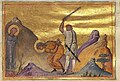 GayaneVenerable Martyr · Armenian abbessSep 30
 Aimilianos of GrevenaHieromartyr · Metropolitan of GrevenaSep 30
- Alexander OrlovHieromartyr · ArchpriestSep 30
- 32 Virgin MartyrsMartyrSep 30
- 70 Martyrs Slain with RhipsimeMartyrSep 30
- Airinne of BreachmhaghSaintSep 30
- Alexander ShishinHieromartyrSep 30
- Alexandra ChervyakovaVenerable MartyrSep 30
- Alexis SerebrennikovMartyrSep 30