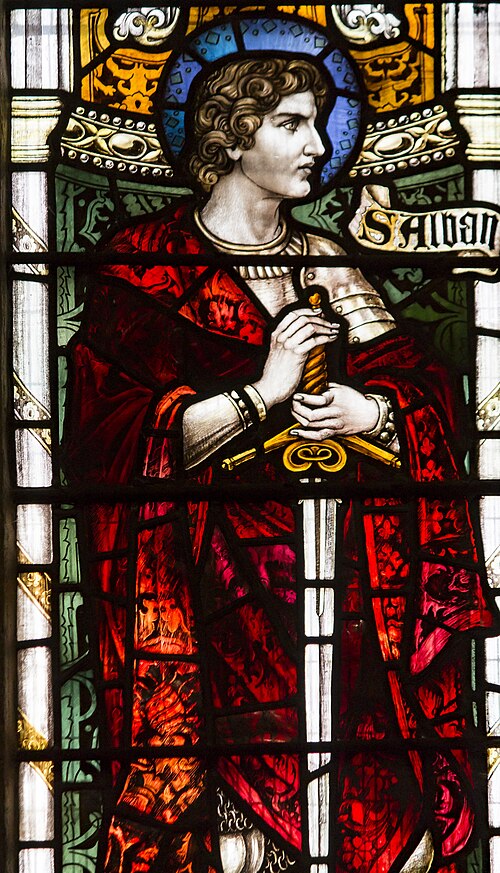
Martyr
Alban
First Martyr of Britain
The first martyr of Britain, killed at Verulamium in the Roman persecution around 305.
Life
Saint Alban was a citizen and, according to some sources, a soldier of Verulamium in Britain who gave his life for Christ in the time of the great persecutions. He is regarded as the first martyr of Britain and, with Saints Julius and Aaron, one of three martyrs of Roman Britain known from early sources. He is commemorated on 22 June.
Life
The sources about him are sparse. We know only that he lived at Verulamium (today St Albans) around 300; neither his family nor his age is known. The earliest source is the Life of Germanus, written by Constantius of Lyons between 460 and 480, which says that Germanus visited Alban’s tomb in 429. The historian Gildas, around 547, also speaks of Alban and his martyrdom. The best-known account is that of the Venerable Bede, from 731. According to Bede, the martyrdom took place in the persecution of Diocletian, between 302 and 305; other sources place it earlier, under Septimius Severus or under Decius.
Confession
Alban received into his house a priest fleeing from persecutors and kept him for some days. The priest, later called Amphibalus (“cloak”), prayed and kept vigil day and night. Alban was so moved by his faith and piety that he began to follow him and became a Christian. When it was learned that he was hiding a fugitive, soldiers came to his house. Alban put on the priest’s cloak and presented himself in his place.
Brought before the judge, who was just then offering sacrifice to idols, Alban refused to worship the gods. He said, “I worship and adore the true and living God, who created all things.” The abbey church of St Albans still prays with these words. The judge ordered him scourged, thinking that suffering would shake his heart, but Alban bore it joyfully. Then he ordered his head cut off.
Death
On the way to the execution Alban came to a swift river, whose bridge was blocked by the crowd of onlookers. With great longing for martyrdom, he raised his eyes to heaven, and the waters drew back so that they crossed on dry ground. The executioner, moved, threw his sword at Alban’s feet and asked to die with him or in his place. They then walked about five hundred paces to a gentle hill covered with flowers. At the top Alban grew thirsty and prayed, and a spring burst out at his feet. There his head was struck off, as was that of the first soldier who, converted, would not kill him, and who was baptized in the blood shed for Christ. According to tradition, the eyes of the second executioner fell from their sockets at the moment Alban’s head fell.
Veneration
Alban’s veneration survived the Anglo-Saxon conquest. Around 429 Bishop Germanus of Auxerre went to his tomb. King Offa of Mercia founded a great Benedictine abbey on the site of the martyrdom, which gave its name to the city of St Albans, and its church is now a cathedral. The stone shrine was smashed in 1539 at the dissolution of the monasteries, and in 1872 over two thousand fragments were gathered and the shrine rebuilt. Services are held beside it by Orthodox and Catholic priests. The Holy Synod of the Russian Orthodox Church entered his name in its calendar in 2017. The church also holds the relics of Amphibalus, the priest Alban sheltered; according to medieval sources he was later caught and put to death at Verulamium.
Commemorated the same day June 22
 Eusebius of SamosataHieromartyr · Bishop of SamosataJun 22
 Acacius of ArmeniaMartyrJun 22
 Sergius MechevHieromartyr · Archpriest in MoscowJun 22
 Mikheil KuloshviliSaint · Ingiloi Georgian priestJun 22
- Gregory the TeacherSaint · Metropolitan of Ungro-WallachiaJun 22
- Peter of ChagraVenerableJun 22
- Zeno of PhiladelphiaMartyrJun 22
 Aaron of AlethVenerableJun 22
- AmbrosiosNew MartyrJun 22
- BasilVenerableJun 22
- Basil PatelariyskyVenerableJun 22
- ConsortiaVenerableJun 22