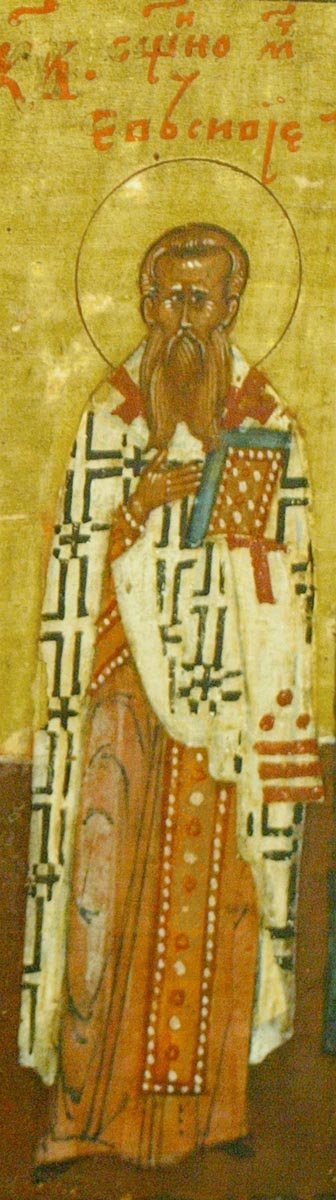
Hieromartyr
Eusebius of Samosata
Bishop of Samosata
Bishop of Samosata and defender of the faith of Nicaea against Arianism; died around 379.
Life
Saint Eusebius of Samosata, Hieromartyr, bishop of Samosata, was a great defender of the faith of Nicaea against Arianism. He died in the year 379, struck by a roof tile thrown by an Arian woman. The Orthodox Church remembers him on 22 June.
All that is known with certainty about him is found in the letters of Saint Basil the Great and Saint Gregory the Theologian and in Theodoret's Church History. In 361 he became bishop of the ancient Syrian city of Samosata. He had been entrusted with the official record of the election (360) of Saint Meletius of Antioch, supported by the Arian bishops, who wrongly thought that they would have him on their side. When Meletius revealed his orthodoxy, the bishops persuaded the emperor Constantius II, a determined Arian, to take the record from Eusebius and destroy it. Constantius threatened to cut off his right hand, because he refused to give up the record, but the threat was withdrawn when Eusebius held out both hands. It was chiefly through his efforts and those of Saint Gregory the Theologian that Saint Basil was elected, in 370, archbishop of Caesarea in Cappadocia.
During the persecution of the Orthodox under Julian the Apostate, Eusebius went about incognito through Syria, Phoenicia and Palestine, dressed as a soldier, to strengthen the Church, ordaining priests and deacons and in places even bishops. After Julian's death he advised Meletius to call a council at Antioch, in which twenty-seven hierarchs took part, where Arianism was condemned again and the teaching of the First Ecumenical Council was confirmed. The Orthodox enjoyed a brief respite in the time of Jovian, but in 374 the emperor Valens, an Arian, sent him into exile in Thrace. Eusebius asked the messenger to keep the order secret, saying: “If the people should learn of it, such is their zeal for the faith that they would rise up in arms against you, and your death might be laid to my charge.” Although advanced in years, he left that same evening. Meletius was exiled to Armenia and Pelagius of Laodicea to Arabia.
After the death of Valens, in 378, Eusebius was restored to his see of Samosata. With the help of Gratian, who gave freedom to the Church, the exiled hierarchs returned to their places. When he came to Dolikha, to install a new bishop and root out Arianism, which was strong there, an Arian woman threw a roof tile from a rooftop that struck him on the head, and Eusebius died of this wound, in 379.
Commemorated the same day June 22
 AlbanMartyr · First Martyr of BritainJun 22
 Acacius of ArmeniaMartyrJun 22
 Sergius MechevHieromartyr · Archpriest in MoscowJun 22
 Mikheil KuloshviliSaint · Ingiloi Georgian priestJun 22
- Gregory the TeacherSaint · Metropolitan of Ungro-WallachiaJun 22
- Peter of ChagraVenerableJun 22
- Zeno of PhiladelphiaMartyrJun 22
 Aaron of AlethVenerableJun 22
- AmbrosiosNew MartyrJun 22
- BasilVenerableJun 22
- Basil PatelariyskyVenerableJun 22
- ConsortiaVenerableJun 22